
0
w V V V V
v
v
v
w
_w
-7W-
-w_
IB ThMihgniy- Wenesay Noembr 8,S00
M- ednesay, ovembr 28,2007- eMcia al 1
The man behind
Save the Big House
What led John Pollack, a Stanford grad
and Capitol Hill veteran, to obsess over
PHOTOS BY CHANEL VON HABSBURG-LOTHRINGEN AND EMMA NOLAN-ABRAHA
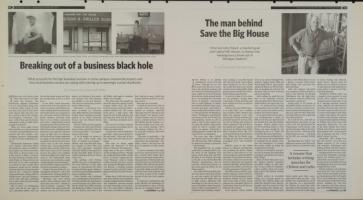
Left: University alum Mike Moeller, owner of the new streetwear boutique on South University Street. Center: Joe's Sub Shop, coming soon on State Street. Right: Seva Lelcaj, owner of Seva on Liberty Street
Breaking out of a business black hole
What accounts for the high business turnover in some campus commercial property and
how local business owners are coping with starting up in seemingly cursed storefronts
here are a few spots in Ann
Abor that seem to be black
holes for business. Not
boarded-up, blighted storefronts
a la L.A. post-Rodney King riots,
or Detroit, rather points of busi-
ness that turn over as if by clock-
work. Spaces that stay bare save
for a realtor's sign in the window,
ever-changing restaurant ban-
ners - why is that some businesses
immediately catch on while others
struggle to make do?
There are three major factors
that contribute to a new restaurant
or retailer's potential lifespan: rent,
concept and this strange, ever-
changing customer demographic
we call University of Michigan stu-
dents.
Independent businesses simply
can't compete with large chains
like Starbucks, which can afford to
pay a higher rent. Even if one fran-
chise folds or doesn't make it out
of the red for a while, a corpora-
tion like Starbucks, Potbelly Sand-
wich Works or Panera Bread can
still bank on its other franchises
or locations to turn a profit. Most
businesses should not be shelling
out more than 10 to 12 percent of its
sales for rent - unless it's "selling
cheap sandwiches, selling coffee or
selling booze," one local business-
owner said, and then sacrificing
two or three times that percentage
is less of a worry.
But if you're an independent
owner with all of your eggs in
your proverbial basket, once you
let out that much money and don't
get enough back, you're in a hard
place.
In the 1990s, South University
Avenue used to be the hottest real
estate on campus, said lifelong Ann
Arbor resident and University alum
Newcombe Clark, now a partner in
his real-estate start-up Bluestone
Realty Advisors. Everyone went,
there to buy clothes, accessories
and shoes; independently-owned
boutiques dotted the strip. But then
McDonalds, Burger King and Taco
Bell all moved in, outbidding other
businesses and signing long-term
leases at high rates. In response,
the landlords and realty companies
in charge of the South University
storefronts took the fast-food fran-
chises' rates as the new market
rates for rent - prices that the inde-
pendent shops couldn't afford once
their leases came up for renewal,
because the prices were suddenly
50 percent higher than shops were
used to. The independent shops
moved out, and, eventually, people
stopped going to fast-food chains -
you can't find a single ground-level
fast-food restaurant on campus.
"South U became kind of a stu-
dent ghetto wasteland ... (It) is now
considered the cheapest market in
downtown Ann Arbor," Clark said.
Obviously, you can't always
predict when a big-box chain will
move onto your turf - though in
close-to-campus locations like
State Street and South University
Avenue, you can bet that money
makers are looking at that quick-
eats category. But when figuring
out whether or not your business
will work in a certain spot, you first
need aviable concept.
Motivation, a streetwear bou-
tique co-owned by University
alum Mike Moeller and Rackham
student Indra Lachhman recently
opened up on South University
Avenue near the Church Streed
intersection.
Moeller said he saw the opening
- formerly the short-lived FuZion
Game Center, and before that the
Cool Waves clothier - as an oppor-
tunity to fill a need.
"A lot of people are saying its
great: 'Ann Arbor needs some
style,' 'It reminds me of home,' "
Moeller said, especially kids from
Los Angeles or New York who
have been pleasantly surprised
with their ability to buy apparel by
brands like Hellz Bellz, Crooks &
Castles and Rogue Status in an Ann
Arbor store.
The problem with FuZion,
Moeller says, was "a concept issue."
The store sold time to play video
games in tournaments but didn't
actually sell video games. Before it,
Cool Waves sold clothing atinflated
prices, Lachhman said.
When Moeller and Lachhman
were undergraduates (he started in
1999, she in2000), the spot housed a
record exchange and a dollar store.
But the dollar store didn't actually
sell things for a dollar ("more like
$1.18 or $1.59"), and what it did
sell didn't really apply to students
(dishes, for example).
The dollar store that opened up
down the street last spring, Sarah's
Campus Dollar Store, has fared
better because it caters to its demo-
graphic, Moeller said. The owner,
Sarah Perry, a 2007 alum, sells
items like nail polish, balloons and
gift bags that work well for birth-
days - and they actually do cost a
dollar.
The success of certain concepts
is also seasonal, according to Sava's
Cafe owner Sava Lelcaj.
"People don't want to drink juice
and study - they want to drink cof-
fee and study," Lelcaj said of juice
bars. "But rent's the same all year
round."
This take on things might
explain the departure of FCB
House of Flavors, the frozen-bev-
erage shop at the end of Nickel's
Arcade on Maynard Street. Though
the vendor did indeed offer a whole
house of flavors (cappuccino-fla-
vored "Slurpees" come to mind),
it didn't exactly have lines out the
door during the Michigan winters.
Ana Banana, a clothing boutique
formerly located on South U, above
Espresso Royale, moved in Novem-
ber.
Before Sava's Caf6 took over the
spot, 211S. State St.was occupied by
a much-maligned Pita Pit franchise
(the franchise's previous location
on South University Avenue buck-
led a few years back), a Mexican
restaurant, an Indian restaurant, a
New York-style eatery called Park
Avenue Deli and a juice bar, accord-
ing to Lelcaj.
But some of it is location.
"I. think it's hard (to do well) at
a location when you pretty much
depend on students, especially
when they leave for Christmas and
other breaks," Ana Banana owner
Claudia Pinheiro said of owning a
shop in student-territory. Now in
the Nickels Arcade location, in a
direction further away from cam-
pus and student housing, "We're
still getting students but also a
lot of people coming in who work
around here."
"This spot in particular - the
storefront is so small," Lelcaj said.
Then there's the competition -Pot-
belly's, Amer's, Cosi and now the
Earl of Sandwich all offer similar
fares.
To attract customers that might
not see her small storefront, Lelcaj
has a "Sava's Caf6" banner above
the door, and a stand-up sign adver-
tising specials. (Unfortunately, the
specials board was stolen this past
weekend.) The cafe has also gotten
positive press in local newspapers,
Lelcaj said, which coincided nicely
with the start of the semester and
the return of most of the student
portion of the Ann Arbor popula-
tion.
So maybe for entrepreneurs like
Lelcaj, Moeller and Lachhman, it's
not necessarily an issue of break-
ing out of a property black hole
See BUSINESS, Page 12B
keeping luxury boxes out of
Michigan Stadium?
ohn Pollack is an unlikely tion, creating a crocodile-shaped
candidate for savior of the Big raft that just barely stayed afloat.
House. Although he's an Ann Most recently he set out to build
rbor native and the son of a pro- the world's first boat made entirely
fessor, the Stanford graduate and of corks. It was in the middle of this
New York City resident doesn't have project that he took the job as Pres-
many visible ties to the University. ident Clinton's speechwriter.
Nevertheless, in the national media As part of a team of six writers
flurry surrounding the University for the president, though there
Board of Regents's controversial wasn't time to think about the cork
plan- to build skyboxes in Michi- boat. Pollack was tied up with his
gan Stadium, Pollack's name comes new position.
up again and again. And though it Clinton, who used a black sharp-
seems unlikely that Pollack, found- ie to make edits, was a ruthless
er of the group Save the Big House, and excellent editor, Pollack said.
former Whitehouse speechwriter When the Supreme Court ruled
and winner of the 1995 World Pun that George W. Bush would become
Championship, would be able to president instead of Al Gore, Clin-
make a dent in the massive sky- ton was in Europe and needed to
box plan, the Athletic Department make a statement. The speechwrit-
would do well to consider what ers quickly put together a speech
they're up against. Thwarting a and sent it to Clinton from White
building project wouldn't the most House Situation Room. The writ-
usual feat he's accomplished. ers waited for hours to get Clinton's
Ten years ago, when Pollack edits. When the fax finally came
first moved into his new office in through, the only three words left
the Old Executive Office Building, unchanged were "Vice President
he noticed one thing in particular Gore."
- the doorknob. Pollack's path to the White
The doorknob bore an anchor House as Clinton's speechwriter
motif, likely a remnant of the origi- was anything but direct. Pollack
nal decor of the building, once was born in Ann Arbor to a Uni-
known as the State, War and Navy versity professor and local political
Building. It was Pollack's first day organizer. He attended a localnurs-
on the job as one of President Bill: ery school, which was run by the
Clinton's speechwriters, and he School of Education. He regularly
took this architectural detail as a attended Michigan football games
good sign, given his affinity for all and joined his father in protests on
things nautical. the Diag against the Vietnam War.
As a sailor and boat builder, Pol- His father, Henry Pollack, a geo-
lack has spent a great deal of time physics professor, came to the Uni-
on and near vessels. He built his versity in 1960 for graduate school.
first boat, the USS Milky Way, out Professor Pollack met his future
of milk cartons. Moments after wife in the halls of Allice Lloyd,
launching it in the Huron River, it when he was a Resident Advisor in
sank. At Stanford, where he gradu- South Quad, when he took his resi-
ated in 1988, he participated in a dents over for a mixer.
cardboard boat building competi- From nursery school, Pollack
went on to attend Pattengill Ele-
mentary, Tappan Junior High and
Huron High School. Upon gradu-
ating from Huron, he left for Stan-
ford. At Stanford, he wrote for the
Stanford Daily, his first of several,
jobs in journalism.
After college, he made his way
East to the Hartford Courant,
where he made $25to $50 per story.
Pollack didn't last long at the Cou-
rant - he wanted to be a foreign
correspondent, and he didn't want
to wait around to be offered such a
position. So he left for Spain.
It was a good time to be an Amer-
ican newspaperman in Spain. In
1992, it was the year Spain hosted
the World's Fair and the Summer
Olympics. Pollack pitched start-
ed off by pitching stories to USA
Today, and soon enough he was
stringing for the L.A. Times and
eventually The Associated Press.
After three years in Madrid, Pol-
lack returned to the United States
to campaign for his mother, Lana,
who was running for U.S. Senate.
His mother ended up losing the
nomination by 1 percent.
Mixing in journalism and poli-
tics isn't so strange. But what about
journalism and politics and Green-
field Village?
Many of those who grew up in
the Detroit suburbs remember
Greenfield Village as that place
that we had visited in elementary
school, middle school and maybe
high school. But Pollack actually
wentback.
Pollack worked in Greenfield
Village on a two-year project to
renovate the railroad depot and
make the railroad tracks Amtrak-
friendly. And if it wasn't for this
brief excursion into railway con-
struction, Pollack may have never
made it to the White House. It was
a former co-worker from Green-
field Village who cued him into
speechwriting.
After the railroad renovation
was completed, Pollack decided to
head to the Beltway. He thought
Washington was the right place
for someone with his political and
journalistic experience.
Saying hello to his friends at
Greenfield Village on his way out
of town, a former co-worker men-
tioned a friend in Washington, D.C.,
who was a speechwriter. When Pol-
lack heard this, he said a light bulb
went off in his head.
So he left for D.C., and with no
speechwriting experience, he got
a job as the sole speechwriter for
Congressman David Bonior, who
was the minority whip at the time.
The year was 1997-- the time of the
impeachment process - and being
on the Hill was exciting, Pollack
said.
Speechwriting for Bonior was
different in several ways than writ-
ing for Clinton. As minority whip,
A resume that
includes writing
speeches for
Clinton and corks
Bonior spoke quite often, some-
times three times per day - and
Pollack was responsible for all of
his speeches. As a speechwriter
for Clinton, he wrote less often
and only covered domestic issues,
whereas he covered a wide range
of issues, foreign and domestic,
under Bonior. Speech topics for
Bonior were on subjects as diverse
as international trade negotiations,
troop policy in Kosovo and Clin-
ton's impeachment.
Writing for Clinton, there was
a lengthy review process for each
speech. First, Pollack would be
assigned a speech, then there would
be a "message meeting" between
policy officials, the speechwriters
and other relevant people. Pollack's
first draft would be edited by poli-
cy experts and political staff. After
a couple more drafts, the speech
would go to the president, who may
or may not make significant chang-
es. Pollack said certain issues, like
monument dedications, saw less
of the black Sharpie than others.
Pollack said Clinton cared deeply
about what he said - he had a great
love of language and had a "nitty
gritty" interest in policy.
Eventually, after seeing Gore
lose the election, and after pro-
longed exposure to the cynical
and relentless Washington poli-
ticking, Pollack left and started a
project that was much more simple
- though possibly even more unex-
pected than launching a campaign
against the building project of a
school that's not your alma mater -
he returned to his childhood dream
of building the first ever boat made
completely from corks.
Pollack solicited cork donations
from local D.C. bars and restau-
rants, friends and family and big-
ger organizations, like Cork Supply
U.S.A., all of which led to the final
cork count that would build a boat:
165,231. Building the cork boat
was expensive and time-consum-
ing. It left Pollack feeling lost and
See POLLACK, Page11B
Scanned image of the page. Keyboard directions: use + to zoom in, - to zoom out, arrow keys to pan inside the viewer.
November 28, 2007 (vol. 118, iss. 58) - Image 13
- Resource type:
- Text
- Publication:
- The Michigan Daily, 2007-11-28
Disclaimer: Computer generated plain text may have errors. Read more about this.