
w V V V _.
m - - Alk Ak I
a
w
v
w
W,
w
w
Wedesdy, ctoer- 7,007 - h-Mcign6aly 7
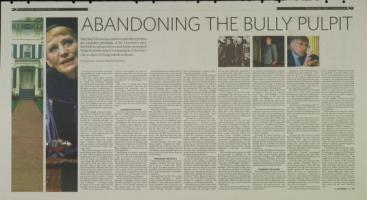
ABANDONING THE BULLY P
ULI
Mary Sue Coleman has a subtler leadership style than
the outspoken presidents of the University's past.
But while her absence from social debate means good
things for fundraising, it's reshaping the University's
role as a force of change outside academia.
By Gary Graca I Associate Editorial Page Editor
Five years into her tenure as Univer-.
sity president, it's tough to find critics
of Mary Sue Coleman.
Sure, the student labor activists
in the group Students Organizing
for Labor and Economic Equality
are still fuming about being arrested
after their sit-in earlier this year. And
Michigan Stadium traditionalists in
the Save the Big House group, the fac-
ulty and the University community at
large are cursing her for her part in
defiling the spirit of Fielding Yost with
elitist luxury boxes. Faculty members
are even getting a few jabs in, espe-
cially after Coleman rejected an addi-
tion to a handbook that would have
codified faculty input in construction
decisions.
Overall, though, Coleman's admin-
istration has fended off any substan-
tial controversy. The University Board
of Regents is singing her praises for
leading the University through two
U.S. Supreme Court cases, uncertain-
ty about state funding and weather-
ing a state constitutional amendment
that outlawed affirmative action. Last
month, it even gave her a 3 percent
raise and a heart-warming letter of
appreciation for her efforts.
For those who aren't won over by
the University's ballooning endow-
ment, Coleman's warm personality
adds an element of friendliness that
even the most hardened skeptic can't
argue resist.
But a lot has changed at the Presi-
dent's House since Coleman took over
in 2002. While Coleman may just be
responding to new circumstances, for
better or worse, her presidency has
veered from the path laid by Univer-
sity leaders of the past. With a new
president came a new vision, and a
style dramatically different than that
of Harold Shapiro, James Duderstadt
and Lee Bollinger, the University pres-
idents before her. Instead of standing
out as a vocal critic of society, Coleman
has fallen in with the national trend of
running her college as if she were run-
ning a business - seemingly trying
to appeal to everyone, especially big
investors, or in her case, big donors.
Unlike her predecessors, Coleman
is not an exceptionally vocal and vis-
ible leader, she avoids controversy and,
most important, her muted leadership
on social issues is making the Univer-
sity ,a follower of social change, not a
leader.
How soon we forget that those
qualities are exactly what has dis-
tinguished the University since it
was founded, what we have come to
expect of our president and what the
American university means to society.
Within this new style of leadership,
finding a balance between a university
as a social servant and a university as
a social critic will mean all the differ-
ence.
FOUNDED ON DISSENT
From its beginning, the University
has been - both by design and in prac-
tice - an independent, often opposi-
tional force in society.
Founded in 1817 as the University
of Michigania, the University existed
two decades before Michigan was
granted statehood. In 1857 its inde-
pendence was solidified when the new
state constitution granted the Uni-
versity constitutional autonomy - a
feature it shares with the other state
universities and that still exists today.
With autonomy, our frontier univer-
sity had the freedom to challenge the
status quo and blaze a new trail with-
out having to fear the wrath of an
aigry legislature. And that is exactly
what happened.
Challenging the private, parochial
universities like Harvard and Yale,
it was not only one of America's first
public universities; it was one of the
first secular institutions. As such, the
school offered a break from the aristo-
cratic and moral confines at other colo-
nial universities. And with that break
came a more varied curriculum and
a more diverse student body, offering
an education to all economic classes
- unlike its East Coast colleagues.
Summarizing the University's com-
mitment to inclusion, James Angell,
the third president, famously said it
offered, "an uncommon education for
the common man." In other words:
19th century affirmative action.
Althoughforthenextsixdecadesthe
University maintained a spotty record
of adhering to its traditions of dissent
and diversity, these values never went
away. In 1853 the first black student
was admitted - 10 years before Abra-
ham Lincoln issued the Emancipation
Proclamation. In 1870 the University
Board of Regents embarked on what
they called at the time, a "dangerous
experiment," admitting women for the
first time. Although it was one of the
first times that any major university
allowed coeducation, women were still
late to the game in getting equal status
- it took another 86 years before they
were allowed to enter the front door of
the Michigan Union.
When the Civil Rights Era bloomed,
the Ann Arbor campus became most
recognized for its central role ih chal-
lenging the status quo. It's easy to for-
get, but the value of dissent and the
University's role in instigating social
change was already well established
in design if not in practice before hip-
pies and sit-ins took hold of campus.
But the 1960s and '70's uproar rein-
vigorated the image - Students for a
Democratic Society was formed here,
sit-ins and teach-ins flourished and
the University became a national focal
point of protest.
Despite the glory that came with
being another Vietnam Era battle-
ground, the University was only fund-
tioning exactly as designed: like all
universities, it was intended to be, in
part, a critic of society and a vehicle of
social change..
UPHOLDING THE LEGACY
When the 1970s ended, so did the
combative protests. But the Univer-
sity's role as a social critic didn't.
The torch was taken up again by the
president, this time mostly through a
fierce and controversial commitment
to diversity.
Although each of the three presi-
dents before Coleman - Harold
Shapiro, James Duderstadt and Lee
Bollinger - were confronted with dif-
ferent problems, three principles tie
them together: a commitment to social
change through diversity, visibility
and a commitment to higher educa-
tion's role in society at large.
When Shapiro was president during
the '80s, things weren't much differ-
ent than they are now: The automo-
tive industry was in decline, Michigan
was struggling because of it and the
University was losing its state fund-
ing. During the 1970s and 1980s, the
portion of the University's budget
provided by the state declined by half,
from 60 percent to 30 percent. Add-
ing to the turbulence, in 1987, campus
erupted in racial tension after a series
of discriminatory incidents, including
black students who were spit on, a disc
jockey on the University radio station
who made racist jokes on the air and
a closed black student meeting inter-
rupted when someone slipped a flier
under the door proclaiming "open
hunting season" on black students.
Through the turmoil, Shapiro man-
aged to work with faculty and other
administrators to downsize during
the budget crisis. As he recounted in
a 2003 interview for the lecture series
"Conversations with History," his style
of governance made all the difference.
Comparing a more corporate approach
to what he considered a more appro-
priate, academic approach, Shapiro
said the following: "In corporate gov-
ernance, there might be alot of discus-
sion going on, but eventually the CEO
decides and everybody marches in that
direction. In an academic institution,
it's more like a partnership. You have
to get people's attention. You have to
get them to sign up for this."
In the same interview, he went on to
say that for universities to be socially
relevant, social problems couldn't be
avoided. He explained that the "dual
role of the modern university as both
a servant of society, serving its various
interests, and as a critic of society ...
simply ensure that the university, if it's
doing its job, is going to be a controver-
sial place." Before he got an opportu-
nity to react to the 1987 race problems,
though, he resigned to take up the
presidency at Princeton University.
His replacement, James Duderstadt,
didn't hesitate to pick up where he left
off: Launching the Michigan Man-
date in 1988, Duderstadt immediately
recommitted the University to racial .
tolerance and diversity. The program
more than doubled of minority enroll-
ment, from 11 percent to 25 percent,
with similar gains in faculty diversity
as well. Duderstadt also launched the
Michigan Agenda for Women in 1994
to promote the inclusion of women in
multiple areas of study.
As he argued in his 1999 book,
"Positioning the University for the
New Millennium," promoting diversi-
ty was not only morally correct; it was
a way to prepare students for a chang-
ing world that wouldn't be dominated
by a single race or ethnicity. As society
turned its back to racial issues, start-
ing in 1996 with California's Propo-
sition 209 to ban affirmative action,
American campuses were supposed to
host the debate in hopes of looking out
for society's best interests.
But diversity wasn't the only issue
Duderstadt tackled. During his eight-
year tenure, Duderstadt launched the
Campaign for Michigan, a fundrais-
ing campaign that brought in roughly
$1.4 billion. Similarly, the endowment
grew to more than $1.6 billion. The
money helped revitalize construc-
tion on campus with an emphasis on
increasing the capacity for scientific
innovation, including projects to cre-
ate the Lurie Engineering Center, the
Cancer and Geriatrics Center and the
integrated Technology Instruction
Center.
When Duderstadt resigned in 1996
and returned to teaching, he left
behind a vision of the University as a
gateway into a new century of global-
ization, technological innovation and
a changing role for higher education.
The University's 12th president, Lee
Bollinger, followed right in step. Now
the outspoken president of Columbia
University in New York City making
national headlines for allowing Irani-
an President Mahmoud Ahmadinejad
to speak last month, Bollinger was only
slightly less visible and controversial
during his four years at the University
of Michigan.
Seizing the spotlight after the Uni-
versity was sued in 1997 for its affirma-
tive action-based admissions policies,
Bollinger, a First Amendment scholar,
became a national figure in defense of
affirmative action. He actively sold the
idea to America. More than 142 indi-
viduals, corporations and professional
associations filed briefs in support of
the University, including Fortune 500
companies as big as GM and Intel.
The University's values and history
converged in the two U.S. Supreme
Court cases with Bollinger as the
named defendant. In the end, the
legality of affirmative action was
upheld even though the point-based
admissions system used by the College
of Literature, Science and the Arts was
not.
Like Duderstadt, Bollinger also con-
tinued the drive into research and sci-
ence, but with an understanding that
there needed to be a multidisciplinary
approach to bring these fields into
society. In 1999 he launched the Life
Sciences Initiative, which channeled
the increased investment and endow-
ment into a project to coordinate a
variety of disciplines into the emerg-
ing fields of genomics, biochemistry
and other sciences.
Although he wasn't perfect, his
ability to be both a vocal social critic
and a promoter of education's role in
shaping growth brought him national
acclaim. He was considered the last of
a dying breed of outspoken university
presidents.
In a profile of Bollinger in December
2000, the New Yorker wrote, "If you
were called upon to invent a perfect
university president, you couldn't do
better than Lee Bollinger, of the Uni-
versity of Michigan" - not because he
raised the most money, but because he
challenged and criticized society.
CHANGING THE GUARD
WhenBollinger moved on to Colum-
bia to face off with world leaders and
continue his free speech crusade, the
University brought in the president of
the University of Iowa, Mary Sue Cole-
man. No one expected her to continue
Bollinger's fire-and-brimstone out-
spokenness, and so far she's lived up to
expectations.
Coming in with two priorities - lowed. Although Coleman promised
fundraising and recruitment - Cole- to "consider every legal option avail-
man has done an exemplary job at able to us," the prominent court battle
both, as the regents acknowledged ended after the University lost its fight
last month. While the collapsing auto- to postpone the implementation of the
motive industry continues to cripple amendment until after the admissions
Michigan's economy, every state fund- cycle was completed. A smaller fight
ed program has taken a hit, the Uni- against the legality of the amendment
versity has been no exception. continued but earlier this year it was
To combat the crisis, the president denied as moot by the U.S. Circuit
created one of the most successful Court of Appeals for the 6th District.
fundraising campaign in campus his- There would not be another Supreme
tory. Her $2.5 billion Michigan Differ- Court battle this time.
ence fundraising campaign has been In the shuffle, Coleman has been
both an absolute success and an abso- lost, pressing forward with the Diver-
lute necessity. sity Blueprints Task Force, an alterna-
Additionally, overseeing major con- tive solution to promoting diversity,
struction projects like Weill Hall and but keeping the attention on the issue
the Mott Children's and Women's to a minimum.
Hospital, Coleman's leadership both in While there is no reason to believe
public and behind the scenes has been that the task force won't be a success,
unmatched. - because so far they have been, the
But unlike those that came before lack of attention could prove to be the
her, her recognition of the University's downfall of the cause elsewhere. Ward
place in society seems to be absent. Connerly, the anti-affirmative action
Ironically, as the University's first mastermind behind both California's
female president, Coleman's presiden- and Michigan's ballot initiatives, is
cy itself is often cited as symbolic of a now taking his cause across the coun-
huge step. Her presidency hasn't been, try. With five more expected targets in
though. Arizona, Colorado, Missouri, Nebras-
Coleman got her chance to show ka and Oklahoma for November 2008,
bold leadership last year. After the according to the Chronicle of Higher
Supreme Court cases on affirma- Education, Connerly is planning a
tive action were decided in 2002, the "Super Tuesday on affirmative action."
debate over affirmative action was Coleman could be a pivotal figure in
supposed to have subsided. Then came defeating these initiatives.
Proposal 2, Michigan's ballot proposal Whenshe has beenvocal, the results
to ban affirmative action. have been positive. In March 2006,
Although Coleman campaigned Coleman gave a speech at the National
against the proposal, once the initia- Press Club in Washington D.C. advo-
tive passed with a shocking 58 percent eating that America reconsider the
of the vote, her voice faded. emphasis placed on science, painting
of course there was the now infa- a picture of a return to the research
mous speech, "Diversity Matters," boom during the Space Race of the
on the Diag on Nov. 8, 2006 after the 1950s and 1960s. The speech, entitled
amendment passed. But that speech "Not Your Father's Space Race," was
simply repeated the word "diversity." acclaimed as engaging and powerful.
There was never an explanation of More importantly, the social mes-
diversity's meaning or importance. sage was clear. Coleman argued, "Our
There was a great deal of the emphasis national priorities are not necessar-
on never ending the fight to maintain ily shared priorities," adding, "There's
it, though. It all ended with a bold con- not a whole lot that we rally behind
cluding statement that, "We are Mich- together as a society, except perhaps
igan. We are diversity." who should be the next 'American
The speech didn't leave many con- Idol."
vinced. Neither did the events that fol- See COLEMAN, Page 12C
Scanned image of the page. Keyboard directions: use + to zoom in, - to zoom out, arrow keys to pan inside the viewer.
October 17, 2007 (vol. 118, iss. 30) - Image 22
- Resource type:
- Text
- Publication:
- The Michigan Daily, 2007-10-17
Disclaimer: Computer generated plain text may have errors. Read more about this.