

crash; firms don't want to make investors
any more skittish. Moreover, recruiters
have been telling Watts that although
they may be interviewing as
many students as last year,
they've been told by head-
quarters not to call back as
many. At Columbia Business
School, director of placement
J. Fredric Way predicts that
there will be only half as many
positions for M.B.A.'s on Wall
Street as there were last year.
And at MIT's Sloan School of
Management, where 22 per-
cent of the graduates entered
investment banking last year,
placement director Linda Stan-
tial expects only 10 percent to
do so this spring.
It can't happen here: Many
business students remain se-
renely self-confident, persuad-
ing themselves that the ax will
fall on the folks behind them.
"Most kids feel that if some-
thing's going to happen, it's
not going to affect me immedi-
ately," says Tim Hanlon, a sen-
ior at Georgetown. "There's
still a strong degree of inter-
est," says Elizabeth A. Meyer,
director of Stanford's School of
Business Career Management
Center, where the number of
investment banks interviewing
on campus actually rose from 30 in 1986
to 35 in 1987.
But there is some reassessment going
on. For instance, Donald J. Gogel, a man-
aging director at Kidder, Peabody, says
attendance at Kidder's informational
meetings at some campuses has fallen 20
percent. More and more, students who
want business careers are exploring op-
tions beyond Wall Street. "One of the big-
gest differences is that people who had
planned to go into investment banking are
now looking at consulting," says Dana Al-
bert, a second-year M.B.A. student at MIT.
Consulting is also looking more attractive
at Northwestern, according to Watts, who
reports that interview schedules for con-
sulting firms are "packed."
Some investment bankers declare
they're glad the hordes are going else-
where. "Those people who were really just
sort of window-shopping may not come
knocking on our doors," says Gogel. Oppor-
tunities may be more limited, however, for
liberal-arts graduates with no special ex-
pertise. "When the times get tougher, all
employers are less likely to take risks with
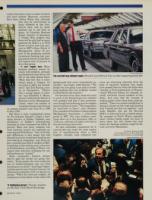
'A frightening lesson': Frantic traders
at the New York Stock Exchange
DAVID n FRANKLIN
The rust belt may shimmer again: Shashlo and Detroit line worker inspecting body fits
backgrounds that aren't immediately ap-
plicable," says Gogel. Adds Stantial, "The
people who are going to get jobs in invest-
ment banking this year probably worked
on Wall Street last summer."
For the short term, then, those who want
to work in the financial-services industry
will probably find jobs if they persevere,
even though the jockeying may be rougher
than it has been in years. "The competition
for interviews is fierce," says Christine
Chu, president of the Sloan Undergraduate
Management Association, a networking
group at MIT, who says students some-
times show up at the placement office at
11:30 p.m. and wait all night to be first in
line for morning interviews.
All that intensified competition for fi-
nancial jobs may make the rusty reputa-
tion of manufacturing shine a little
brighter. Already, some industrial con-
cerns are attracting attention from the
kind of top-notch students who might
have passed them by when the bulls were
running. A Ford presentation at Pennsyl-
vania's Wharton School, for example, re-
cently attracted record numbers of stu-
dents. And some find the rewards of
making goods, rather than deals, quite ap-
pealing. "There is a certain satisfaction in
seeing a Lincoln on the road and knowing
that I helped put that car together," says
Andy Shashlo, who got his Harvard
M.B.A. in July and is now a vehicle-assem-
bly manager at Ford's Wixom assembly
plant. Gordon Gekko might not want to
move there, but who knows-the next
mecca for business students might be De-
troit, not lower Manhattan.
CONNIE LESLIE with
TODD BARRETT in New York and
DEBRA ROSENBERG in Cambridge
MARIA BASTONE-AFP
MARCH 1988