

WF I
Interns
from Page 1
out, the earlier you apply, the better
your cnances are of getting hired.
One out of seven college un-
dergraduates spends at least one sum-
mer or a semester working as an intern
of some sort and most find that any type
of hands-on experience gives them an
added edge when they enter the in-
creasingly competitive job market.
Competition is stiff in almost every
area and landing an internship isn't
easy. The Southfield office of Inter-
national Business Machines (IBM), for
example, last year received resumes
from 900 college students for summer
business and sales internships. There
were 16 spots available. Ceco Com-
munications in Warren sifted through
500 resumes to fill six positions on its
business and media staffs.
The University sponsors two inter-
nship programs - the Public Service
Intern and Business Intern - that help
place about 200 University students an-
nually across the country.
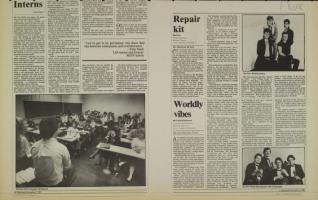
Last month about 300 students inter-
viewed for 66 positions in the Business
Intern Program. Although an inter-
nship is not guaranteed, most of the
students accepted will land paid en-
try-level positions that relate to their
major - computer science, marketing,
communication, industrial relations or
engineering - at companies ranging
from Michigan Bell to The Gap.
The Public Service Intern Program
coordinators selected 105 students from
256 applicants. These students will
work, usually on a volunteer basis, at
public. servla agencies in Washington
D.C. and Lansing. Both programs
provide students with counseling and
job-hunting guidance.
Students can also apply for inter-
nships through the University's chapter
of AIESEC, a student-run organization
that places interns worldwide.
Yet hundreds of other students hunt
down internships on their own. Because
there is no established program to
gather information on potential em-
ployers or set up interviews, students
who do it on their own must be deter-
mined to fight through what can
sometimes be miles 6f red tape.
"You've got to be persistent,". says
Tom Nash, an LSA senior, "but draw
that fine line between enthusiasm and
overbearance."
Nash landed an internship on the
sports staff at Detroit's WDIV two
summers ago despite the station's
initial lack of interest.
"I kept calling back and calling back,
and then one day the man said, 'hey,
I've got great news for you,"' Nash
recalls.
Nash, a communication major, had
taken some television production
classes, but before his first internship
had little first-hand experience in the
area. Although Nash's initiative may
have had some impact on the station's
decision, motivation isn't enough.
On the whole employers choose their
interns on the basis of grades, extra-
curricular and work experience, and
class standing. It varies, however, from
field to field. Some professions,
including architecture, art and jour-
nalism, place previous work samples
above all else.
"The single most important thing is
the quality of the work the student has
done," says Ripley Hotch, who coor-
dinated the intern program at the
Detroit Free Press last YI". "A good
article reflects the writer's intelligence
and ability to think clearly."
Hotch also stresses the importance of
applying early. Although the Free
Press accepts applications until
January, he recommends that students
looking for internships apply by the end
of November.
While it's important for internship-
seekers to make themselves stand out
from the crowd, this can sometimes
backfire. Hotch remembers a cover let-
ter he once received from a student in
Minnesota.
"He or she had come to Detroit
during the summer and wrote that she
read our newspaper. He or she tried to
in Sen. 'W- Levin's (D-Mich.) 4Ww
Washington D.C. office last summer,
said that he received an added push
from a relative of a friend.
"Of the 16 interns in my office," he
says, "12 were political appointments."
But Johh Karasienski of IBM's per-
sonnel placement office said a recom-
mendation coming from inside the
company would have little impact on an
intern's chances of landing a job.
O NE WAY to beat out the compe-
tition is to look where everyone
else isn't, according to Anne Richter,
supervisor of experiential education
programs for Career Planning and
Placement.
_~v
71
..
/
'You've got to be persistent, but draw that
line between enthusiasm and overbearance.'
-Tom Nash
LSA senior and former
WDIV intern
show familiarity with our product by
complimenting several reporters," he
recalls. "It was unfortunate that she
confused the two Detroit papers."
A common misconception about the
internship selection process is that it's
not what you know that matters, but
who you know. For certain internships
- legislative appointments, medical,
and law - recommendations or per-
sonal contacts may be the deciding fac-
tor. In other fields, a good word may be
completely ignored.
LSA senior Tom Lehker, who worked
Too often students pass up excellent
internships because they overlook
small firms or scoff at a company
because of its name, she says.
"Cedar Point is one of the biggest
participants in the (Career Planning
and Placement sponsored) Summer
Job Fair with offers for positions in
management which are overlooked just
because of its name."
LSA -senior Pam Maas landed an in-
ternship with the Consumer Protection
Agency in Washington D.C. after more
"glamorous" offices turned her away.
Repair
The Flxx
Prism Productions
Michigan Theater
7 p.m., Monday, November 7
By Melissia Bryan
CAN somebody find another place
to start a band besides art school?
I'm not against art or anything, but it
seems a little bit silly to turn all these
painters and textile makers into
singers. How does that happen?
The Fixx didn't go to art school exac-
tly, but their drummer went to drama
school. Anyway, he's not singing or
anything, so I guess it doesn't matter.
Forget what I said about art school. We
need art schools.
The Fixx, who play at the Michigan
Theater this coming Monday, evolved
from the New Romantic brouhaha that
sort of erupted from England. Ac-
tually, Cy Curnin, the lead singer,
Adam Woods, the former drama
student drummer-man, and an un-
named keyboard accomplice, started a
band called the Portraits. The Por-
traits were pretty special-they got a
record contract, but they failed to do
much by way of meaningful sound.
vibes
New World Quartet
University Musical Society
Rackham Auditorium
4 p.m., Sunday, November 6
By Gordon Jay Frost
A NN ARBOR continually debuts scores
of unproven talent. Sometimes the
theaters and societies present the
younger groups to help them get their
footing: This is all supported by an in-
defatiguable audience; as Lawrence
Kasdan said this week, "No matter how
much they get burned," college studen-
ts keep going back for more.
This idea holds true on the traditional
side as well. The University Musical
Society introduces young ensembles to
Ann Arbor every year and this Sunday
UMS is once again bringing in the New
World String Quartet.
This ensemble is taking risks. That
alone could account for their low
visibility and "newness," despite the
fact that they have performed two
"Bonus" concerts in the UMS 1979-80
season. First, they have rejected New
York City as a home base and have
remained in Grand Rapids where they
originated. Secondly, they insist upon
performing new compositions and
relatively contemporary composeys.
The Portraits evolved into the Fixx
by way of the semi-popular Melody
Maker magazine, which is where the
band advertised for another guitar
player. Through the magic of media,
Jamie West-Oram completed the Fixx
foursome.
Curnin is enamored of his new
guitarist, in an artistic fashion:
"(West-Gram) is like a French
plasterer: He covers a large area, adds
great details, and gives it all a wonder-
ful sheen."
A French plasterer-what a super
special way to describe somebody. It is
really too much.
I think this is an art band. Never
mind that they didn't go to art school.
You don't need to go to art school to do
all the cool stuff that the Fixx has done.
I'm willing to wager that many art
students think that they will become
rock stars; maybe that is why they pay
all that money to get into rock art ban-
ds.
Most artists aren't recognized in their
lifetimes. So I bet all those art critic
people were really surprised when the
Fixx won the hearts of fans all over the
USA. I bet that the Fixx is even making
a bunch of money on their new record,
Reach for the Beach. I think they
deserve to make a decent return on the
whole art package because it sounds
really nice.
"Saved by Zero" makes me feel light,
and special, but a little forboding. Cur-
nin says the song is about doing away
with encumbrances. I think that.
sounds about right. When I hum the
song I sort of amble down the street,
and I don't care where I'm going.
The Fixx: Musical junkees
The Fixx have four big hits, "Saved
by Zero," "One Thing Leads to
Another," "Red Skies," and "Stand or
Fall." They have two good albums,
Reach the Beach and Shuttered Room.
Reach the Beach has been quite suc-
cessful to date, surging its way to the
top 10. . . which probably miffs a lot
of art students. They think the Fixx are
too commercial. Well tough beans to
you, art students. I bet you'd like to
Finally, they have changed their mem-
bership several times with only one
original member remaining. While
these changes may improve the en-
semble musically, it doesn't help gar-
ner them an image of any depth or con-
tinuity. In fact, it will be hard to say
how good "they" are until we see who
they are.
At latest report, the group's members
are Curtis Macomber (violin), Vahn
Armstrong (viola) and Ross Harbaugh
( cello). The various combinations of
performers in the New World String
Quartet, since 1977, have won the
stellar Naumburg Competition in New
York, performed in various series
across the nation, premiered a work at
the Library of Congress, and performed
the complete cycle of Bartok quartets
with the Detroit Symphony.
Their recording credits, completed
and in progress, on Vox, Golden Crest,
and Centaur, are equally impressive. In
addition, they have played at several
prestigious festivals including Ravinia
and at Interlochen. The Michigan
Foundation for the Arts even
recognized them as "Outstanding
Musicians of the State" in 1983. But
who, exactly, did they recognize?
Individual biographies of the perfor-
mers read like a Juilliard yearbook.
Macomber, for example, was a Fuchs
student and a top-prize winner in the
competition for the residency of
American Violin music. He has per-
formed as soloist with a number of or-
chestras since his Carnegie Hall debut
in 1979 and joined the quartet in early
1982. His best review has come from
Bruce Galbraith, Director of the In-
terlochen Arts Academy, who
described his playing as "dynamic.
Exciting and unorthodox." Macom-
ber's bowing, he said, isn't "smooth
and beautiful but strong."
Patterson, the man pictured who is no
longer a member, was an Interlochen
Arts Academy graduate who has left
music for stocks, insurance and the rest
of the business world. His counterpart,
Vahn Armstrong, joined with the
recommendation of Robert Mann of the
Juilliard Quartet. Robert Dan, a faculty
member at the Manhattan School of
Music, was also a graduate of the
Eastern school.
Ross Harbaugh, the only survivor of
the ensemble's many incarnations, had
his debut with the Toledo Symphony at
17 and has since enjoyed several full
performing fellowships and soloed with
several orchestras.
No matter the membership, the quar-
tet has consistently performed more
contemporary work than many non-
specializing young ensembles. Besides
their Bartok work, and the William
make a
stewpot.
by some
hour listo
bands fro
that the r
And if'i
a little m
can conti
vice to
playing t
Bergsma
CongresG
record s
had a w
selves.
"The
microtor
ensembl
by one
everythi
or do, th
out all tE
pitchesa
delve inl
ensembl
group.
Sunda
what wi
There v
presents
is like a
shift, ci
but they
place th
S
N
N
C
N
Y
yyN
The New World String Quartet: Old world qualit:
Business Intern Program: Kicking off
10 Weekend/November 4, 1983
31
4 .,: . * .
4_i F' ; ' , 4 .a ' ' i J . , ; ° ,It . J - ri 1i' A