
a
OPINIoN
Page 4 Sunday, October 5, 1980 The Michigan Daily
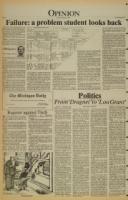
Failure a problem student looks back.
When I hear friends grumbling about a bad
grade on a quiz, a test, or even a final, my reac-
tion is one that some might think unusual. I
become intensely envious. I quake with jealous
fury at what my compatriots, a generally in-
telligent, studious lot, call "bad grades."
For them, a "bad grade" is anything that will
significantly mar their pristine 3.7, or 3.4, or
3.15 Grade Point Averages. I should have such,
worries.
FOR ME, A bad grade is the mark I have
earned in 8 of the 24 courses I have taken here,
a grade unseen by the vast majority of my
fellow drudges. So as not to be too blunt about
it, that grade is a vowel, but is not the first let-
By Joshua Peck
ADMIT-TED TO COIE6E Of LITERATURE, SCIENCE, AND THE ARTS N pt___ -_
FROM
TRANSFERRED TO N
TRANSFERRED TO _____________ _ IN ____
GRADING SYSTEMI (EFFECTIVE FALL 1975)t
A+ 4.0 B-.7D+ 1.3 P-"ASS (A+--)W-OFFICIAL DROP U--UNSATISFACTORY
A 4.0 C" .3 D .0 F-PAIL (D-t) EO-UNOFF. DROP CR-CREDIT
A- S.7 C S.0 D^ 0.7 I-INCOMPLETC N^ MN-NO GRADE REPORTEIgNC-NO CREDIT
B+ S.C C- 1.7 E 0.0 X-ABSENT PROM EXAM Q-UNOFFICIAL ELECTIO VI-OFFICIAL AUDIT
SSO .0Y-EXTENDED COURSE S-SATISFACTORY
THE UNIVERSITY OF MICHIGAN
ANN ARBOR
DEGREES AND CERTIFICATES
ACADEMI.: RECORD OF
(NAME: LA , FIRST, MIDDLE)/
1332 GREST COURT/
I N arc
RBOR MT 481o4
-7
TWO SUMMARIES FOLLON THEENTRIES FOR EACH PERIOD IN RESIAENCET
MICHIGAN TERM HOURS ELECTED, TOTAL TERM HOURS CREDITED TOWARD
HONOR POINTS EARNED{ SECOND, A CUMULATIVE TOTAL ON THE SAME FACTd
2.0 POINTS FOR EACH HOUR ELEI TED IS REQUIRED FOR A .'IEGREE.1
FIRST. A TOTAL OF
~ROORA MMICHIGAN
RS. AN AVCRAGE OF
ER M SEMESTER
BIRTHDATE 06-12-57
CONCENTR ION:
------.- /
THETR i hAI .IUI DRA~z+ 7
* ~ -V
/I
COURSE
.&ECK.JOSHUA MAGENJCE
FALL 75 12452J474:1
~T BOOKS 191. GKEAT NOOKS
PATH1 115 ANAL GEOM-<ALC I_
@HYS 140 GENERAL PHIYS I
;PHYS 141 ELEM LAb I
&USS 101 FIRST-~YEAR.
rM H CTP 11 MH 33.7
- Del~oT~peCI ,o4'f'c..lA
>$:WINTUk 76 1245204740
iNGL.467 SHAKL- PEARE PLAYS
PHYvS 40 GENERAL PHYS 11
PHYS 941 ELEM LAB 11
loss-102 FIRST-SYEADk
2.971
*MSH 19 C P f8 MHIP 54.5
MICH I CR01 IMICK
TERM TWRDJ HONOR
KRS IPROM POINTS
COURSt
TER TWD ONO
COURSE' ,
I I.-.. .1 5 ~ - - -
r
:3
4
12
3
3
1
4
7
3
4
4
4
-A3
R-
w
8-
Lb
A-
1.1
W
w"
A-
1
86
8-
.8+
E
A
JE
10
81
1 4b
3 G
6'O-
1481
208
13,
16
- WINTE
i Eb&R W 20
4OURN 301
SYCH 171
kUSS 202
G6SS 450
-HMSH 57a
k 77 124 5204740
)2 ELEM MUOD HEBREW
L ASIS NEWS WRIT
AS WCIAL SCI
.SECOND YEAR
20TH C RUSS LIT
2.095
C TP 46 MHe 133.7
5
4
4
3
20
2.
G+
ID
IE
17
x1j5
4~.0
1.37
',
x+09
v-
SPRING 80 1.
RE IGION 304 TH
M-H 83 CTP
- i
t
ter of the alphabet. That's it; the one between
"D" and "F" (although I have one of each of
those too).
I am an astonishingly bad student. I was
when I arrived here five long years ago, I
remained one through my first four terms, and
I would have been one during the next year,
had I not left school for a year. I have since con-
tinued in that noble tradition over my last three
semesters.
It's weird, really, for at no point during the
compilation of my current 1.996 Grade Point
Average have I ever been accused of being
stupid. I really don't think it would be fair to
call me intellectually disadvantaged or
culturally deteriorated or any of those other
lovely euphemisms social workers throw
around.
BUT I DO have some sort of perverse strain
that interferes with high academic
achievement. It can't just be laziness; from
what I observe, everybody is lazy, but vir-
tually anybody else comes through with a self-
delivered spur when needed. I only rarely do.
Psychologists and psychiatrists, of which my
parents are two (three, counting my step-
mother), would think me an obvious sufferer of
FALL 78 1245204740
IST 434 SOVIET UNION
HURN302..WXTNG.%S.S MEDIA
.1USS 301 . THIRD-'EAR
OSC 100 PRINCIPLES
JPPEECH 00 FUNDAMENTAL
MSH 67 CTP 46 MHP
MMUNCTN 8178
CN617
ENGL 567 'H.A
uST 4 53
L0?L S C!1
IiHEA
TTX
4
4
4 3
, FALL . 76 1245204740
ANTHR CUL 411 INTRO-LING
JOURN 01 SOS RLE-ME0IA
POL.SCI 395 URV SOV UNION
tUSS 201. . SECOND-YEAR
RUSS 451 SURVEY RUSS LIT
I _
I
. ,
\1 / V
gleefully answer "four or five" when he asked
for an estimate of the hours I spent each week
studying. (My average has since declined.)
And thus it was possible for me to self-
destruct in a semester consisting of some of the
easiest courses LSA had to offer.
It was Fall, 1978. I had just returned from my
year out of School, during which I had been
working, writing, acting, and gaining residen-
cy. When in mid-November my girlfriend of the
previous six months and I parted ways, I took a
little vacation, ignoring classes for a' week
while nursing my wounds and listening to Burt
Bacharach records.
WHEN I returned to class the following
week, teachers and fellow students expressed
interest about where I'd been, most of it offered
in perfectly benevolent fashion. I took their
comments as an affront to my liberty,
naturtlly, and put my typewriter and textbooks
aside for the rest of the term. The results?
Russian 301: Incomplete, later lapsed to "E."
Journalism 302: "F." Sociology 100: "E."
Speech 100 (everyone's favorite "cake"):"E."
All depends on your definition of "cake," I
guess.
I took the year following that semester off as
well, though this time it was the Academic Ac-
tions Office that got the idea.
How could it have happened? The second-
place finisher of the Anna C. Scott Elementary
School second grade spelling bee, winner of an
all-around excellence award the following
year, the master of ceremonies of his high
school graduation, tossed mercilessly out of
college on his ear without so much as a war-
ning.
THE COMBINATION that has landed me in
hot water time and time again is that hard-
bitten resistance to authority, and excessive,
inflated pride. I resent the assignment of, say,
a final term paper for a Political Science class.
I put off researching it until the day before it's
due, and then come to the conclusion that
there's no point in turning in a paper that will
be so clearly inferior to what I could have done
with more preparation. So I'm off to my tenth
viewing of Seven Brides for Seven Brothers,
failure be damned.
I have no sure way of telling what my life
would have been like had I been a nose-to-the-
grindstone type. I probably would have
graduated a year-and-a-half ago with a degree
in Astronomy or Russian (my intended majors
freshman and sophomore years, respectively).
Conceivably, I could have been on my way to a
professorship at some university.
BUT I SOMTIMES wonder if more atten-
tion to the Humanities might not have cost me
the attention I've been able to devote to
humanity. Playing by my rules, I have been
able to afford avid involvements in all manner
of endeavors: from studying the stars, to per-
forming in a theater, to writing about the
theater, to romantic entanglements, to editing
this page.
I cannot speak from experience, but surely
pursuit of the academic above all else-and
that does seem to be the only sure road to su -
cess here-would have cramped my rather
spontaneous style.
If and when I graduate, I'll be a few years
older than most, a little more tired of Ann Ar-
bor, and-who knows-maybe a little wiser.,0
My academic achievements (or lack thereof)
have not cost me companionship, my health, ,r
my sanity. I wonder if all those who have put-
sued a Phi Beta Kappa key instead can say the
same.
"fear of success"-a malady associated with
an underlying fear of failure. I'm sure that's
not it, though. In the areas of my life that are
not academically related, I pursue and
frequently achieve sometimes lofty goals. I
know the delicious flavor of work well done,
and wouldn't mind at all experiencing that
flavor in the academic arena as well.
If there is a psychological factor beyond
laziness, I think it must be my hatred of
authority. I can't stand having other people tell
me what to eat or wear, how much or where to
sleep, or more pertinently, what to read, write,
think about, and listen to. Yet however freely I
may have chosen a given University course,
the syllabus with which I am forced to contend
seems to smack of authoritarianism. Faced
with the choice of submission or failure, the lat-
ter alternative too quickly comes to seem the
more attractive one.
THUS IT WAS possible for me to fail Russian
451 four years ago because I refused to read
War and Peace and then turn around and ab-
sorb the Tolstoy masterpiece in my free time
the following term with pleasure and
amusement. At that point, of course, the three
wasted credits were unsalvageable.
Thus it was possible for me to look my
Honors counselor in the eye freshman
year-yes, I was in Honors once-and almost
Joshua Peck
Daily's Opinion
every Sunday.
is the co-editor of The
page. His column appears
Edited and managed by students at The University of Michig
Vol. XCI, No. 28
420 Mayn
Ann Arbor,
Editorials represent a majority opinion of The Daily's Editorial E
estat
'Re iser against 1s
Y OU'VE GOT until 8 p.m. tomor- ,
row night to arm yourself for
the war against the Tisch tax cut
proposal.
Tomorrow night is the deadline to
register to vote in the November elec-
tion-an election especially important
because of the ballot proposals to be
decided as well as the president to be
elected.
Whether or not you are a Michigan
resident, as a member of The Univer-
sity of Michigan community you
should be vitally interested in working
and voting to defeat the irresponsible
Tisch plan, which would roll back
property taxes to - 1978 levels, slash
them in half, and require the state to
-make up for the lost revenue.
Of course, the state has no money to
replace those lost funds-already
public employees such as state
troopers have been laid off. The effect
of the Tisch plan will be utter
devastation of
economy-not to menti
University.
Further, the Tisch pla
the hands of the state tc
lost revenues by ra
taxes-any increase wo
approved by 60 percent
figure nearly impossible
Within the University
is easy to become com
the threat that Tisch pr
everyone on campus is
plan.
But throughout a sta
unemployment, the Tis
joying great popularity
A recent poll indicate
Proposal D could win 6(
November vote.
Register to vote tor
Secretary of State's offi
up in the Union or the
going to be a tough figh
is desperately needed.
an
nard St.
, M 48109
Board
ch
Michigan's
ion that of the
n carefully ties
o replace those
ising fees or
)uld have to be
of the voters,a
e to reach.
community, it
nplacent about
resents: nearly
opposed to the
te ravaged by
;ch plan is en-
as a quick fix.
s that Tisch's
D percent of the
norrow at the
ce or tables set
Fishbowl. It's
t and your help
j ,
"Politics," Chairman Mao
used to say, "comes out of the
barrel of a gun." In 1980 that
axiom holds doubly true for
Americans, but with a twist.
The gun in question is mounted
at the rear of a television picture
tube, where it fires electronic
images at the screen on which so
much of American life-political
and otherwise-is now conduc-
ted.
And it derives much of its
power from programs which do
not, on the surface, appear even
remotely related to politics. In
ways which are little understood,
the character of mainstream U.S.
political opinion has been defined
less by Walter Cronkite and
David Brinkley than it has by
"Father Knows* Best," "Bonan-
za," "Kojak," and "Lou Grant."
WHAT POLITICS SELLS today
is a vision of life, rather than an
organized program for the
governing of society. It presents
ideology in the broadest sense, a
"belief system" full of conven-
tional views of the world and con-
ventional expectations of it. And
that, after all, is just what
television entertainment presen-
ts. It is the chief ideological force
in America, the chief testing
ground of our conventional ex-
pectations, thanks to a
systematic effort to read the
national pulse and address the
most deeply felt public needs.
In the age of Television
Politics, no politician can survive
long if he ignores the TV public or
the principles which guide enter-
tainment programming. As a
result, successful politics and
successful TV have run sur-
prisingly parallel courses
through the last 30 years.
Even in the medium's infancy,
a rudimentary relationship bet-
ween political imagery and the
prevailing images of television
entertainment was apparent.
Dwight Eisenhower was the
very embodiment of those ideals
which elevated Robert Young
and "Father Knows Best" to the
Nielsen summit: solid.
P olitics
From 'Dranet 'to 'Lou Grant'
equivalent. Dozens of tense spy
and police programs in the early
fifties ("I Led Three Lives,"
"Dragnet," "Racket Squad,"
"The Crusader") operated on the
premise that a criminal or
political confidence man lurked
behind every American door.
They were the most common
television fare of theirnera.
But not nearly as common as
their successors at the heart of
the TV schedule: the westerns of
1956 to 1960. During the second
Eisenhower administration, John
Foster Dulles shifted the locus of
American paranoia from
domestic subversion to inter-
national Cold War conflict. In the
four years which saw Dulles
bring the U.S. ever closer to the
brink of nuclear war, some 60 dif-
ferent TV frontier series
premiered, and they often spoke,
at least metaphorically, to the
mentality of brinksmanship.
Many worked on the thesis of
Have Gun Will Travel, in which a
grim but purposeful gunman
travelled about the less
developed world offering his
violent skills in the service of}
freedom, American-style. They
were parables of foreign inter-
vention, punctuated inevitably by
a confrontation in which the
menace to American values was
annihilated.
Anyone who. finds the notion
outrageous that the western
shoot-out had some metaphorical
relationship with the Cold War
should consider the summation of
the 1962 Cuban Missile Crisis of-
fered by then-Secretary of State
Dean Rusk: "We were eyeball to
eyeball," he told the press, "and
the other guy blinked."
THE EISENHOWER YEARS
marked the triumph of a critical
principle for image-makers. Like
the well-balanced TV schedule,
the successful political formula
required a sympathetic per-
sonality (Eisenhower himself),
reinforced by a hard, aggressive
M viw mnnlhi _I j -a enm-
By Frank Viviano
Television was full of Kennedy
images: The nation had been
exhausted by the ideological
strain of the Fifties; television
knew enough to rid itself of stone-
faced gunmen like Paladin and to
replace them with stylish detec-
tives on the model of "77 Sunset
Strip" and appealing idealists
like Dr. Kildare. It was part of
the Kennedy genius to recognize
the same thing, while Richard
Nixon paid the price for a fixed
identification with the paranoid
Fifties.
OVER THE ENSUING years,
this curious process has taken
even firmer root, with politicians
rising and falling in suggestive
proportion to their ability to
reflect-or generate-an image
which matches the expectations
of television entertainment.
When Lyndon Johnson was at his
best during the early Vietnam
War years, he could seem like a
modernized version of "Bonan-
za's" Hoss Cartwright: big and
immensely powerful, but driven
only by the best of intentions.
"Bonanza," "Big Valley," and
programs like them were all
about gigantism, about sym-
pathetic' super-states which
were not too big to help out a little
guy in trouble-which was the
way the nation and its president
also chose to see themselves until
the unpleasant truth gradually
emerged toward the end of the
decade.
But the truth, in a way, was too
unpleasant for the mass
imagination, and. as George
McGovern learned, opposition to
the war and embracement of the
rival left-liberal ideology meant
political disaster. The Counter
Cultre/New Left generated-some
sympathetic television
images-most notably "Kung
Fu"-but the real action was on
the right.
Nixon himself never
managed to meet the image ex-
pectations of television in
anything but a negative sense. He
family life of "Little House on the
Prairie" or the Osmonds. To a
remarkable extent, both Gerald
Ford and .Jimmy Carter offered'
that prospect. One was from
small-town Georgia, the other
from small-city Michigan. Both
had big, happy families. The
most frequent word used to
describe each was not "com-
petent," or "forceful," but
"decent."
FOUR YEARS LATER, that
formula has had its chance and
failed the test of global and
domestic challenges. If the
president has any image on xTV
entertainment today, it is in the
image of incompetence com-
municated in programs like
"Carter Country" or "The Dukes
of Hazzard," in which the small
town South is populated by buni-
bling clowns. This is precisely the
image that media fixation on the
comic vagaries of brother Billy
has helped give to Jimmy Carter.
Beyond that, it is difficult to
generalize about contemporary
television entertainment,
because it has never in the
mediumts history suggested so
little consensus on values. There
are no prevailing images on TV in
1980, certainly not in the sense
that theegrim thriller prevailed in
1952, the western in 1958, the
stylish idealist in 1963, the ethni
cop in 1972, or the wholesome
family in 1976.
If anything, television seems
taken with itself, with a nar=
cissistic assertion that the mass
media are the real stars, evident
in programs like "WKRP in Cin-
cinnati," "Lou, Grant," or the
relentlessly prosecutorial "Sixty
Minutes."
There may be nothing sur-
prising about this, for in the :30
years which now separate .us
from the first combining -of
political imagery and television
entertainment, politics, in effect,
has become a television enter-
tainment series.
The political primaries of 1980
recalled nothing so much as the
classic American television
f i L' lL"-Vic L4 )'AWE
Scanned image of the page. Keyboard directions: use + to zoom in, - to zoom out, arrow keys to pan inside the viewer.
October 05, 1980 (vol. 91, iss. 28) - Image 4
- Resource type:
- Text
- Publication:
- The Michigan Daily, 1980-10-05
Disclaimer: Computer generated plain text may have errors. Read more about this.