
S a e THE MICHIGAN DAILY
E NE music in review Thursday, April 8, 1976 Page Five
. . . . .. . ... .
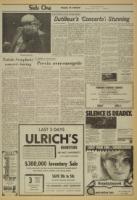
ROSTROPOVICH PERFORMS:
Dutileux's
'Concertos Stunning
By KEVIN COUNIHAN ' great works of music have oc- the Concerto is a musical illu-;
casionally been written from mination of a passage from
UNTIL the twentieth-century, commissions in the twentieth Baudelaire called "Tout un
composers earned as much I century. (Bartok's Concerto for monde lointain . ." ("whole
of their living from commis- Orchestra comes to mind as distant world"). Each move-'
sions as from teaching and , does the Schoenberg Trio. A ; ment is a reaction to Baude-
performance. It was standard newcomer to this auspicious I laire, and, in this way, resem-
practice to illicit the patronage clan is Henri Dutilleux's Cello bles Boulez's Pli Selon Ph
of a wealthy nobleman or mer- Concerto, commissioned and re- which worked in a similar fash-
chant who, more often than ' corded by Mstislav Rostropo- ion to poems by Marleme.
not, was a musician in addition ' vich and the Orchestra de
to being a supporter of the Paris (Angel S-37146). It is a Unlike Boulez, Dutillex con-
arts. sumptuous and brilliantly or- centrates less on the explora-
As is generally known, some, ganized experience from one tion of sonic labyrinths as in
of the greatest works of our' of the world's most distinguish- suggesting the depth and dark-
civilization were created from ed composers. ness of Baudelaire through col-
such commissions, including oristic exchanges between the
much of the music of Bach, IT IS indeed a rarity to come orchestra and the cello. Begin-
Mozart, and Beethoven. In our' across a work of this quality, ning with a cryptic cymbal roll,
time, commissions have become and I would hazard the guess the Concerto proceeds with a
more of a luxury to the stable that Dutilleux's Concerto will seven-note arpeggio from the
of composers from our colleges be later regarded as one of the cello that serves as the primary
and universities. The modern great works of this century. It motif for the piece. This theme
patron is more autonomous and has the intelligence, sophisti- grows in complexity and in
institutionalized, and generally , cation, and musicality of a mas- volume until the entrance of
takes the form of a foundation. terpiece and seems to expose the orchestra winds break the
Despite the lack of interest in more of itself upon further lis- intensity and the cello is al-!
contemporary music, whether tenings. lowed to digress to a new area.
it be American or European, I Written in five movements,
THE symmetrical construc-I
the soloist or the
ments. The effect
ily attractive,
other instru- ning motif in the cello is re-
is necessar- stated and the concerto closes
with a curious but satisfying
whisper
.1
i
t'
,
t"
k
i"
f'
4
(
The final movement "Hymne"
capsulizes the essential ma-
terial of the previous four sec-
tions, such as the velvet chords
from the harp and muted brass
in movement four, and the high{
cello passage from the second
section. Once again, the begin-
Interesiii gfacts
The U.S. battleship Maine ex-
ploded in Havana Harbor Feb.
15, 1889, with a loss of 260 crew-
men.
The United States broke off
relations with Germany Feb. 3,!
1917, because of its sinking of
U.S. ships by submarines.
President Woodrow W i l s o n
suffered a stroke Oct. 3, 1919,
which left him an invalid for the
rest of his life.
ROSTROPOVICH plays with
surprising worldliness through-
out the piece. As a musician
known primarily for his inter-
pretations of 19th century mu-
sic, he is unusually gifted in
adapting to the jumps of in-
tervals and to the rapid chang-
es of dynamics which defines
so much of modern music. As
usual, his intonation is simply
exquisite and his phrasing is
sensitive yet precise.
Included wth the Dutilleux
piece is another Rostropovich
commission by the Polish com-
poser Witold Lutoslawski.
Known mostly for his Concerto
for Orchestra, Lutoslawski has
generally worked in the style of
controlled improvisation, called
'aleatory composition (Stock-
hausen is frequent practitioner
of this form).
Daily Photo by KEN FINK
Rostropovich
Toledo Symphony'CARMINA BURANA':
T O--i
'9"
It
31
I
G'
t
,
4r
,,......
4,
concert -- boring
Jrevrn over-energetie
tion of the Concerto is appar-
ent in the action of the pivotal
third movement where the mo-
tif from the opening section un-
dergoes variation and expan-
sion. As in the first movement,
the orchestra is treated in a
sectionalized, pointillistic man-
ner and sections of strings,
winds, brass, and percussion
i
i
j
i
I
j
E
i
t
His Concerto is a one move-
The Panama Canal was open- ment piece that fluftuates he-
ed to ship traffic Aug. 15, 1914. tween the Key of D and its
chromatic neighbors. It is a
In 1915, the population of the provocative work that is saved
United States reached the 100 mostly through the attention of
million mark. the soloist. The orchestra plays
with similar care under the
The Natonal Spelling Bee, guidance of the composer.
encn ted by Icrinns - Howard -
By JEFFREY SELBST
each of which is a direct change of mood from
fn ;t rrnanrOf npftly d rpi
By TOM GODELL
TT sounded like a good idea,
but it just didn't work. An
evening of Tchaikovsky with
the Toledo Symphony may con-
jure up visions of sugar plum
fairies and heroic grandeur,
but the concert was, in a word,
dull.
There are numerous reasons.
The program was too long and
poorly balanced, presenting
Francesca da Rimini and the
Symphony no. 1 all before inter-
mission, and then concluding
with the First Piano Concerto.
Further, Francesca da Rimini
is not the kind of work to begin
a concert with. It is dark and
brooding music, based as it is
on one of the gloomier stories
from Dante's Inferno. This is
hardly the kind of music to gain
an audience's interest at the
outset of a concert. Nor is it
one of the composers better
efforts. The piece is far too
long for the material it con-
tains, and fails to reach any
real dramatic heights.
CONDUCTOR Fournier gave
the work his best effort, but
that still was not enough to
pump life into this over-inflat-
ed opus. Fournier's approach
was Wagnerian, which was
quite effective as far as it went.
About half way into the piece,
I lost all interest in it.
If I was bored, however, the
members of the orchestra most
certainly were not. Their play-
ing was magnificent through-
out. I don't believe that I have
ever heard the orchestra play
so well.
The concert continued with
Tchaikovsky's First Symphony
in G minor, Op. 13, subtitled
"Winter Dreams." While this
work is hardly as well-known
as his later symphonies, it does
not deserve the obscurity in
which it languishes.
Unfortunately, Fournier's ap-
proach to this music was less
than sympathetic. For evam-
ple, his choice of tempo in the
opening movement was much
too fast. In the ensuing rush
the real beauty of the music
was. distorted and ultimately
lost. The orchestra had no
trouble whatsoever with the
brisk tempo, and played almost
as well as in Francesca. There
was one major difference, how-
ever, in that the string tone
was much too harsh.
? here 1, a ;4
difference!
* *RPA FR
"rREARE fir: e
9
" MCAT Over35years
AT and success
e Small classes s
e LSAT ".
*constantly updated
e ~OD Tape facilities for:
Sreviews of class
Slessonsandfor use*
" of supplementary e
FLEX materials e
e *
e Makeups for
ECFMG missed lessons
NAT'L MED BDS
NATL DENT BS :
THE SECOND movement was
considerably more successful,
and was presented in a delicate
and loving fashion. But the fin-
al two movements suffered
from the same problems as the'
first. All in all it was a per-
formance neither wintry nor
dreamy.
CARL ORFF'S Carmina Burana is a strange
work, with ardent defenders on. the one hand
and passionate detractors on the other. I first
heard of the piece through a French teacher of
mine who recommended it. The odd thing was
that this woman was virulently anti-Nazi and
anything connected with them, yet she saw noth-
The concert concluded with ing of that ideology in the music.
Tchaikovsky's First Piano Con- But the work premiered in Frankfurt-am-Main
certo featuring soloist J o h n in 1937, under the reign of Hitler, and as such,
Browning. This work, in spite was approved by him. Orff himself was, cultur-
of its tremendous popularity, ;ally, an influential Nazi. It may be true that,
my interest. Browning's per- as in the case of Ezra Pound, the art produced
formance did nothing to change may supercede the shortcomings of the artist.
my opinion of the music, and Yet it seems to me that there is so much bar-
its all - encompassing bore- barism, so much musical regression in the
dom. work that, given the politics of its composer,
To be sure he is a pianist of the piece itself ought to stand as a grating re-
great talent and marvelous fa- minder of Germany's worst hours.
cility. He tossed off difficult Carmina Burana is possessed of the capacity,
runs and complex hand cross- then, to be nearly all things to all people. And
ings with no wasted motion or considering the scope of the work, this is the
effort. The resultingrtone had all least surprising thing about it. Set to a text of
anof e thelpowersdiriessta poems "sacred and profane" written by monks
anyone could desire. tof the thirteenth century, which were onlyun-
Yt somthilng impotanc w earthed in the nineteenth, the music ranges
missing. hl i ehiu
was formidable, the approach from lusty to simpering, inventive to nearly repe-
was cold, lacking any real feel- titive, and, on the new Angel recording, from
ing and precluding true excite- well-played to mediocre.
ment.
While this was a problem in ANDRE PREVIN is backed up by the London
the outer movements, Browning Symphony Orchestra, its chorus, and the St.
gave what was perhaps the Clement Danes Grammar School Boys Choir,
best and most moving reading in this latest attempt (Angel S-37117). With the
of the Andantino movement that Tilson Thomas version coming out only a year
I have ever heard. In his hands before, it seems as if a recording of Carmina
music sang in a way that was Burana is becoming a must for young conduc-
t quite endhanting. The orchestra tors.
S srow mg ere, match for But this one succeeds where Tilson Thomas
was almost destroyed by what ultimately failed--that is, Previn manages to
can only be described as an imbue a great deal of this static music with
unpolished sound, lacking in excitement and musical statement. This is no
depth of expression. mean task-the work is divided into seven parts,
from its o prdnssr. orn .pparen y care , - - --iI u y, p
nothing for transition. make entrances in accordance Newspapers since 1939, was in-
And Previn is rather anxious to not overdo to the progression of the cello. stituted by the Louisville, Ky., U of M Dance Dept.
these switches. For example, the first part is Dutilleux is a graceful crafts- j Courier-Journal in 1925. School of Music
the rather heavy "Fortuna Imperatrix Mundi,'' man and does ndulge i the
the section that also closes Burana. Previn lays harshness of loud clusters of EU""MPEME LI-MELO"
down a heavy hand on this chorale, yet it is the sound like so mtather kingvors' (a dance concert)
sort of thing needed. Rather than seeming pom- composersbu rahrfvs
s subtle puffs of music from his Fri. & Sat., April 9 & 10
pous, it is appropriate. players. Percussion is utilized:! 8:00 p.m.
THEN WE come to the second section, "Primo for maximum contrast and di- Schorlina Aud.--$1.50
Vere." Previn loses sight here of the point, versity but never dom ates_
which is to sound languid and almost lyrical. + W ,'n'M ' T ^ ?'" °
This too manages to come off deliberate, too- i. Te o e nc Dermnt an
carefully languid, self-consciously lyrical. The The Group on Latin American Issues present
effect nearly succeeds, until one realizes what's
at the base of it. In some places conscientious FERNANDO HENRIQUE ARDOSV
musicianship must be abdicated for a lighter
kind of tone, often achievable only by abnega- BRAZILIAN SOCIAL SCIENTIST ui
tion of conductorial "duty." And here Previn Now of Prnceton's Institute of Advanced Studies
does his duty, and a little bit too much. TWO DISCUSSIONS T4
"Uf dem Anger" opens with a thoroughly de- 12 P.M.: "The Consumption of Dependency Theory
lightful Tanz, and here Previn does the same i t"
thing. Too much deliberation will "ruin any idea 1 A the U.S.HA
of spontaneity. 101 ANGELL HALL
THE NEXT three' sections of the piece, "In 3:30 P.M.: "State and Society in Latin America:
Taberna," "our d'Amours," and "Blanziflor iThe Political Economy of Action and Change"
et Helena," are all somewhat draggier as music RECREATION ROOM, INTERNATIONAL CENTER
(and certainly as poety), yet Previn manages COFFEE AND MAYBE COOKIES
to swallow them all down in one highly con- N FRIDAY APRIL
petent gulp.AN I 0 5
Only when "Fortuna Imperatrix Mundi" re-
turns to close the work does Previn's heavy- . , - AA:A. .. ...A
handed attitude return also.
Carmina Burana is more of a challenge to
conduct than, say, Poulenc, precisely because
Orff, in disregarding the advances of modern
music up until the time this piece was written
(mid-1930's), could so easily sound hackneyed.
Previn, at least, doesn't sound hackneyed. He
is fresh, and the music is' made to sound entic-
ing. The recording itself, by the way, is of
highest sonic quality, and reproduces the con-
ductor's effects just beautifully.
SI
IS DEDY
E
LAST 3 DAYS
When someone drinks too
much and then drives, it's the
silence that kills. Your silence.
It kills your friends, your
relatives, and people you don't even.
know. But they're all people you
could save.
If youknew what to say,
maybe you'd be less quiet. Maybe
fewer people would die.
What you should say is, "IIl
drive you home." Or, "Let me call a
nb." Or, "Sleep on my couch
tonight."
Don't hesitate because your
friend may have been drinking only
beer. Beer and wine can be just as
intoxicating as mixed drinks.
And don't think that black
coffee will make him sober. Black
coffee never made anyone sober.
Maybe it would keep him awake
long enough to have an accident.
But that's about all.
The best way to prevent a
drunk from becoming a dead drunk
is to stop him from driving.
Speak up. Don't let silence
be thr last sound he hears.
BOX 2345
RIO vil MARYLANO 2052 I
I I don't want to remain sient.
j Teli me what else I can do.
myname
FRIy ,ENDS DON'~mT LET FRENDS
DRIVE ~n4 DUNK 0ll1 /MI~i O
A
ww wmrwqpwship
NO GIMMICKS-Just Good Old Fashioned Bargains Be-
cause of the thousands of items which we carry-it would
be impossible to mark down each item-all regular price
merchandise will be discounted 201/1 at the Registers.
Special priced items or items with2a Larger discount will
be tagged. This sale is ULRICH'S way of thanking our
Regular customers and introducing ourselves to the many
new people who might not have heard of us-HAVE FUNI
549 EAST UNIVERSITY
ANN ARBOR, MICHIGAN
$300,000 Inventory Sale
INVOLVING EVERY ARTICLE IN OUR STORE ON BOTH FLOORS EXCEPT
TEXT BOOKS, SPECIAL ORDERS, AND CALCULATORS
~ ii
i
GREAT
SALE
I
SAVE 20c to 50c
ON EVERY DOLLAR YOU SPEND
_ !
MAE M. .1
Scanned image of the page. Keyboard directions: use + to zoom in, - to zoom out, arrow keys to pan inside the viewer.
April 08, 1976 (vol. 86, iss. 154) - Image 5
- Resource type:
- Text
- Publication:
- Michigan Daily, 1976-04-08
Disclaimer: Computer generated plain text may have errors. Read more about this.