
- . ;
y x:.
... yv:..,.,,?rte<:}:<L"."."};:; ,:...: " :.v:: v::::.v: "s: " .... ;:Yt
'HE AMERICAN THEATER
Thirty-Seven Cents From Mankato'
By tdAJIUA BOWL
M'Igi .acn-aEditore riflclua
eftWAS ONLY until recently when the
playgoer, asked to compare his theatri-
cal exerrences In Londog Paris and
New York, would quickly submit to a
prfenc for the sta efforts abroad.
He is now shanging hIs tune. it is not
earticlay bcause Encnlish and conti
a ental th oPater is e sin ose; rather
Amera tleatce is cettin much better.
AmeriCs, tdhr oug hi P erientn a
cultfr bosm. Th l o unty it readn
mOegl, girnc to u.pe certs, and even
teyii trenoo tk a Li-Pa tO eIn- films
Ike os that h ed stuhar.ia t is
Yorsthr ee hsed - A meiCa nai In
Catr trNtion, 1mpkl ai, in mondy-n
fTr h i'mo btin, ap leaste thet rich
ASme ifl ris th "ato des alits": Hnt-
atestan s'tiol, tthei ro th e antic A
fortue, f now pubishin r a splashy, alos
sy mnagazine calked "Show," which meent-
ly hailed thin "the Goldesn Ae of Ameni
cat a i Athe is. Harttford ao plays
Freenh sion in the West as he bnisna
together xv i r:is in a plush resort atmos-
phere.
There are many more fruitful cultural
efforts in the country than those oft Mr.
Huntington Hartford. Of all the artistic
mediums currently enjoying a kind of
Renaissance, American theater is ex-
periencing the most substantial "boom."
It has always had a hard time of it in
comparison to European theater.
PRODUCERS ABROAD begin with a
number of advantages. France, for
example, is a highly centralized nation:
all roads lead to Paris. It is, in fact, a well
known tale in France that it is faster
to go out of one's way by several hundred
kilometers, and through Paris, .than to
take a more direct but less efficient line
from one small town to another. This
seemingly circuitous example does illus-
trate an important point about the coun-
try. The French look to Paris as the cen-
ter of all, including the theater. It is
there that the national government sup-
ports three houses-Comedie Francaise,
Theatre National Populaire, and Odeon.
There is a host of tiny, private theaters.
Some flourish, many flop. The little the-
aters are essential to the progress of the
theater, sfor they give new writers and
experimenting producers the opportunity
to exhibit their wares. But the playgoing
public can generally be assured of ex-
cellent productions at the large national
theaters.
Government subsidy comforts' the oth-
erwise persistent financial headache that
plagues producers.' The French producer
in the national theater does not have to
Yearch for backers. Neither does he fear
an empty theater for subsidy encourages
ar e audiences with its low licket prices.
Even in the private thaters in Paris,
students can have seats in the orchestra
tn asll a one dollar.
As wuldb~eneeed.thenatonal the-
clssc adths xnttnby acnoi
e d ' ~ d u l y x x r i ~ h s . T i t x p e i m e r a to
. i 11 rB i , {~
on ''do ~r ;fth..
1. i c"'acnmctn
'' th hi ieuuul oiial in
in France than on the state of the
)UT LOTIDON bd Paris I teater have
had more over. New York than just
years of theatrical exerience.-and subsi-
dization. Theater in London and Paris is
terribly comfortable to go to: one does
not have to order tickets long in advance,
nor wait long hours in line to see a pro-
duction. Save for the weekends, one can
generally pick up tickets immediately
prior to the performance. And the student
who insists that all the dressing up ob-
scures the joy of the theatrical experi-
ence may go to a play in a T-shirt and
jeans if he so pleases, especially if he's
sitting up in the (inexpensive) second
balcony. Theater going in London and
Paris is as casual as movie going in the
States.
Both London and Paris theater are in-
expensive and "comfortable." The En-
glish, however, have just recently gotten
a substantial French-like subsidization
itch, and last year hailed the announce-
ment of a new National Theater whose
organization will be undertaken by Sir
Laurence Olivier. Again, the size of the
country is a great advantage in giving
more people an opportunity to see the.
best the nation's theater has to offer.
Unlike the French, who have no other
recognized theater town except Paris, the
new modern theatre at Stratford-on-
Avon in England is a great drawing
card.
CENTRALIZED theater is a European
phenomenon; decentralized theater is
becoming an American fact. Ours is a'
theater which has always fought financial
difficulties. Broadway's proliferation of
musical comedy is evidence of the back-
er's vwillingness to go in for the soft touch,
and his fear of putting up money for
serious drama. Bertolt Brecht's "Mother
Courage" did poory in New York; even
an Academy' Award winning movie star
could not keep the theater full. "Mother
Courage" is the kind of theater that Euro-
peans know °well and like. Americans,
if they are expoed more ofre to serious
drama, will c ^rn als &ogrow' to appre-
ciate it.
Buttm ,srawlhia mn eoahy of the na-
tion has arade it issno; m.b T for p oduc s
anid actors to srve the great numbers
of 'citizens outide the e's'York City
a, '.who are s htriuiyfor Tdthe Ty-r
as the GE'si teiners. A the '" TsntCved citi-
zenry which has made occasional ex-
hansthin -ntreks to New York to stnd in
Igngplics is nowy able to stay home. The
American theater is in tranrition r
From theatrial centralization in a
country hih refuses to be -centralized,
decentralization is setting in. The pion-
eers are numerous-the Association of
Producing Artists in Ann Arbor has made
a significant contribution. The new Ty-
Hone Guthrie theater in the Twin Cities in
Minnesota is a most recent and striking
example of the move to expand theater
in the country. New York Times critic
Austin C. Wehrwein, writing from Min-
neapolis, noted that "the professional
American theater, caged by commWercial-
ismonManhattan Island, neurotic with
self-doubt and guilt complexes, loathed
and loved by those who live in it, is
about to experience an: experiment that
could help liberate it."
THE TYRONE Guthrie theater was f-
nanced by the kind of ingenuity for
which Americans are known all over the
world. The editor of the Minneapolis Star
and Tribune got the community's busi-
nessmen and bigwigs behind the project,
and after that, according to Wehrwein
"contributions began to flow in; they
came from all the usual sources touched
in community-service drives and from
3,500 families, the Junior League, the
Women's Club and even 37 cents from a
Sunday school class in a small town
called Mankato."
At a time when the critics were calling
the 1962-63 Broadway season one of the
poorest ever, the grass roots middle west
and western theater was looking its best.
In New York, the Actors Studio had
emerged asa producing organization and
done a revival of Eugene O'Neill's
"Strange Interlude," but it was Edward
Albee who had taken all the newsprint
and most of the prizes with "Who's Afraid
of Virginia Woolf?" Off-Broadway was
attracting more patrons than ever. Th
internationalexchanges were still a part
of the New York-London-Paris merry-go-
round. Broadway had Tchin-Tchin from
France, Peter Ustinov's "Photo Finish,"
"Beyond the Fringe," and "Oliver,"
among others, from London.
But the emphasis in American theater
has switched from New York.The sum-
mer straw hat circuit keeps the ball ol-
ing, as it whets the appetites of Ameri-
cans who would like to see theater like
that in their communities all year round.
It is precisely the hope of the profes-
sionals that the American theatergoer
will become more sophisticated and more
demanding, thus helping to raise the
over-all standards. The success of the
Tyrone Guthrie theater and others like it
signals the arrival of more, and better.
American play production, and shouldbe
a great boon to what wen may now start
calling off-off-Broadway theater. Min-
neapolis and St. Paul are encouraging
other American cities -to follow sit Mil-
Waukee Clevelandand Detroit have 'a-
ready shown great interest Ini broadening
the cultural opportunities of their citizens.
The boom is on. The rich, like Ifunting-
ton Hartford, will put :in their millions
But it's the thirty-seven cents from-
Mankato that's going to count.
Y
t
,...
A PERUSAL of Ann Arbor's cul-
tural calendar for the fall shows
a number of important events in
music, art, and drama. This brief
rundown should serve to acquaint
freshmen with the opportunities
here; a more concise version will
appear in this column in future
issues.
The' music season begin with
what promises to beone of the best
offerings of 'the' Choral Union Ser-
ics: Leonard Bernstein will conduct
the New York Philharmonic Or-
chestra in a concert on Wdnesde:;
evening, September 11 at 8:i0 p m.
Gyory Sandor, a native of FTn-
University, will be the featuredi per-
former in the second Chora Union
concert of the season on 'Puescpy.
gsetrmber 24.
Foar those student"s inierested in
art. e Aiumni Menol ta.Art Mu-
skun, across from he Union, i
pres'Ant a mTewr of interhertin
exhiitions this falil The halcony
euxomtian cy'srenoy feratr.s '-
crmn <'rcr C' raw.invs, pini's and
'-siunt 're and a shI winge C' Fi-
mies ~f~ ' m Its' H avme2 collec-
The ou ttnrmg oroe io na '
ph ' r pogrem of the" Association
for Pr'oducing Artists APA) Will
make its I196g- 64 debut "In (Oc'.o 'r
10. Tihe an'nouniemient of clays had
not been made by press time, The
University of Mieniean Players will
epen its se'ason six days. Tht"r ith
a production of Moliere's b'est-
known comic farce "The Miser".
(L'Avare,. The work of another-
French playwright, Jean Anouilh's
"Thieves Carnival" will be the ama-
teur company's November offering.,
In Ann Arbor
:}
A Successful Educational Institution
Should Attach Emotional Value
To the Pursutt of Higiter Learning
z. _ .. , ' ei . _, e: S
T oas Gmadureind, sir A man of
rn e fties. A mn of facts en sale-p
latiens. A man whO pruc''ds upon
ahe tcipe tha. two and two are
'Our and nohins oxer, nad who is
't to e talk' heinto auoting fr
for' anyitingx' ovr[Thom Grad-
rh, sir -- prest-ily Thomas -
oadrind. With a rule and pair of
sce s, and the ultiplication table
alsays in his pocket, sir, ready too
xveigh and measure any parcel of
human nature, and tell you exactly
what it comes to. It is a mere ques-
tion of figures, a case of simple
arithmetic. Hr 'e
-Carles Dicens
EOMETRY-the kind taught in high
schools at least -- bears out old
Tomas Gradgrind. The whole is the
sum 'of the parts. The parts tw~o and two
constitute the whole four without too
much room for doubt You can delin' aie,
de"fine, dissect gnU bs ect to your. he'art's
conitent, then put tht' parItS bank toigether
and stil ha"' a ipa'alle umram or a ri-
scale Or a i 1e,
But the Gradg'in mU nt fod-w'e'ghing '
and measuing "aniuy pau'\el of huann
naturc"--has its feilings. And now'.her e
1.1 this failure more import ant and moure
obvious than i thc eductional process.
We ai; besieged by an army of statis-
tics about the University: So many fac-
ulty members received their doctorates
from Harvard. So many faculty members
have published so many articles in the
last year. The University has now ex-
panded to the point where it spends so
many dollars per year. So many entering
freshmen have college board scores above
such and such a point. So many research
discoveries of such and such a magnitude
were made here last year. So many dol-
lars of defense contracts went to the
University last year. So many alumni
THAT
In This Issue
UNIVERSITY
FEEL
. .
The "woman's role" is a much
discussed subject which has received
every kind of treatment in every
magazine in the country . . . The
young American wife of a French-
man, a junior at.the University and
a former reporter for the St. Louis
Post Dispatch, Carolyn Buchene,
reviews the current American best
seller, "The Feminine Mystique,"
and relates it to a highly literate
French study by Simone de Beau-
voir, "The Second Sex." .. . Daily
Editorial Director David Marcus, a
senior in English, covered Academic
Affairs for the University before his
editorial appointment. His observa-
tions on the intellectual experience
are most appropriatae as a message
to entering freshmen, and_ will cer-
tainly be meaningful to the "veter-
ans" .. . Another view of education
-this time in the context of an
internataional university-is con-
sidered by Michael Zweig, a senior
at the University and a former
night editor on The Daily. Zweig
worked for.-UNESCO in Paris, and
is currently in Geneva doing re-
search for a'book which will explore
the proposals for a world university.
Daily night editor Michael Juliar,
who writes science stories and re-
views with equal aplomb, now takes:
up philately-stamp collecting, and
relates the tale of the hobby which
depends on governmenterror.
--G.B.
..
_s
>
Z{
!: \
f
C
- i'1
iii'
t:":
y:
t^ i'
tir
}
" 1
:V.
:C
Jf'
Lam:
::{
X5:4
I :
ti
tij
V
A
x
e i
ii
:F
S:
!.j
,are listed in "Who's Who." Statistics
1k those can be reeled off ad nauseum,
Sm''how, the- 're''suosed to prove that
t1',1. Unx'iesity is a gret intitutio), that
it is s compi lihing 1its aims and that
('I'ics ha' n't a statisticl leg to stand
01i.
YETr AS I listen to these statistics, I
can understand how the students in
Thomas Gradgrind's school must have
felt: discontent and only half-satisfied.
I do not doubt the truth of the statistics,
But they do not seem to prove their con-
clusion. They seemto commit the fallacy
of composition-the belief that the parts
equal the whole. If the components are
sound, the whole is sound.
The final element is something that
cannot be quantified. Harvard does not
give it away with its doctorates. It is an
element that must be generated within
the institution itself. Liberals label this
final quality "community." Less sophis-
ticated observers call it University spirit
or something similar. But whatever mean-
ingless label one chooses to apply, it is
"something" that ought to permeate the
campus and interweave itself in the class-
room. Students and faculty ought to be
able to feel "it" in the salmon-colored
gaucheness of the Administration Bldg.
or. the row-house ugliness of North
Campus.
Of course I do not mean to imply that
architecture alone is the major factor in
this emotional reaction. In this feeling
are the essential characteristics which
differentiate the University and a busi-
ness. It is this feeling that ultimately
defines the University and places it in
a unique position.
This feeling is beyond the realm of
formalized ideals. The ideals are a part
of it; no university can command respect
or loyalty if it is obviously lacking aca-
demic freedom and some approximation
of an open forum. Yet there is an ele-
ment that must transcend these ideals,
which must make them heart-felt as
well as intellectually held.
Intellectual ideals are limited. Galileo
did not hesitate to give up his intellec-
tual ideals when it seemed that they
might cost him his life. As Camus pointed
out, Galileo's discovery-as important a
scientific step as it was-was a matter of
the profoundest indifference in human
terms.
PER3APS HERE is one of the keys to
the final element, the unidentified
quantity. It is the translation of the work
of a university into some sort of human
terms. It means that knowledge must
be .translated from the level of intellec-
tual communication to the point where
it envelopes or at least penetrates the
personality of both the transmittor and
receiver. In other words, knowledge and
the pursuit of knowledge must acquire
an emotional value.
We must feel the experience of knowl-
edge in the same way that poet-critic
John Ciardi says we must feel the ex--
perience of poetry. Quite apart from an-
alysis or understanding, knowledge must
acquire for the individual a value with
which the individual identiifes himself,
his feelings and his aspirations.
Any such feeling is, of course, indi-
vidual. it is impossible .to gauge xactly
how much
or any 01 he
ur-d. Yet i
imost imPo'
gu"acine"s c
Jack of any
mate test.
A FTER A]
Unieri
omewhat
that the p
preservatior
ment of a
tage, Clearl
and researc
of leaders f
If the U
function, i
The institu
kind of va
function. It
the profit-c
versity as a
itself a tor
students an
institution
that know]
gripped the
centuries a:
means to a
ourselves b(
feel such a
and wheth
tution worl
even in reg
must be in
experience
Only a
knowledge :
can give va
institution
identificati
deserves to
HERE, I]f
greatest
statistical s
tratively, th
corporation
administrat
away from
demic coir
values whic
Many fa
of corporat
enough. Ma
a part of
impersonal
gard thems
ers. Only a
an active i
sity outside
interest.
Students,
their lethar
thing outsic
BUT EVE
solved tc
be a great
fiable eleme
ing for one'
of knowled
tual level. I
within an i
institution
again, perk
the liberal 4
But the
constitute t
Ciardi, betty
THIRTY-SEVEN CENTS
FROM MANKATO......Page Two
By Gloria Bowles
THE ROMANCE OF
PHILATELY ..........Page Three
By Michael Juliar
FRIEDAN AND DE BEAUVOIR
ON WOMEN. . .Pages Four and Five
By Mme. Carolyn Buchene
PREVIEWS AND REVIEWS...Page Six
THAT UNIVERSITY
'FEELING'.. ...... . .Page Seven
By David Marcus
A 'WORLD COLLEGE': ITS
DISAPPOINTING
HISTORY. .... .... Page Eight
By Michael Zweig
MAGAZINE EDITOR:
GLORIA BOWLES
Photo Crpdits: James Keson, pages
three, four, five; Kamalakar ao,"
page three.
Sketches: Sandra Zisman, pages four
and five.
Playbills, Continental and American
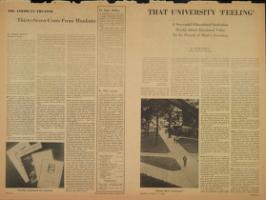
Liberals call it "community"
Scanned image of the page. Keyboard directions: use + to zoom in, - to zoom out, arrow keys to pan inside the viewer.
August 27, 1963 (vol. 9, iss. 0) - Image 58
- Resource type:
- Text
- Publication:
- The Michigan Daily, 1963-08-27
- Note:
- This is a tabloid page
Disclaimer: Computer generated plain text may have errors. Read more about this.