

r n
t. anc [archbank. iew Brown
Texa ,in 1899
Th majority of th
thin ,
ction, r c1 th t
r th uniform of
n to w ar th
of th t
nit
Ld
Th ne r at color oldi r on th id walk nd bar him from
th ir ,1< n r ort, and pla of amu m nt.
, hv, \ h n I wt down th r , on . iund .. y I th Ight I ould g
1 wn t Point I ab lla, on th Bay, to p nd the day. So in com
pan, with a young lady I w nt down to th d pot and purcha d
tw tick t. (t: kin advantr of th x ur . n r .. t th n off r d),
1 .. rd d th train (which w . only a littl tt r than walking),
\\' nt into th car and took a at. Wh n th train started, one of
th o-call d "Texas Rang r "cam up to me and told me I was 10
th wrong plac. aid co 0, I gu 5S not; I ju t r ad your law, and it
.. Y th egro and white po. ng r will n t ride in the arne
oa ·h pt on cur ion ." H r pli d, "D n't make any differ-
n ou tout .of here; Y u are too mart ny way; I will br ak
thi �'lm v r your h ad if you say much," the m antime menacing
m with .. si -sh ot r, of th mo t irnprov d villainou patt rn and
alih r.' 11 I ob v d hi rd becaus I wr alone and could
nth Ip my If. I knew that I was ing tr • t d wrong, hut h
h ld a "no al flush:' and I only had.a "four-card bob," and I knew
I uld not "bluff' him.
0101' d man who has the di position f 'a toad frog (I mean
n who an tand to b beat n in th back and puff up and take
it) is .. 11 right; he can tay in that country. But tho e who fe I hot
blood running through their veins, and who ar proudly and cred
itahly waring the uniform of a Unit d tates oldier, standing
r ady to protect and d fend the American Ila , against any enemy
whom v r, to obey the order of the Pre ident of the United
. tate and the orders of the officer appointed over them (which
th y h. v alway. don with prid and honor), cannot' stay down
th r in p a with honor. Th p ople d not want them either b _
call.' til)' wi11 prol ably not h ahl to • rry ut th ir favorite
port, hanging a olored man to a limb, or tarring and feath ring
him anrl hurning him, t th tak without trial, while the colored
solcli rs ar . tationed th reo
tt. Voi e, D ccmb r 1906, p. 549
o
'�_ •• I_' .--. __ .... __ ..
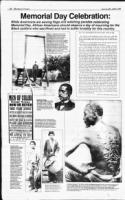
. THREE YEARS' SERVICE!
Hi an org
Wa hlngton Wllnam, Civil
W r veteran who enli ted In
the Black calvary in 1869,
quit when he was refused 8
promotion to officer' ran
on the grounds that the Army
would not appoint Blacks a
officer.
This poster to encourage Blacks to
join the Union Army, promised hopes
never realized in or out of the military .
By implication, Northern Black had
to prove that free ociety. engend red
greater character in the BI ck race
than did the the institution of lavery.
Sill\( J Til nnr'll UF nu .11'"
...................... _-- __ .....
VALOR IDJIEROISM
PORT HUDSON AND M1LLIKElfS BEND.
-- - -C:---�-.�-- _ 6_:":-_- ... -..._..
ARE FREEMEN LESS BRAVE THAN SLAV
:=-= �::..��:.:-_.:::::==::::.:..- - -:::... -=- ":.7"-::=.==-== ..
0111 t'ST OrrOiITl '1Tl' II \S (Uft :
. .. .. - .. _-_ . .--._------.-_.-
EN OF COLOR. BROTIItIlS 1ND FATHERS I
WE APPEAL TO YOU!
- 7 .. _·::'".·· .-----
Approxim tely
144,000 of the 178,000
Black who erved in
the Un·on Army
during the Civil war
came from.the lave
tate. For mo t,
e peci Ily ex- lave ,
ervice in the Union
r nk wa a gre t
opportunity to prove
that Black merited
full citizenship. In the
ey of Blacks and
white, the Union
u form elevated th
tatus of the e
freedmen from chattel
to man. For young
man named Jack on,
the transformation
w triking. The first
picture is Jackson as
a lav, working as a
erv nt in the
Cont derate Army.
The econd
photograph i
Drummer Jack on of
the United State
Colored Troops.
(MOLlUS- .achuset1s
Collection, U.S. Army
Military HI.tory In.tltute).
Pictures reprinted from Forg din
B ttle: The Civil War Alliance of
Black SoldIers and White Officer by
Jo eph T. GI t1h r. Publl h d by
The Free Prf" s, division of
Macmillan, Inc., W York. 1 90
Assi tant Surg on T. W. Mercer of the 47th M achu ett Infantry ent thi photogr ph of
a former Mi • ippi lave named Gordon with me ag to a colonel: -I have found a
large number of the 400 contraband examined by me to be badly lacerated as the
specimen repre ented in til enclose photograph. - According to other descriptions in th
USCT, uch evid nce of brutality s not uncommon. (MOlLUS-M sa�hu ett Collection, U.S.
Army Military History In tltut .)
I
in