

alcolm int rvi w from 1 5 i
P rt n w coIl tion from Pathfind r
hint rvi w low w giv n by
Mal 1m X to a corr pondent for the
J h nn burg und y pr . It i
t k n form February 1 65: Th Fin I
'-JLI""""",h , a new boo publi hed by
Pathfind r.
Coil ted in thi volume r t
p eches and interviews from th
thr wee prior to Malcolm' sas-
ination on February 21, 1965.
During this short period, he addressed
audiences in Selma, Alabama; several
erne in Britain; Paris; Detroit;
R ch ter, w Yor ; and New York
City.
From city to city, in each of the
meetings Malcolm stressed the need
to view the struggle of Blacks in the
United States as an integral part of the
"global rebellion of the oppressed
against the oppressor, the exploitation
. against the exploiter."
Along these lines, he explained
why the liberation struggles in the
Congo, Vietnam, and elsewhere were
of key importance for fighters for
Black rights in the United States and
other countries.
MUCH OF THE MATERIAL
published in the new collection has
been unavailable for more than two
and a half decades; some of it appears
in print for the first time.
This is the first of several new
books by Pathfinder that will print, in
chronological order, Malcolm's
major speeches. Since 1965, when it
published Malcolm X Speaks, Path
finder has been the central publisher
of Malcolm's works.
The interview with the Johannes
burg Sunday Express was conducted
in London, February 12, 1965, by cor
respondent Alan Scholefield. It has
remained virtually unknown for more
than 27 years.
At the time the interview was
given, the apartheid regime was inten
sifying its attack on democratic rights
in, South Africa.
THE ANC ITSELF, and other or
ganizations opposed to the regime,
bad been banned in 960 in the wake.
of protests against the police massacre
of scores of demonstrators at Shar
peville.
February 1965: The Final Speeches
is copyrighted 1992 by Pathfinder
Press.
Question: How far would your
movement take violence. in the strug
gle going on in places like South
Africa and Angola?
Answer: All the way. As far as the
South African situation is concerned,
I don't give the Black credit in any
way, shape, or form for restraining
themselves or confining themselves
to ground .rules that limit their scope
of activity against their threatened
society. I believe that the .only solu
tion to the South African problem is
the same solution that was u ed in
Algeria or the onethat is being used
right now in Vietnam.(1)
Q: What would be your comment,
then, on someone like the Nobel
Peace Prize winner, Chief Albert
Luthuli?(2)
A: He is just another Martin Luther
King who i used to keep the op
pre ed people in check and keep
them from u ing bona fide methods to
pr duce bona fide results. I think the
real I ader in South Africa are
Sobuke and Mandela.(3) They are in
tun with th tim . don't
with ny ntiwhit ling bee
don't h v ny ntiwhit
antiwhit a bl nket ndem
Q: ill your 0 ani1JJtio
frican r voltuianarie ?
: Oh, y , w beli ve th t it i on
truggl in South Afric , Angol ,
ozambique, nd Al b m. They
are all th me truggle.
Q: Have your been ivin eitar
moral or phy ·cal aid to African
r volutionarie ?
: I'd rather not an wer that.
Q: Have you met many frican
exiles-South Africans and 0111 rs?
A: Yes. I've done a lot of traveling
in Africa. When I was in the Blae
Muslim movement Elijah Muham
mad-the leader-would not let me
travel. Not even to the American
South. Last summer I traveled to
Tanzania, Egypt, Kuwait, Lebanon,
the Sudan, Ethiopia, Kenya, Nigeria,
Ghana, Guinea, Liberia, and Algeria.
To me the South African exile is
too complacent. He's sad about his
condition but not mad. Now in Kenya
the Kikuyu got angry and their anger
is what produced the action that got
them independenc .4) When the
Black in South Africa reaches the
same stage of anger, then the situation
in South Africa will be resolved. I
don't think economic factor will inter
vene.
Q: What are your co� ",s on
the spread ofracism in Britain?
A: People will begin to realize that
racism is not something you can con
fine to anyone country. Especially
with the power and influence which
America has. She is dictating today
to almost to the entire world through
propoganda media. American racism
is a cancer spreading all over the
world and it is having its effects on
Britain.
Q: You think that America is more
to. blame than a country like South
Africa?
A: Formerly Black people looked
on South Africa as just about the worst
country in the world. But I think
today that many Africans are begin
ning to see that America and South
Africa are not so different. The only
difference being that South Africa
preaches and practices segregation
whereas America preaches integra
tion and practices segregation.
South Africa is a as. onest with
its racism. America IS Just as racist
whereas it is dishonest with it. South
African racism is so open that people
are on guard against it. Like when a
person has a cold and you don't want
to catch it, you make yourself immune
to it when you happen to be around
him. But now when you get a person
who has a cold and hides the fact,
you're more likel y to catch it from that
person than someone who has an open
cold. And American racism is so hid
den, so subtle, so hypocritical-she
spreads her racism wherever she goes.
Q: You talk of subtle racism.
Would you care to comment on the
fact that almost nothing is ever heard
of the A ustralian aborigine?
A: Because the aboriginal
Australian isn't even permitted tQ get
into a position where he can make his
voice heard in any way, shape, or
form. But I don't think that situation
will be too quiet too much longer.
Q: Do you mean that your or
ganizatonn proposes to Jake in
people like the aborigines as well?
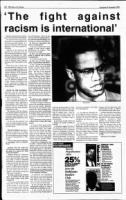
A: Just as racism has become an
international thing, the fight against it
/
MALCOLM X
is also becoming international. Those
who were the victims of it and were
kept apart from each other are begin
ning to compare notes. They are
beginning to find that it doesn't stem
from their own country alone. It is
international. We intend to fight it
internationally.
Q: If violence is used, is there not
a danger of racism working in
reverse?
A: [Malcolm laughs] You know I
was surprised in Africa, since it was
an area which had been so completely
coveted by Europeans, at the mini
mum of anti-European feeling. If
there is any anti-European feeling it is
directed at individuals-it's not a col
lective feeling. I was quite shocked.
I think the Africans basically will
never be anti-anything. I don't think Congress of South Africa from 1952
it's in their make-up. until his death in 1967. In 1960 he
was awarded the Nobel Peace Prize.
(1). An eight-year liberation war (3). Robert Sobukwe was president
led by Algeria's National Liberation of the Pan-Africanist Congress
front forced the French government to (PAC), established in 1959 by forces
withdraw its troops in 1962 and that split from the African National
recognize the country's inde- Congress. Arrested in 1960,
pendence. · Sobukwe was imprisoned on Roben
At the time this interview was Island unti11969. He died in 197�.
given, the U.S. government was (4). The Kikuyu-one of the
beginning to escalate its military in- peoples in the British colony of
tervention in Vietnam. By the end or Kenya-provided many of the
July 1965, there were 75,000 U.S. fighters who carried out actions
troops in Vietnam, rising to 540,000 during the 1950s that were part of the
by 1968. South Vietnam was struggle that led to the independence
liberated in 1978. in 1963.
(2). Albert Luthuli, an elected Zulu Reprinted from The Militant.
chief in the Groutville area, was presi-
dent-general of the African National
New from
PATHFINDER
Special
Prepublication
Offer
%
DIIICOUIIF RJD:==-_
,..".,.AIW
�IIUII"C""
Join the
. Pathfinder
Readers
Club
Po, II $10 IIIIIIIMIl fee )'OU am
tIIh IJdv.".e of sp«UIl
. offers lih this lind get II 1596
discount on QU other
Pathfinder rid�. AWJiLlble
from yollt' loaJl Prlthfinder
bookstore listed on page 12 or
write Po,thfinder, 410 West
St. New York, NY 10014.
.., X
spe«lta from tilt .t
thr« web of MlIIcolm
X� life, pmmri,., the
explosm n<Olutiora of Iris
politiaJI views. A l4tp
ptII't is rPIIIIer'UIl previously
IIIItIWIiWJIe, with some ira
prjrrt for tilt first time.
$17.95
(.,.w off ... $JJ.JO)
YANY_ANI.
C R
''' I00I.
..---------- spe«lta tnId,., the
ewn<iora of MIIb,,"�
views ora politiall
1Illi4rtca. i�
womm� riglrts,
Cllpitlliism IftI socUJlism,
I11III 'PnOfY. $15.95
(.,.w off ... $Jl.IIO)
9fferends
December 15, 1992.