

i De
ti tution I nd
g nt of
for un pul r vi
Zundel..' • pu Ii h d
P mphl t yi ng the
Holo u t w n over-
bl n myth perpetrated by
worldwid Jewi h con
pi y.
Trl I for King b
Ing del yed
L G L - Ac-
quitted on crimin I charge
from th Rodn y King ,
the four offi ers ' federal
trial ha been moved to
September 29 to give
defen e attorney more
time to prepare.
An attorney for on of
the officers told U.S. Di -
trict Court Judge John
Davies that he would file a
motion asking him to rule
that his client could not get
a fair trial anywhere in the
United Stat .
Asked by th judge if he
would be pre enting
evidence to back hi claim,
Harland Braun, attorney for
Theodore Bri eno, aid he
might conduct a survey to
prove his point.
The four officers' ac
quittal on the criminal char
ges in April spawned
chaotic community reac
tions that left 51 people
dead and cau ed an e -
1 n in
�-Il=--·-re in-
dicted by rand
1 ry this civil
violations in the beating of
King.
,
.
t , w mon ix pe e
nomin ted Dr. Fulani.
Five hundr d people from 5
t t th red t th mid-M nh ttan
Omni P r Council Hot 1 for th
convention, hich fe tured pan 1
on ind pend nt politi that in luded
John At . nson, a Perot campaign
wor er from Oklahoma, Dr. John
H gelin, th pre idential candidate
of atural Law Party, orm Segal,
the Libertarian P rty' candidate for
the U.S. nat ,fromNewYor .and
Ro lyn Allen, the orthern tate'
chair of th California Peace and
Freedom Party.
Dr. Fred Newm n, campaign
manager for the Fulani campaign,
introduced th paneli ts to th New
Alliance Party.
"W PROUDLY left of
center. We are equally proud that we
are not orne dogmatic party charac
teristic and typical of the American
left. We will work with all people of
good pirit, with all people of intel
ligence and decency, to build om -
thing which will make a difference
to all the people of this country."
Q: Where is this drought tllking
place? TM ten nations of Southern
Africa, Angola, BotswafUl, Lesotho,
Malawi, Mozambique, Namibia,
South Africa, SwaziUlnd, ZambiD,
and Zimbabwe, are in the midst of
the worst drought to hit the region
in this century.
The United Nations estimates that
1S-million people are directly at risk
of starvation or severe malnutrition.
Furthermore. over 100-million
people will be affected by the loss of
crop, livestock, and employment.
International relief efforts, including
transport upport have prevented a
di aster. so far. However. the
region' estimated food need have
not been met. The Shortage of water
supplies are literally forcing the
evacuation of entire cities.
Moreover. the effects of the drought
'will continue at least until April,
1993, assuming the rains come in
November.
Q: What are the circumstances
surrounding this drought? Ina
region where cyclical droughts are
a fact of life (they occur in varying
degrees about every ten years), this
one is quite unusual. The growing
season in this part of the world is
from October to April/May. Rains
typically fall from mid-October
through March. This year, unlike
the pattern of most droughts, the
rains fell abundantly in November
and December. This prompted
people to plant extensively and a
bumper crop was predicted for the
region. Suddenly, however, the
rains stopped in January, well
before the crops could reach
maturity. Very liltle has turned out
to be salvageable, with crop failure
approaching 70% in countries liIu
ZambiD and Zimbabwe. Even South
Africa, which has always been a
food exporter, experienced an over
aU 60% crop failure and will have
to import massive amounts of food
for its own consumption.
Q: What has been the effect of
South African destabili:l.Jllion? For
over a decade, South Africa has
violently resisted the attempts at
peacefu! change by people in
outhern Africa. Direct military at
tacks on Zambia, Zimbabwe, An
gola, Botswana, Lesotho,
MOVlmbique, and Swa1.iland were
combined with South Africa's
mililllry support to antigovernment
rebels in several countrie . In
•
WORLD/NATION
" D WH T A fringe party
looks like - that' us. Because
the rest of America com to know
us better, millions of Americans will
see something they can identify with
very strongly - that's being at the
fringe.
At the fringe of political power.
At the fringe of economic prosperity.
In fact, the majority of the American
people are at the fringe. That is why
I believe that one day soon the New
Alliance Party, America's fringe
party, will be a majority party in the
United States of America."
Later, the Reverend Al Sharpton,
a candidate for the U.S. Senate, and
Dr. Georges Nzongola-Ntalaja, a
leader of the democracy movement
in Zaire (soon to be renamed the
Congo) delivered keynote add res es.
The convention reelected Dr.
Fulani a the party' chair, and
elected a new national committee.
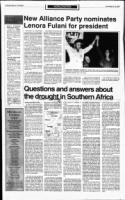
Independent Presidential candidate Dr. Lenora Fulani and her running mate Elizabeth Munoz
received the nomination of the New Alliance Party at the New Alliance Party National Nominating
Convention recently. (photo: Bob Geor< ) •
Also during the convention, par
ticipants marched to the New York
campaign headquarters of Bill Clin
ton and George Bush to prote t the
bipartisan failure to "End AIDS
Now!"
and
I
M ozambique and A ngola, those
rebel forces were most devastating,
but South A/rica made simiUlr at
tempts to create anti-government
rebel groups in Zimbabwe and
ZambiD.
The regional grouping of inde
pendent southern African countries
(Southern Africa Development
Coordination Conference -
SADCC) e timates the cos ts of des
tabilization at S60 billion since the
mid-I97Os. The e losses exceed by
at least 20 time all U.S. foreign aid
to the region over the past decade.
These monetary estimates represent
actual los es to infrastructure and
transportaion, to social service
faci li ties and other direct war
damage. They also include the
higher costs of transportation. in
surance and security. They include
the expenses of building up and
maintaining security forces by each
government. The 10 S or diversion of
resources from industry, manufac
turing, agriculture are included.
However, the human co ts - over
1.5 million killed, millions of others
wounded or forced to flee their
homes and livelihoods, the
p ychologicat impact to children or
phaned by the war and all children
caught up in South Africa's wars
are not as readily calculated.
Q: How does this drought differ
from those Africa has faced in tile
eighties? Imagine if no rain fell
west of the Mississippi all year. A
drought of uch a magnitude is rare
for the world, let alone Africa. The
UN estimates that IS-miUion p.eople
are at direct risk of dying because of
the drought. Additionally, over 100·
million, virtuaUy the population of
the entire region, willfeel the effects
.� ,�,II "11'1'1 1'111 .... '1- '11',1 �, "t ,,' Jill ". '.oJ ' • I. ., ,.
of the drought in 0;'00;;" 0;" cks c;;;1bk� equ'�bl�d;;t,.u,',;t.·· s��(d··��ti�·r;o���ber �r later. � ..
anothtr. ing food aid. Moreover, all tb« one-time SBO-million appropriation
In the mid-eighties, the Hom of countries of the region, except for OFDA will help insure the
Africa was afflicted by drought in South Africa, are linktd economi- transportation network will hold
Ethiopia, Somalia, and the Sudan. cally by the Southern African togetller and the warehouses will be
Overall, about 10-million people Development Coordinating Con- built to store the food. '
suffered du�ng that period. This ference or.SA�C. SADCC, which Q. What can be dOM to reduc«
southern �can drought will hurt has been III exist�nce for over ten the impact of futru« drough/s?
over ten times as many people. years, was esf!lbltshed as a trade Some of the money for droughl
and .dev�lopment bloc to lessen the relief is being used to dig wells aNI
regl.on s dependence o,! South build dams. However, as m'lI.
Afr&c� and to. help budd each tiontd above, the region wiD alwa,s
other s economies. . be prontd to droughts. However,
�s,a result of SADCC, the certain policies of the U.s. govem-
region s governments are used to ment the World Bank, and the III-
worki�g t?gethe� a�d �i11 be able to ter�tiofUll Monetllry Fund (IMP)
coord.m�te the distribution of nearly have made this drought worst aNI
ll-nulhon tons of food. The S50- will continue to do so unless
�il1ion apPfOOP.riation request will changed.
aid SADCC I� Its work. At a recent Most of the countries in the
Senate he�r.Ing. on. the drought, region are under IMF Sturctural Ad-
USAID offIclal� indicated th.at �hey justment Programs (SAP) which
�ere pleased With how t�e distribu- force the elimination of price sup-
tton prog�m was pr�ceedm� and ex - ports for food products and make
pected It to continue With few commercially grown food almost
problems. unaffordable for the average family.
Q: What are the transportation These SAP's force the raising of ex
requirements of the region? Tradi- portable crops such as com (maize)
tionally, most of the region 's which are not very drought-resistant.
agriculture is subsistence farming. People �hus planted a crop which
This means that people raise was very weather-sensitive in the
,nough food for their own needs name of the SAP. Furthermore,
and consume it on the spot. Little countries are discouraged from
transponation is required. How- maintaining stockpiles in the case of
ever, with no foOd available to sub. I drought. A bitter irony of the current
slstence farmers, it must all be' situation is that Zimbabwe, the
'brought in from outside. Accord. country hardest-hit by the drought,
ingly, the region's transportation was forced by the IMF to sell off its
network wiU be required to handle surplus just a few weeks before the
four times the volume of trains and drought was declared.
trucksthan u normatly does.Asius, For a year now, Zimbabwe's
the region is heavily dependant on policies have been under the direc-
raillines emanating in South Africa tion of an IMF Structural Adjust-
which connect with the port cities of ment Program. Subsidies on basic
Capt Town, Port Elizabeth, and foods have been reduced substanuat.
Durban. While there are port ly, so that food price stripled. Sub-
facilities in tM MOVlmbique cities sidles on public transportation also
of Maputo and Beira, they are VlrY were cut and price of gas ro e. RUral
limited �nd the rail network to people frequently buy some food
which· they art linlud is unrelilible from towns with savings set aside for
du« to the continuedfighting in that periodic crop failures. However, the
country. Thus th« region will rely price of food and transport has effec-
primarily on South Africa's tively doubled the co t of food to
transportaion infrastructure to un- rural consumers. The e price rises
load food and move it northward. come on the top of increases in
UnfortufUltely, South Africa will be school and health ervice fee -al 0
d�voting two of its three ports to it linked to the tructual adjustment
own needs, putting an enormous program-whichfurtherdepletethe
strain on the region's transpoeta- ability of people to meet their needs.
lion systems. In effect, the structual adjustment
Moreover, as the food arriv , it programs have weakened household
is being warehoused. Bear in mind and community economies, in-
that even if there are good rains in ere ed the vulnerability of low in-
1992-93, people will not be able to come group to the food hortages
harve t that food until April, 1993. as ociated with the drought, and
Thus to balance the transportation rai ed the likelihood of widespread
load in the region, food m t be hunger and deprivation aero the
tored now which might not be con- region.
Q: How is the us. Congress
responding? The U.S. has tllken a
, leading role in providing drought
relief. The ouse has provided
funding in the 1993 Appropriations
bill for aiding drought victims
which the Senate Appropriations
Foreign Operations Subcommittee
is expected to consider in Septem
ber. Specifically, the legislation
would: '
1) Retain the SBO-million one
time appropriation earmarked for
drought relief, as established by the
House for the Office of U.S. Foreign
Disaster Assistance (OFDA) to
direct these funds toward the
Southern Africa Development Coor
dinating Conference (SADCC),
church organizations, and other
NqnGovernmental Organizations
for miscellaneous costs associated
with the transportation and storage
of food supplies.
2) Maintain funding for the
OFDA at S69-million and keep the
borrowing authority of the OFDA at
S50-million in order to allow some
of the infrastructure-rebuilding
needs to be met.
3) Maintain the funding level for
SADCC at S50-million.
4) Maintain funding for Title II
PL 480 at S810-million which
enables the U.S. to respond to food
Shortage emergencies around the
world, either natural or manmade.
The first three measures have
been approved by the House. The
Ti tie II appropriation is under the
jurisdiction of the Senate Appropria
tions Agriculture, Rural Develop
ment, and Related Agencies
Subcommittee which has recom
meded a funding level of S810-mil
lion.
Q: What assurances do �·t have
that aid will be distributed fairly?
Actually, plenty. For the fir t time
in years, the region is relatively at
peace. Only in Mozambique is there
a large cale civil conflict betwten
the government and RENAMO
rebels. In most countrit ther« M'
functioning, democratic stat,s
which have the governIMntGl agen·
, .. ,
,I t:,. it