

e civil Plftllb!
ntto�!lS1S
obiliz c
d pent II
t tee
nyoft iden h d
n poorly educ t d in the
tate' re ted nd poor-
ly funded public educa ·0
y tem d ere in-
timidated by t e lmo un
limit d po r th t ite
peopl h d over their live .
n the te here Emm tt
Till h d be n lynched, nor
mo courage a required
to ttempt to reg ter to
vote.
Succ 0 in
S CC, the Cong of Ra·
ci I Eq ty (CORE), and
other grou orked
dill ntly d pa ently to
gain th conftdence of Black
r idents and then to till
in th e residen the nee •
ry confidence to lead their
o n truggl for equal
rights and political po ere
the folio in ,
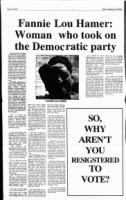
Mr . Fa ni Lo am r
de cribes the experience
that suddenly. and unexpec
tedly brought her into the
· issippi movement and
subsequently tran formed
her into a conftdent and ef
fective leader.
From: To Praise Our
Bridges: An Autobiography
of Mrs. Fanny Lou Hamer
(Jackson: KIP CO, 1967),
pages 5-17. Used by permis
sion of Arybie Rose, Fannie
Lou Hamer Living Memorial
Charitable Trust Fund, and
the Hamer famil y.
I was born 'October sixth,
nineteen and seventeen in
Montgomery County, Missis
sippi. My parents moved to
Sunflower County when I was
two years old, to a plantation
about four and a half miles
from here, Mr. E. W.
Brandon 's plantation.
... My parents were
sharecroppers and they had a
big family. Twenty children.
Fourteen boys and six girls.
I'm the twentieth child. All
of us worked in the fields, of
course, but we never get any
thing out of sharecropping ...
My' life has been almost
like my mother's was, be
cause I married a man who
sharecropped. We didn't
have it easy and the only way
we could ever make it through
the winter was because Pap
had a little juke joint and we
made liquo
That was the only way we
made it. I married in 1944
'and stayed on the plantation
until 1962 when I went down
to the courthouse in Indianola
to register to vote. That hap
pened because I went to a
mass meeting one night.
U ntil then I'd never heard
of no mas meeting and I
didn't know that a Negro
could register and vote. Bob
'Moses, Reggie Robinson, Jim
Bevel and James Forman
were some of the SNCC
workers who ran that meet
ing. VVhen they asked for
those to raise their hands
who'd go down to the court
house next day, I raised mine.
Had it up as high a I could get
it. I guess if I'd had any sense
I'd a-been a little scared, but
what was the point of being
scared. The only thing they
could do to me was kill me
and it seemed like they'd been
trying to do that a little bit at
a time ever since I could
remember.
Well, there was eighteen of
us who went down to the
courthouse that day and all of
us w ... re arrested. Police said
the bus was painted the wrong
color-said it was too yellow.
After I got bailed out went
back to the, plantation where
Pap and I had lived for
eighteen years. My oldest
girl met me and told me that
Mr. Marlow, the plantation
owner, was mad and raising
sand.
He had heard that I tried to
register. That night he called
on us and said, "We're not
going to have this in Missis
sippi and you will have to
withdraw. I am looking for
your answer, yea or nay?" I
just looked. He said "I will
give you until tomorrow
'morning. And if you don't
withdraw you will have to
leave. If you do go withdraw,
it's only how I feel, you might
still have to leave." So I left
that same night. Pap had to
stay on till work on the plan
tation was through. Ten days
later they fired into Mrs.
Tucker's house where I was
staying, They also shot two
girls at Mr. Sissel's
That was a rough winter. I
hadn't a chance to do any can
ning before I got kicked off,
so didn't have hardly any
thing. I always can more than
stay on till wor on the plan
tation was through. Ten days
later they fired into Mrs.
Tucker's house where I was
staying. They also shot two
girls at Mr. Sissel's
That was a rough winter. ,I
hadn't a chance to do any can
ning before I got kicked off,
so didn't have hardly any
thing. I always can more than
my family can use 'cause
there's always people who
don't have enough. That
winter was bad, though. Pap
couldn't get a job nowhere
, 'cause everybody knew he
was my husband. We made it
on through, though, and since
then I just been trying to work
and get our people organized.
, I reckon the most horrible
experience I've had was in
June of 1963. I was arrested
along with several others in
Winona, Mississippi. That's
in Montgomery County, the
. county where I was born. I
was carried to a cell and lock
ed up with Euvester Simpson.
I began to hear the sound of
licks, and I could hear people
screaming ...
After than, the State High
way patrolmen came and car
ried me out of the cell into
another cell where there were
two Negro prisoners. .The
patrolman gave the first
Negro a long blackjack that
was heavy. It was loaded
with something and they had
me lay down on the bunk with.
my face down, and I was beat.
I was beat by the first Negro
till he gave out. Then the
patrolman ordered the other
man to take the blackjack and
he began to beat ...
. . .. After I got out of jail, half
dead, I found out that Medgar
Evers had been shot down in
his own yard.
I've wor ed on voter Atlanta City. But we I mCd
registration here ever ince I the hard way that even tough
went to th t first m meet-· we had all th law and 1 the
ing. In 1964 we regi t red righteousn on our i
63,000 BI c P opl from that white man i not going to
Missis ippi into the Freedom give up his power to us.
Democratic Party. We
formed our own party because
the whites wouldn't even let
us register. We decided to
challenge the white Mi sis
sippi Democratic Party at the
National Convention.
We followed all the laws
that the white people themsel
ves made. We tried to attend
the precinct meetings and
they locked the doors on u or
moved the meetings and
that's against the laws they
made for their ownselves. So
'we werethe ones that held the
real precinct meetings. At all
these meetings across the
state we elected our repre
sentatives to go to the Nation
al Democratic Convention in
We have to build our own
power. We have to win every
single-political office we can,
where we have a majority of
Blac, people ...
The question for Blac'
people is not, when is the
white man going to give us
our rights, or when is he going
to give us good education for
our children, or when is he
going to give us jobs-if the
white man gives you any
thing-ju t remember when
he gets ready he will take it
right back. We have to take
for ourselves.
_0,
,
?