

5
Opinion' Comrnentarv.Editonats Letters
•
I
.e fig
The last decade has it
nessed an omino resurgence
of racism in America.
The climate created by
Reagan, Reaganomic and
Reaganism shaped a fertile en
vironment for the r face of in
dividual and' institutional
r cism to resurface with ugly
and painful consequences.
In the final analysis,
h ver, I have contended that
the most recent upsurge in overt
r cism is merely symptomatic of
deep seated maladies in
American culture, and the
character of America's
economic and politi institu
tions. As we contemplate the
struggle to end racism, must
be careful to avoid simply strik �
ing out at the symptoms. The '
fight against racism must eradi- ,
cate the basic underpinnings of
thi anti-human and infectious
disease.in our society. -
African-Americans as the
principal object, target and vic
tims of racism must, out of a
necessity to survive, lead the
. struggle to overcome racism. To
lead the fight against r cism ef
fectively African-Americans
must have a ubi-dimensional
approach designed to combat
and overcome the various
cau of racism. .
First and foremo t our sur
vival and development requires
that we constantly seek to
counteract the de tating im
pact of racism and cultural ag
gression on our own people .'
African-Americans cannot ac
cept or yield to the notion of our
inferiority to other races, ethnic
groups or nationalities. .
Blacks' self-hatred is one of
the most devastating. effects of
centuries of racist oppression,
and cultural aggression. Self
hatred is engendered and per
petuated by a culture and
educational system that stilllar
gely glorifies the history and
culture of Europe, and white
America while minimizing or
denying the culture and history
of Africa and Africans in
A'merica. As African
Americans we. have a respon
sibility to- teach ourselves about
ourselves and to promote an
ideo ogy of r cialsolidarity and
racial development. Given the
history' arid legacy of racism in
America, African-Americans
must be ever vigilant against
racism and unapologetic about
the necessity' and responsibility
to protect and promote our in
terests.
Racism in America however
is not a' African-American
problem. Racism is an
American problem. It is rooted
in the culture and the institu
tions of this nation, and the fight
against racism must aim to do
no less than erase it from
America's culture, it in titu-'
tions nd the American charac
ter.
African-Americans there
fore mu be in the forefront of
the struggle for African
American studies at all levels
within the educational system as
a critical and indispensible
component of a multi-racial,
multi-cultural, multi-national
and multi-lingual educational
process in America.
African-Americans should
not tolerate the perpetuation of
an educational process hich is
Euro-centric, white oriented
and ignores the contribution to
America and the world of
African , Native-Americans,
Latinoes, Arabs, Asians aDd
other people of color.
America must come to terms
with the need to relate to the
majority of the peoples of the
world. In that context the con
cept of "English only" is irration
al and totally unacceptable. It is
,like a national death wish for a '
minority in the world to see to
impose its cultures and lan
guages on the majority of the
world. African-Americans must
fight for an America which ap
preciate and respects the rich
diversity of oples and culture
in America d the world. A
crucial place to begin is by in
stituting a multi-racial, multi
cultural, multi-national and
multi-lingual educational
process in this nation.
Of equal importance is the
understanding that the struggle
again racism is everybody's
fight. It is not exclusively a
African-American respon
sibility. Hence African
Americans must seek to unite
all people - Black, white,
brown, yellow and red who are
willing to step forward to. resist
racism. Though the culture and
institutions 0 America make it
virtually impossible for most
white people not to, function
with some prejudices and racist
attitudes, we must not make the
mistake of di counting tho e
white Americans who are con
sciously struggling to rid them
selves and America of the
dise e of racism.
Our strategy and tactics
therefore must not tr at white
people as if they are monolithic.
Both in principle and as a prac
tical matter it makes sense for
white Americans to confront
other white Americans as we
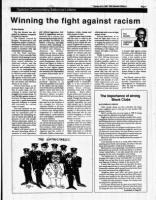
'THE UNTOUCIIABLES.'.
•
racrs
collecti seek to win the fight
��tracism.
African-Americans, as we
lead th fight, must create an
environment hieb is conducive
to forging the greatest possible
combination of forces com
mitted to ending racism without
sacrificing or own dignity, self- _
respect and right to self-deter- A decisive fight against racism
mination. ther fore, must ultimately seek
Finally, it would seem to fol- to transform America and
low that African-Americans create a new society; a' new
must unite and lead the society based on respect for ra-
broadest possible coalition of cial and cultural pluralism,
forces willing to challenge and human priorities and the prin-
ideology and system which ciples of genuine political and
fosters and tolerates racism, ra- economic democracy; a society
cial oppression, and whose where the exploitation of
power elite (the rich and the human beings by other human
super-rich) has historically u ed beings is unacceptabl .
racism as a tool to divide, con
quer and exploit working
people and people of color
when .opportune and con-�
venient. The American system\
breeds racism and economic ex
ploitation at home and abroad.
VANTAGE.'
POINT
Ron Daniels serves as Presi- -
dent of the Institute for Com
munity Organization and
Development in Youngstown,
Ohio. He may be contacted at
(216) 746-5747.
8yFWD
Older people always say they remember the times
when neighbors used to look .2ut for one another with
geniune concern.
Well I say that time can start again in 1989 if strong
block clubs are allowed'to develop in Detroit.
RigHt now, the street on which my mother lives, an ex
isting block club has carried out the two top items on their
hard-hitting itineraries which include painting house ad
dresses on curbs and making sure everyone has a decora
tive lamp post in their yards.
Their agenda does not include forceful means of tear
ing down a vacant house which has caught fife and serves
as a haven for crack addicts. Nor does it hint at tactics to
stop the everyday threat of drug dealers transforming one
of our houses into a violence-riddened crack house.
Moreover, the lock has totally missed the purpose of
a true block club.
I can hone tly say th t a young child I didn't care
anything about block club meetings, but what I did care
about and remember vividly is the socialization.
Bloc parties were happenings. I was thrilled to attend
block p ties OD my block, 0 the next bloc or on blocks
I ne r visited before. I not only enjoyed the music and
dancing, but the entire atmosphere was inviting.
The togetherness the neighbors displayed made mere
strangers feel right at home. NotJcably this "era of good
feeling" was not just that, it never passed, and the kind-
n lingered on failing to change as the seasons did.
It wasn't like these clubs were one big click, the mem
bers simply ew the key to a succe fuJ block club -- good �
mmunity relations which spread down the block; down
the street and around the neighborhood.
Neighbors knew each other and cared about one
another's well being. Sure everyone had thei differences,
but they were pushed to the side when even the smallest
problem threatened the sacredne of the club or street.
I realize the only constant is change, but change must
be shaped into a positive form .
. I'm 23 years old and part of a generation which I have
termed the "Pepsi Generation: because individuals (and
. I'm using this term very loosely) in my age range tend to
Continued on 22
The importance of strong
Bloc Clubs