

MAY 2 • 2024 | 41
cise, in the offices where three physicians
completed assessment forms. Two plus signs
would doom the “useless eater.
”
Nothing better expresses for me the
moral distance Germany has traveled since
those dark days than the association of a
school devoted to children, once deemed
expendable by the Nazi state, with markers
acknowledging the fate of Jews who had
been viewed as similarly superfluous. “We
feel a responsibility for these stones,
” the
school’s director had said, and the partici-
pation of his students exhibited the depth of
that commitment. Those children, a teacher
told me, had raised vegetables in a nearby
garden allotment and secured the sunflow-
ers and other blooms by exchanging pro-
duce for the more delicate offerings.
Although Dieter had said a few words
early on, he remained mostly in the back-
ground until the ceremony neared its end.
With a nod to his violinist, he led the group
in the song he had mentioned at the café:
“Sag mir, vo die Blumen sind.
” A few bars
were enough to purge any thoughts of
Marlene Dietrich in a top hat. They were
singing Pete Seeger’s “Where Have All the
Flowers Gone?” On a trip filled with
coincidences, happenstance and unex-
pected connections, the great chanteuse
had provided yet another. During a tour
of Israel in the early 1960s Dietrich per-
formed the German version of Seeger’s
song to much acclaim. She was the first
singer allowed to perform there in the
language of Wagner and Hitler.
To hear the haunting refrain “wann
wire man je verstehen” (“when will
they ever learn”) rising up from
Mendelssohnstrae — by that partic-
ular group of singers, at that particular
moment, in that particular setting —
helped me to better appreciate Dieter
Sander’s inspired compassion. This
indeed is how it should be done, I
thought, as the crowd offered itself some
well-deserved applause.
MODERN-DAY HORRORS
Just over a year later I received an
email from Dieter, with the subject line
“Rachel Horowicz Mendelssohnstr”
and an ominous brief note: “Maybe
you remember Rachel. You met her in
Mendelssohnstrasse. What a horrible
story, what a horrible war!” At the bot-
tom was a link to an Instagram video. I
clicked, immediately recognized Rachel’s
face, and girded myself for the worst. I
clicked again — then she started speaking to
the camera.
Rachel said she was from Kibutz Kfar Aza,
near the border with Gaza. When Hamas
terrorists entered her home on the morning
of Oct. 7, her daughter, who had also attend-
ed the stolpersteine ceremony, had had the
presence of mind to alert her mother to be
quiet. Along with the daughter’s boyfriend,
they huddled in their shelter, covered in
blankets.
Rachel then noted that she had overseen
security for the kibbutz and that from under
a blanket she continued to send and receive
messages. “I was just focusing on trying to
save people,
” she says in a weary voice. “Just
focusing on what to do in the best way.
” She
admitted they were lucky that the terrorists
had not invaded their shelter, though she
could not say for how long they waited for
rescue. Eventually, the IDF came.
More than 50 from her community were
murdered and 17 taken hostage. In the zone
for young couples and families, the losses
were especially horrific. “One child had had
his whole body burned,
” recalled ZAKA vol-
unteer Simcha Greineman, “but there was
a knife stuck in his head from side to side.
”
In another burned-out house, Greineman
described finding five dead members of a
family “standing in a circle, hugging each
other.
”
The members of Kfar Aza had often
employed Palestinians from Gaza and driv-
en others to medical appointments in Israel.
Some of them are believed to have passed on
details about the kibbutz to Hamas.
Rachel says in the video that she had
received help. A neighbor of her sister Orna
gave the family a house to live in, instilling
a sense of hope that “we can still stay as a
union, as a nation together,
” that maybe
“something good will come out of it.
” Her
spirit is indeed inspiring, as is her embrace
of the hope, the hatikvah of Israel’s national
anthem.
But as November turned to December, I
found myself showing a clip from Claude
Lanzmann’s Shoah to students in a course on
the Holocaust. Filip Müller, one of the few
Sonderkommando at Auschwitz to survive,
recounts witnessing in Crematorium II the
gassing of several thousand from the Czech
family camp in March 1944: “
And sudden-
ly I heard, like a choir … singing spread
through the undressing room … And then
it became clear they were singing the Czech
national anthem and … the ‘Hatikvah.
”’
The hope I felt for the future
on that September day in 2022 at
Mendelssohnstrae now feels far away. The
children of the Helene-Haeusler-Schule may
have sung waren wire man je verstechen, but
the words now seem too innocent, beyond
reach. And watching Rachel’s testimony con-
firms for me that, even after eight decades,
the Holocaust remains not so long ago, not
so far away.
Her mother Charlotte (Lotti) had survived
by being hidden with a Catholic family in a
small Belgian village. Lotti’s mother, Gitla,
had survived Auschwitz. Yet in the third
decade of the 21st century, Gitla’s grand-
daughter and great-granddaughter were
hiding in their home, awaiting murderers
looking for the next Jew.
Robert Franciosi is associate professor of English and
Honors at Grand Valley State University. He is editor of
Good Morning: A Holocaust Memoir.
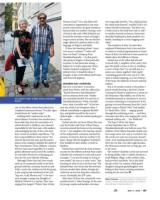
The author’s wife, Jo Ellyn Clarey, and Dieter
Sander.