

40 | MAY 2 • 2024
where I saw a gathering of over 50 people,
the group mostly comprised of young stu-
dents and their teachers.
I made my way into the crowd, gratified
that it was indeed a crowd, though disap-
pointment wafted over me as I recalled the
pro forma installation for the Goldsteins
a few days earlier. This was exactly how it
should have been done.
From my wife’s place close to the front,
I could see Dieter, speaking with several
women who had traveled from Israel for
the event. Their stolpersteine had been laid
in March 2021, without ceremony during
the COVID-19 pandemic. This day, the
Horowicz descendants were animated and
visibly pleased to honor their relatives, one
of whom, their uncle Manfred, had been a
focus of Dieter’s research. He and the Israeli
relatives had driven to Lieberose the day
before, the site of the forced labor camp
where Manfred had perished.
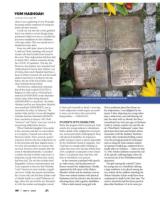
The Horowicz stolpersteine indicated
that all four had escaped (FLUCHT) to
Belgium in 1938, and in 1944 had been
interned (INTERNIERT) at the Mechelen
transit camp, before being deported
(DEPORTIERT) to Auschwitz. The father
Abraham and his son Menachem Manfred
were murdered (ERMORDET), one in
Auschwitz; the other, at Lieberose. The
mother Gitla and her 14-year-old daughter
Charlotte had been liberated (BEFREIT)
from Auschwitz in January 1945. Both
“interniert” and “befreit” were new words in
my growing stolpersteine lexicon.
When Charlotte’s daughter Orna spoke
at the ceremony and later in conversation
at a reception, I learned more about the
Horowicz family. There seemed a perfect
symmetry between the four stolpersteine set
in the pavement and their aligned stories —
two men who perished, two women who
survived. However, three months after the
event at Mendelssohnstrae, I consulted
a website devoted to Berlin stolpersteine to
determine exactly when these four stones
had been laid. The site also includes brief
biographies of those commemorated, and
I was surprised to discover that Charlotte
“Lotti” Horowicz’s stone includes a signifi-
cant error. Unlike her parents and brother,
the 14-year-old Lotti had been hidden with
a Catholic family in a small Wallonian vil-
lage, where she survived the war. Reunited
in 1945, the mother and daughter moved
to Paris and eventually to Israel. Correcting
Lotti’s stolperstein would require yet anoth-
er term, one for those who survived by
being hidden — VERSTECKT.
STUDENTS WITH DISABILITIES
Before the program itself commenced, I had
noted a few young students in wheelchairs.
Berlin, despite other enlightened social poli-
cies, seems particularly challenging for those
with physical disabilities. Its impressive
public transport system is almost impossible
for the wheelchair-bound to negotiate. And
I had been in enough public buildings to
realize that many were decades behind their
ADA-compliant counterparts in the United
States. I was pleased, then, that these chil-
dren in wheelchairs were present.
As the ceremony continued with speech-
es, violin music, and the placement of
flowers around four stolpersteine, I finally
registered the full nature of the Helene-
Haeusler-Schule and the students it serves.
There were indeed students with physical
limitations; but the school is also devoted to
educating those with cognitive disabilities.
When a dark-haired young girl with
Down syndrome placed her flower on
the stolpersteine, I was delighted by her
jaunty T-shirt, depicting two young riders
atop a white horse, one with flaming red
hair, the other with icy blonde. But then I
remembered my visit years ago to Hartheim
Castle in Austria, outside Linz and the site
of a Third Reich “euthanasia” center. Nazi
physicians there had used bottled carbon
monoxide to kill the disabled. Hartheim
and the other medicalized killing centers
were the proving grounds for techniques
such as using the truck exhaust, instead
of expensive bottled gas, employed first to
deadly effect at Chelmno — where on May
15, 1942, Frieda Goldstein reached the end
of the specific suffering begun when she
was forced out of her Fehrbellinerstrae
apartment.
The girl wearing the colorful T-shirt;
the young man in a wheelchair offering
a large sunflower to be placed among the
rest; indeed, all the children attending the
Helene-Haeusler-Schule would have been
condemned to death by the Nazi state. The
road to Auschwitz had first been paved at
places like Hartheim. Or to be more pre-
YOM HASHOAH
continued from page 39
Stolpersteine commemorating the Horowicz family of Mendelssohnstrae