

36 | DECEMBER 28 • 2023
J
N
W
hen COVID hit
in early 2020,
many businesses
were thrown into turmoil.
But for the Rochester Center
for Behavioral Medicine
(RCBM), the pandemic offered
new accessibilities to provide
much-needed help to more and
more people.
Under the direction of Jaime
Saal, who was then chief oper-
ating officer and who has since
been promoted to chief execu-
tive officer, the practice quickly
pivoted to an almost-entirely
online model. As a result, the
clinic nearly doubled the num-
ber of patients it serves.
RCBM was started in 1993 by
psychiatrist Joel Young, M.D.,
who continues to serve as medi-
cal director. The clinic describes
itself as a leader in the diagno-
sis and treatment of attention
deficit-hyperactivity disorder
(ADHD) and learning disabili-
ties, as well as depression, bipo-
lar disorder, and other mood
and anxiety disorders, work-re-
lated concerns, family and mar-
ital issues, and substance abuse
and eating disorders.
Its more than 100 employees
includes 47 therapists, with
28 of the psychiatrists, nurse
practitioners and physician
assistants able to prescribe med-
ication.
Young, of Bloomfield Hills, is
a member of Temple Israel, as
is Saal.
Saal joined RCBM 20 years
ago as a clinical therapist. She
grew up in Southfield and grad-
uated from Groves High School,
then attended the University
of Michigan, where she earned
a B.A. in psychology, and the
Indiana University School of
Education for a master’s of arts
in counseling.
She also holds certifications
in executive healthcare lead-
ership and healthcare change
management from Cornell
University Online.
When Saal started at the
clinic, few mental health
practices followed the multi-
disciplinary model for which
RCBM has become known.
Young brought various provid-
ers under one roof including
nurse practitioners, physician
assistants and a registered
dietitian — a practice not very
common in the 1990s.
GOING DIGITAL
At the start of the COVID pan-
demic, the RCBM profession-
als were concerned about what
would happen if they couldn’t
see their clients in person. At
the time, said Saal, the staff had
been recording their sessions on
paper. Only a few people in the
practice used Zoom, including
one based out of state (but who
held a Michigan license). Few
of their patients even knew of
Zoom.
The staff delved into research
about telehealth platforms and
methods for making the forms
they needed accessible electron-
ically.
Saal set up a command center
in her West Bloomfield home,
where she lives with her hus-
band, Matt Pulliam, and her
sons, Alec, now 11, and Jake,
now 7, working around the
boys’ virtual school sessions.
The clinic shut down for a
few days — and then the staff
simply started seeing their
patients via Zoom and tracking
activity on their computers
using an electronic medical
records system.
“Within two weeks, we were
set up with protocols that
worked for us,
” said Saal.
The transition was difficult
for everyone, but the alternative
— that their patients wouldn’t
get the mental health care they
needed — was simply unaccept-
able, she said.
Many of the staff were initial-
ly overwhelmed, but once they
started using the remote system,
they loved it. “Their fear of
change was quickly overcome,
”
said Saal.
Some staff members have
returned to the office, but no
one works completely on-site.
Most prefer to work from home
because of the flexibility it gives
them. Working remotely also
minimizes personal safety con-
cerns.
Some parents prefer in-per-
son counseling for their young
children because it gives the
children a chance to talk to the
therapist without the parent
being present. But remote coun-
seling works well for adoles-
cents, Saal said.
The staff found that remote
counseling broke down a lot
of barriers and brought in new
clients who lived in areas where
mental health services were not
readily available.
Cancellations used to be
fairly frequent, Saal said. With
the new system, patients don’t
have to worry about travel time
or bad weather. Their appoint-
Pivoting to
Telehealth
Grows a
Practice
Mental and behavioral health care
delivered digitally.
BARBARA LEWIS CONTRIBUTING WRITER
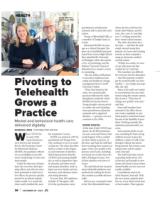
Jaime Saal and
Joel Young, M.D.
HEALTH