

52 | JULY 20 • 2023
ALL OPPENHEIMER — WITH
ALMOST ALL THE JEWISH
‘PLAYERS!’
Oppenheimer, which opens
in theaters on July 21, is a
$100 million budget, big-cast
film about physicist J. Robert
Oppenheimer (1904-67).
He was the head of the
Manhattan Project, the code-
name given to the successful
American program to develop
an atomic weapon during
WWII. Oppenheimer was not
the most brilliant theoretical
physicist, but he was “very
good.” He had the scientific
knowledge and administrative
skills to make the bomb a
reality.
The film was directed and
written by Christopher Nolan,
51, who is best known for mak-
ing some of the best Batman
films. The film’s screenplay
was based on a Pulitzer
Prize-winning historical study,
American Prometheus: The
Triumph and Tragedy of J.
Robert Oppenheimer (2005).
It was written by the late
Martin J. Sherwin and Kai Bird
(Years ago, Bird told me he
isn’t Jewish, but his daughter
was raised in his wife’s Jewish
faith.)
Here is the “arc” of
Oppenheimer’s life in super
short form: He was born and
raised in Manhattan. His father
was a German Jew who came
to the States and did very well
in the textile business. His
parents were non-observant.
Robert, a “weird smarty,” was
bullied in school, but did very
well in his studies. Eventually,
he realized his forte was
theoretical physics. He was
teaching at the University of
California, Berkeley, when
WWII broke out.
In 1939, Albert Einstein
(played by Tom Conti in the
film) sent a letter to President
Roosevelt, telling him that the
Nazis might be working on an
atomic weapon. This letter got
the Manhattan Project rolling.
Army General Leslie Groves
was tasked with finding an
American-born physicist to
lead the Project. Groves’ sur-
prise pick was Oppenheimer.
Groves (Matt Damon) saw tal-
ents that many others did not,
like Oppenheimer’s ability to
explain difficult subjects and
get the best out of others.
After the bomb was
dropped (1945) and the war
ended, newspapers were full
of accounts of the making of
the bomb. Oppenheimer’s role
was made public, and he was
lionized in much of the media.
In 1947, he became the head
of the Institute for Advanced
Study at Princeton University.
Einstein was an Institute pro-
fessor from the time he fled
Germany to America (1933)
until he died in 1955.
The third “act” in
Oppenheimer’s life reached
its pinnacle when he was
informed, in 1953, that the gov-
ernment would move to have
his security clearance taken
away. More on that below.
I reviewed the background
of the first 20 “real” persons
in the film’s credits and the
background of the actors who
played them. I won’t get into,
here, the “Jew-Face” issue
(non-Jews playing Jews). I will
address that next week.
Twelve of the 20 were
physicists. With the exception
of Einstein, all worked on the
Manhattan Project. Its striking
that nine out of the 12 “top”
physicists were Jewish and
three were refugees. An aster-
isk notes they were Nobel
Prize winners. Here are the 12:
Einstein*; Oppenheimer (Cillian
Murphy); Niels Bohr*, Danish
refugee. His mother was
Jewish (Kenneth Branagh);
Edward Teller, Hungarian
Jew — not a refugee (Benny
Safdie); Frank Oppenheimer,
Robert’s brother (Dylan
Arnold. His mother is Jewish);
Hans Bethe*, German Jewish
refugee (Gustaf Skarsgaard);
Isidor Issac Rabi* (David
Krumholtz); Robert Serber
(Michael Angarano); Richard
Feynman* (Jack Quaid);
Kenneth Bainbridge (Josh
Peck), Ernest Lawrence* (Josh
Hartnett); and David L. Hall
(Rami Malek).
Three women are in the
“20.” Emily Blunt plays “Kitty”
Oppenheimer, Robert’s
non-Jewish wife; Florence
Pugh plays Jean Tatlock,
Robert’s non-Jewish former
fiancée; and Olivia Thirlby
(her mother is Jewish) plays
Lili Hornig, a top chemist. Her
parents were Czech Jews who
settled in Berlin in 1929. They
moved to America after Hitler’s
1933 takeover.
The remainder are people in
security or administrative posi-
tions, like Groves. Only one
was Jewish. The one is Lewis
Strauss (played by Robert
Downey Jr., who is 3/8 Jewish
and calls himself Jewish).
Strauss studied physics in
high school, and later, but his
family couldn’t afford to send
him to college. An eye injury
prevented him from serving
in WWI, so he volunteered to
help Herbert Hoover’s human-
itarian work. Through Hoover,
he got a post-war position
in a banking company, and
he became rich. Drafted in
WWII, he did great in admin-
istrative positions and ended
his service as an admiral. He
became religious and helped
Jewish refugees.
In 1953, he was made
head of the Atomic Energy
Commission. He pushed for
lifting Oppenheimer’s security
clearance based on several
things — mainly Communists
or ex-Communists in
Oppenheimer’s circle and
Oppenheimer’s opposition to
the creation of the hydrogen
bomb. Also, he was annoyed
by Robert’s almost indifference
to his Jewish background.
The 1954 hearing was a
farce. Evidence was gath-
ered through illegal wire
taps on Oppenheimer and
his attorneys. Ironically,
Oppenheimer didn’t need a
security clearance anymore.
Einstein told him so and when
Oppenheimer told him he
would go to the hearing —
Einstein called him a “nar”
(“fool” in Yiddish).
His clearance was pulled
and Oppenheimer, friends
said, was never the same per-
son.
CELEBRITY NEWS
NATE BLOOM COLUMNIST
ARTS&LIFE
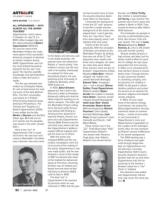
Albert Einstein
Niels Bohr
J. Robert Oppenheimer