

FEBRUARY 23 • 2023 | 55
barrels. A film clip shows a
busy street on the Lower East
side that’s lined with pushcart
vendors. In one scene, a
policeman intimidates a vendor
to get him to move his cart.
Eventually, these immigrants
opened their own restaurants,
serving the foods from their
homelands.
Joel Russ, original owner
of Russ and Daughters on the
Lower East Side, sold smoked
fish from a pushcart until he
opened his own shop in 1914.
The restaurant was passed
down from generations and is
still a popular Jewish culinary
takeout shop and restaurant
today.
During World War II, New
Yorkers sent American soldiers
Jewish deli food in the mail.
Delicatessens and kosher
butcher shops had heavily
promoted the idea of sending
hard salami to Jewish service
members during the war. The
slogan “Send a Salami to Your
Boy in the Army” was originally
developed by Sixth Avenue
Delicatessen waiter Louis
Schwartz but was used by other
delis including Katz’s — which
proudly displays the slogan to
this day. A reproduction sign
of that ad can be seen at the
exhibit. There’s also a letter on
display from a soldier stationed
in Italy writing to his fiancee
about the salami his mom sent
him.
After the war, Holocaust
survivors and refugees relocated
to the United States, and
delis were a lifeline as they
acclimated to a new country.
The establishments provided a
livelihood and purpose for the
immigrants.
In the heyday of the deli,
many establishments became
icons and tourist attractions. At
one point, there were thousands
of Jewish delis in New York.
Celebrities frequented these
Jewish eateries and sky-high
sandwiches were even named
after them. The famed Reuben’s
Restaurant offered a Frank
Sinatra (cream cheese, tongue,
bar-le-duc, sweet pickle on
whole wheat) a Ray Bolger
(turkey, tomato and crisp
bacon) and a Judy Garland
(Nova and Swiss cheese),
among many more celebrity
tailor-made sandwiches. Their
1952 menu is on display.
Although Manhattan
MANUFACTURERS, 45 E. HOUSTON STREET, C. 1900/ PATRICIA D. KLINGENSTEIN LIBRARY, NEW-YORK HISTORICAL SOCIETY
Detroit Jewish
Delicatessen
History
According to Catherine
Cangany, executive
director of the Jewish
Historical Society of
Michigan, the first
Jewish deli in Detroit
was operational in 1904
by Charles Simons.
Simons lived above his
deli at 1507 Woodward
Ave. The following year,
Isadore Lichtenstein was
operating a deli at 319
Woodward Ave., before
going bankrupt in 1908.
There’s a record of a
deli opening in Grand
Rapids in 1905, and one
in Kalamazoo in 1909,
but the owners are not
known.
“The Detroit Yiddish
Directory lists one
unnamed delicatessen
in 1907 — probably
Lichtenstein’s. Lefkovsky’s
was a well-known Jewish
deli that first appears in
the 1909 city directory,”
reports Cangany, “along-
side Meyer Davis and
Nathan Brodder’s deli
at 514 Hastings St. The
well-known Boesky’s
Delicatessen was
operational by 1920.”
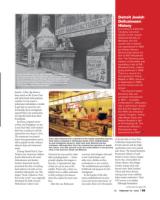
In the late 19th and early 20th centuries, the United States
experienced an influx of Ashkenazi Jewish immigrants
from Central and Eastern Europe. As they settled into their
new homeland, many of these immigrants began to sell
food in their communities, starting businesses that grew
into the restaurants we know today.
IMAGE PROFESSIONALS GMBH / ALAMY STOCK PHOTO
Some delis followed their customers to the rapidly expanding suburbs,
while others remained in historically Jewish urban neighborhoods
as new immigrants moved in, often from Latin America and the
Caribbean. Although New York City remained the epicenter of Jewish
deli culture, new delis opened across the United States in fast-growing
cities in the American South and Midwest.
continued on page 56