

DETROIT JEWISH NEWS
32255 Northwestern Hwy. Suite 205,
Farmington Hills, MI 48334
248-354-6060
thejewishnews.com
FEBRUARY 2 • 2023 | 7
The Court found in favor of
TWA. In so doing, it famously
provided the following gloss on
how far employers were required
to extend themselves when it
came to religious accommoda-
tions: “To require TWA to bear
more than a de minimis cost”
— that is, a trivial or minor cost
— “in order to give Hardison
Saturdays off is an undue hard-
ship.
” Thus, even if TWA could
have accommodated Hardison
by, for example, paying overtime
wages to another employee to
cover the Saturday shifts, it was
not required to do so. Such
“additional costs” would consti-
tute more than the “de minimis”
investment required by Title VII.
But a straightforward reading
of “undue hardship” certainly
seems to require that employers
exert more than the barest mini-
mum effort, leading any number
of critics to attack the court’s
analysis in Hardison. In requir-
ing so little of employers, detrac-
tors argue, it has left employees
seeking religious accommoda-
tions from federal law with lim-
ited legal protections.
For example, in rejecting
Groff’s claims for religious
accommodation, the federal
court of appeals noted that
everything from “negative
impacts on the employer’s opera-
tions” to even “reduced employee
morale” have served as sufficient
justification for not providing a
religious accommodation.
RELIGIOUS MINORITIES
Among the problems with this
prevailing standard is that those
left most exposed by the court’s
stingy interpretation of Title VII
have been religious minorities,
whose practices often don’t
track the prevailing rhythms
of the workplace. According
to one brief filed before the
Supreme Court in 2020, nearly
half of Title VII accommodation
appeals are filed by religious
minorities, even though those
minorities only account for 15%
of the population.
Unsurprisingly, American
Jews have been at the forefront
of attempts to enhance the
protections afforded religious
employees in the workplace, as
diluting employers’ obligation to
accommodate religious practices
in the workplace continues to
present a significant obstacle to
Shabbat observance.
Already back in 1977, a broad
coalition of Jewish organizations
filed amicus briefs before the
Supreme Court supporting the
plaintiff in Hardison, including
the National Jewish Commission
on Law and Public Affairs, the
Central Conference of American
Rabbis, the American Jewish
Committee and the Anti-
Defamation League, among
many others.
In subsequent decades, a
diverse range of Jewish orga-
nizations have supported the
Workplace Religious Freedom
Act, an ultimately unsuccessful
attempt since 1999 to expand the
religious accommodation pro-
tections afforded employees in
the workplace.
Even today, the idea that
employers need not expend
more than de minimis resources
and efforts to accommodate reli-
gious employees has generated
criticism from across the politi-
cal spectrum. It is one of the rare
church-state issues where one
can find at least some modicum
of agreement in Fox News and
Slate. It does, therefore, make
one wonder why the court orig-
inally chose this interpretive
route back in 1977.
Maybe the strongest expla-
nation for the court’s decision
comes from Justice Thurgood
Marshall’s dissenting opinion
in TWA v. Hardison. The lurk-
ing concern (one that Marshall
emphatically rejected) was that
recognizing a right in Title VII
to religious accommodation
granted too much protection,
and too much power, to religious
employees. That sort of power
granted to religious employees to
make demands on their employ-
ers might have consequences for
other employees and therefore
might trigger First Amendment
concerns over establishing reli-
gion.
But as Marshall noted
at the time, these concerns
seem wildly exaggerated. The
Supreme Court, on any number
of occasions, has upheld laws
accommodating religion so long
as they don’t privilege those
accommodations unequivocally
and unyieldingly over all other
interest. By contrast, the court
has been clear for some time
that “appropriately balanced”
accommodations don’t trigger
First Amendment concerns — a
conclusion that has been fur-
ther bolstered by more recent
decisions that have further min-
imized the demands of separa-
tion of church and state.
A NEW STANDARD?
Critics more recently have won-
dered what standard should
replace the existing standard.
Sure, we should require more
of employers, but how much
more? Some have worried that a
standard that grants employees
an unfettered right to religious
accommodations would gener-
ate its own parade of horribles,
such as a police officer’s refusal
to protect an abortion clinic or
a social worker’s demand to use
Bible readings, as opposed to
mental health counseling, to heal
prison inmates.
But, in other contexts, the
law has already found a pretty
successful middle ground. When
it comes to the accommoda-
tions required pursuant to the
Americans with Disabilities Act,
for example, undue hardship is
interpreted to mean “significant
difficulty or expense.
” As a result,
employers cannot satisfy their
obligation by merely asserting
that a requested accommodation
imposes a “de minimis” burden;
instead, they must extend them-
selves further in seeking to find
an accommodation for those
with disabilities, unless doing
so will actually generate costs or
difficulties that are significant.
This standard has proven
workable when it comes to
accommodations under the
ADA, providing good reason to
think it could work as well in the
context of religious accommoda-
tions in the workplace.
Time will tell as to which path
the court ultimately chooses.
For now, the court’s decision
to hear Groff v. DeJoy holds
out the hope of remedying
a longstanding wrong and
providing people of faith in the
workplace with more expanded
protections. Properly balanced,
these sorts of accommodations
will hopefully provide a middle
ground, ensuring that the cost of
entering the workforce need not
be the discarding of one’s faith
commitments.
Michael A. Helfand is an expert on
religious law and religious liberty. He is
the Brenden Mann Foundation Chair in
Law and Religion at Pepperdine Caruso
School of Law, Visiting Professor and
Oscar M. Ruebhausen Distinguished
Fellow at Yale Law School, and Senior
Fellow at the Shalom Hartman Institute.
Originally published on Forward.com.
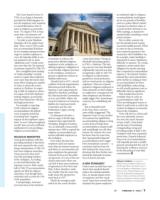
The U.S. Supreme
Court building in
Washington, D.C.