

14 | DECEMBER 23 • 2021
OUR COMMUNITY
pain and other symptoms, as well as spiritual needs.
Patients include both those receiving palliative and
hospice care. Palliative care patients may be severe-
ly ill with Parkinson’s disease, Alzheimer’s, MS,
cancer or heart disease. These patients may be in
a pre-hospice situation and bringing them into the
agency sooner through its LifeLinks program pro-
vides a more seamless transition when they become
hospice patients, Krakoff explains.
Rosenfield explains that the term hospice general-
ly refers to individuals whose life spans are expected
to be six months or less. Some patients don’t meet
the criteria for hospice or may not be emotionally
ready for it, and some patients improve enough to
move off of hospice care.
Regardless of their diagnosis, patients receive
individualized services, including spiritual guidance
appropriate for their personal beliefs, and social
work navigation to help with home health care,
insurance or medical issues.
“Our goal is to see patients every two weeks, but
it can be every day depending on their needs. We
are always asking what more we can do,” Krakoff
says. JHCN also helps educate caregivers with
an annual conference — the Caring Coalition
Conference.
For several years, JHCN has provided enrichment
programs — bringing music, art, salon services, pet
visits, tai chi and the opportunity to create legacy
books to patients. This program “changed the face
of the organization. It made us an organization
more about life and less about death,” Krakoff says.
With the exception of the COVID lockdown peri-
od, JHCN staff visit and help patients wherever they
are — at home, in assisted living facilities, a nursing
home or hospital. During the COVID lockdown,
virtual visits and Zoom meetings were used to con-
nect patients, families, staff and volunteers to main-
tain vital support and connections.
“We reached out more, including providing an
opportunity for out-of-town family members to join
in end-of-life prayers online,” Rosenfield says.
NO-FEE MODEL
From its inception, Freedman chose not to bill gov-
ernment agencies, insurance plans, other hospices
or patients for JHCN services. “We had a wonderful
staff, and if you create goodwill, it will come back to
you,” he says.
Freedman’s funding model of reliance on philan-
thropy has continued. Krakoff says that it relies on
the “kindness and philanthropy of this Jewish com-
munity.” He says that about 30 percent of patients
Rabbi Davey Rosen of Ann Arbor, Natalie Rosenfield of Walled Lake,
Rabbi Joseph “Joey” Krakoff of West Bloomfield, Rabbi E.B. “Bunny” Freedman
of Oak Park, Rabbi Rachel Lawson Shere of West Bloomfield and
Rabbi Shalom Freedman of Oak Park.
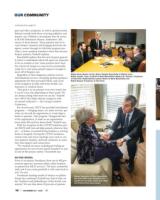
Gladys Sampson of West Bloomfield
sits with Rabbi Joey Krakoff in her
apartment and talks about their past
and friends they have known.
continued from page 13