

DECEMBER 23 • 2021 | 15
and their families contribute to Jewish
Hospice and the remainder of its bud-
get — just over $2 million annually — is
covered by other donors and founda-
tions, including the Jewish Fund.
Jewish Fund Executive Director Margo
Pernick says the Jewish Fund has pro-
vided more than $1.5 million in grants
over the years to Jewish Hospice and
Chaplaincy, mainly for programs and
capacity building. A recent grant will be
used for training rabbis.
Pernick says that Jewish Hospice
“aligned super well with the Jewish
Fund’s goal of focusing on the health
and welfare he Jewish community. The
organization is healthy and
well-run. They don’t charge
for services, which is not
typical, but they’ve been suc-
cessful.”
Krakoff is especially proud
that the Jewish Fund has
twice honored JHCN with
its Robert Sosnick Award
of Excellence, most recently
with its 2021 Award for its
LifeLinks and enrichment
programs. Jewish Hospice is the only
Jewish agency to receive this award
twice.
Pernick concurs with Krakoff’s
description of Jewish Hospice services —
that it’s about achieving the highest qual-
ity of life regardless of the stage a patient
is experiencing — not about dying.
UPCOMING TRANSITION
Now Jewish Hospice and Chaplaincy is
going through a transition and expan-
sion. This January, Freedman will retire
from his CEO position and serve as CEO
emeritus and senior advisor. Three other
JHCN rabbis — David Nelson, Avie
Shapiro and A. Irving Schipper — are
retiring as well.
Krakoff will become CEO of JHCN
and three new rabbis — Shalom
Freedman, Davey Rosen and Rachel
Shere, representing a range of
Jewish movements, will join
its staff. Freedman will help
train the new rabbis and focus
on building an endowment
for JHCN. In addition, he will
seek ways to spread the JHCN
model to other Jewish commu-
nities.
Shalom Freedman will focus
on operations, marketing and
development. Rosen will con-
centrate on education and outreach with
community members — expanding part-
nerships with synagogues, and temples,
clergy and Jewish communal organiza-
tions, and others.
Shere will be starting a bereavement
program, conducting several different
types of bereavement groups for
JHCN. She will also lead study sessions
focused on Jewish belief and practice
surrounding death and escorting the
soul.
Krakoff believes these changes —
dubbed the JHCN 2.0 Model — will
help ensure the organization’s successful
future for the next 20 years and beyond.
Techner, JHCN’s founding
president, who continues as a board
member, describes Jewish Hospice
as a “wonderful organization with an
amazing team.”
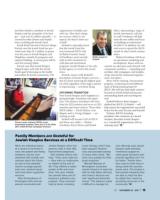
Rabbi Joseph H.
Krakoff
When an individual learns
of a severe or terminal ill-
ness, the patient and family
members may be over-
whelmed with anxiety and
sadness about the future,
as well as the potential
need to arrange special-
ized care, medical equip-
ment and other supportive
services.
Ellen Kirshenbaum of
Farmington Hills and her
parents connected with
Jewish Hospice when her
parents, both in their 90s,
had terminal diagnoses.
She needed advice and
help. “They came right out
— they were so responsive,
so helpful at the end of
life. They offered a better
quality of life and more
time,” she says. Initially
her parents were part of
Hospice’s palliative care
program. They received
help at home, including
music therapy, which they
both enjoyed. Pastoral
care was provided weekly
or every other week. “We
were very grateful for their
great response.”
Mitchell Bleznak of
Birmingham contacted
Jewish Hospice to help him
with his late father, Richard,
who lived in Arizona and
had “significant dementia
issues.” The distance made
it difficult to manage his
care. Bleznak says Jewish
Hospice staff provided
“emotional support to
make good decisions and
provide dignified care” for
his father. “Family mem-
bers want to think they’re
doing what their parents
would want. The beauty is
that (Jewish Hospice) they
are able to help the fam-
ily satisfy their needs by
providing resources in the
community.”
Family Members are Grateful for
Jewish Hospice Services at a Difficult Time
Carole Lasser enjoyed JHCN’s music
enrichment program. Here she is in the 2016-
2017 JHCN Annual Campaign brochure.
DECEMBER 23 • 2021 | 15
MONNI MUST