

10 | OCTOBER 14 • 2021
PURELY COMMENTARY
essay
My Travel to a ‘Forbidden’ Country
I
’m struggling to put into
words how upset I am that
as our Jewish professional
in Windsor you visited an
anti-Israel, antisemitic coun-
try,” a seasoned
community
member wrote
to me after hear-
ing that I had
recently visited
Lebanon.
Let’s back-
track: As a
Jew who previously lived in
Israel, I always told myself
that I would never put myself
in danger by visiting one of
Israel’s sworn enemies — that
is, until I visited the Islamic
Republic of Iran in 2018.
Having made it through Iran
in one piece, and in need of
another adrenaline rush after
a year and a half of COVID-19
monotony, I signed up for a
tour to Lebanon organized by
a company that specializes in
travel to unusual destinations.
It is illegal for Israeli and
Lebanese citizens to visit each
other’s countries, and arrivals
bearing any sign of having
visited Israel are sometimes
refused entry to Lebanon.
I held my breath as I went
through passport control in
Beirut, terrified that the bor-
der control officer would flag
and take me away for ques-
tioning.
As my fellow travelers
became acquainted with one
another, it turned out that
most of us had, in fact, pre-
viously visited Israel, which
in public we called in hushed
tones “the I word.” I was
astonished to discover that
one of my fellow travelers, an
unassuming 60-something-
year-old retired teacher, who I
will call “Sally,” was the former
president of her synagogue in
upstate New York.
Intrepid Sally mentioned to
me without a hint of irony that
she plans on signing up for
the company’s Syria tour next
year, and I saw on Facebook
that she has subsequently vis-
ited Iraqi Kurdistan. Except
for Sally, I was very careful not
to reveal my true identity and
profession.
HEZBOLLAH TERRITORY
Experiencing Hezbollah-
controlled territory in South
Lebanon, near the border
with Israel, took me back to
my travels in Iran. The towns
we drove through were alco-
hol-free; yellow Hezbollah
and black Shia flags flapped in
the wind; and posters of Iran’s
Ayatollah Khomeini adorned
the town squares.
Hezbollah is classified as a
foreign terrorist organization
by the U.S. and is believed
to have carried out the 1994
bombing of the AMIA Jewish
community building in
Buenos Aires, which I have
visited. Our tour of the move-
ment’s museum began with a
15-minute propaganda film
narrated by its leader, Hassan
Nasrallah. We were then guid-
ed by an English-speaking
Hezbollah member to various
artistic installations displaying
seized Israeli tanks entan-
gled in metal spiderwebs, an
artistic homage to Nasrallah’s
famous saying, “This Israel,
and I promise, is more fragile
than a spider’s web.”
The artist even constructed
the symbolic tombstone of
an Israeli soldier, titled “The
Invader’s Grave,” not far from
several rocket launchers that
targeted northern Israel.
While Sally complimented
my Oscar-worthy poker face,
she simply couldn’t help her-
self, and at the end of our
three-hour tour dedicated to
destroying Israel, asked our
now bewildered guide: “Do
you support a two-state solu-
tion?”
On our way back to Beirut,
we stopped to view Ein El
Hilweh, Lebanon’s largest
Palestinian refugee camp.
Like the other Palestinian
refugee camps in Lebanon, it
is guarded at the entrance by
the Lebanese army, who dare
not enter. Despite living in
the country for more than 70
years, the country’s Palestinian
refugees have still not been
granted Lebanese citizenship.
Our Christian guide
explained that Palestinians are
denied Lebanese citizenship as
per the wish of the late PLO
Chairman Yasser Arafat, who
believed that perpetual state-
lessness would preserve the
Palestinian struggle. In addi-
tion, the government wished
to preserve the demographics
of Lebanon’s Christian minori-
ty, who comprise 30% of the
population.
The same guide told our tour
group at the ancient city of
Byblos that he had previously
worked with Israelis in Turkey,
but that he could get into seri-
ous trouble with the authori-
ties if he stayed in touch with
them. He expressed a lifelong
dream to visit Jerusalem and
said that most Christians and
Sunni Lebanese want Lebanon
and Israel to make peace, but
that the Shiite population is the
main obstacle.
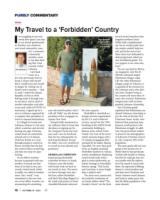
Dan Brotman
PHOTOS BY DAN BROTMAN
Dan Brotman
at Hezbollah’s
“museum”
in Lebanon