

S
en. Carl Levin’s Jewish
roots developed during
his Detroit childhood,
growing up in a home with par-
ents who were strong Zionists;
his mother was very active in
Hadassah. The family attended
Congregation Shaarey Zedek and
Carl went to Central High School,
which had a great number of
Jewish students.
“His most Jewish connection
was that he lived tikkun olam
every day of his life with every
bone of his body,
”
says Eugene Driker,
a prominent lawyer
and former chair
of the Board of
Governors at Wayne
State University.
Driker and his wife,
Elaine, became
friends with Sen. Levin and his
wife, Barbara, when the two fam-
ilies moved to Detroit’s Green
Acres neighborhood 56 years ago.
“Sen. Levin was a strong sup-
porter of Israel, but he had his own
ideas about what support for Israel
should look like,
” says Driker. “He
supported the Iran nuclear accord
and parted company with AIPAC
over its opposition.
”
Driker remembers that Sen.
Levin initiated an economic
development project between
Israelis and Arabs living in Gaza
and the West Bank. A small
group of businessmen, including
some Detroiters, met regularly to
build business connections across
borders. After the deadly violence
of the Second Intifada, however,
the project was shelved.
“It was indicative of his char-
acter to reach for the stars in
creative ways to create peace and
harmony,
” Driker says.
“Sen. Levin was always con-
cerned about the underdog and
always an advocate for under-
served populations,
” says Bob
Aronson, former CEO of the
Jewish Federation of Metropolitan
Detroit. “He was concerned about
social justice, which is a big part
of Jewish values.
”
Sen. Levin and his brother, for-
mer Rep. Sander Levin, were hon-
ored by the Jewish Theological
Seminary with its Eternal Light
Award in 2010 for their impact
on the Jewish community.
Sen. Levin was also very com-
mitted to Detroit. The Levins
were founding members of
Detroit’s Congregation T’
chiyah
— the first new Jewish congre-
gation in the city for many years
— when it was established more
than 40 years ago. A small group
of Jewish Detroiters had been
gathering for monthly Jewish
observances, says Judy Harris, a
Detroiter. Sen. Levin contacted
her about creating a more formal
organization.
“We had a committee that
developed guiding princi-
ples, and Carl Levin brought
a lot of insight into the pro-
cess. Many Reconstructionist
principles were brought into
T’chiyah, which affiliated with
the Reconstructionist move-
ment during the mid-1980s.
Reconstructionist Judaism is par-
ticipatory, inclusive and egalitar-
ian,” explains Harris, who served
as T’chiyah’s first president.
The congregation met initial-
ly on the third floor of the St.
Mary’s Church school building
in Greektown. When the first
two floors were unused, the
building was kept locked. Harris
remembers that Levin provided
a bell that was tied to a rope so
that congregants who wanted
entry could communicate that
they were outside to be let in.
T’
chiyah eventually split into
suburban and city congregations.
The Levins continued to attend
T’
chiyah after the congregation
moved to Oakland County,
but then shifted to the new
Reconstructionist Congregation
of Detroit, which remains in
the city. According to Matthew
Schenk, its president, the Levins
participated in some of the con-
gregation’s holiday services via
Zoom during the pandemic.
“Carl Levin was a natural
Jewish leader,
” Aronson says.
“He had that aura
and personality to
be a Jewish leader.
He commanded
respect. He was a
humble man who
had a calming influ-
ence with a sense of
humor and warmth.
He was incorruptible.
“He was always there for the
Jewish community. If Federation
asked him to do something, be on
a panel or speak, he would always
participate. I remember him
speaking after the 9-11 attacks. He
was an extraordinary man.
”
A Proud Jewish Detroiter
Focused on Tikkun Olam
Eugene
Driker
SHARI S. COHEN CONTRIBUTING WRITER
16 | AUGUST 12 • 2021
THE PEOPLE’S ADVOCATE
SEN. CARL LEVIN
“WE HONOR THE MEMORY OF SEN. CARL LEVIN, A BELOVED MEMBER OF OUR LOCAL
JEWISH COMMUNITY. THROUGHOUT HIS HISTORIC CAREER, SEN. LEVIN TIRELESSLY
ADVOCATED FOR THE WELL-BEING OF ALL MICHIGANDERS. A TRUE STATESMAN, SEN.
LEVIN WAS ALSO A GREAT FRIEND TO THE STATE OF ISRAEL. HE WILL BE REMEMBERED
FOR HIS INTEGRITY AND COMMITMENT TO BUILDING A BETTER SOCIETY.”
MATTHEW B. LESTER, PRESIDENT, JEWISH FEDERATION OF METROPOLITAN DETROIT
DENNIS S. BERNARD, PRESIDENT, UNITED JEWISH FOUNDATION
STEVEN INGBER, CEO, JEWISH FEDERATION OF METROPOLITAN DETROIT
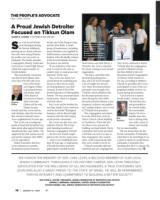
Bob
Aronson
Mary Freeman and Andy
Levin; Syma Echeandia,
then-president of
Congregation T’chiyah;
Sander Levin; and
Barbara and Carl Levin
at a benefit dinner for
the synagogue in 2013