

AUGUST 12 • 2021 | 15
G
rowing up in the
1930s and ’40s in
Detroit, Carl Levin
and his older brother and sis-
ter, Sander and Hannah, were
close with their
parents, Bess
and Saul, who
were part of an
iconic political
and Jewish
family. But the
inquisitive sib-
lings awaited
Sundays with relatives in the
family’s westside home, first on
LaSalle Boulevard and later on
Boston Boulevard.
It was during Sunday dinner
the siblings grasped the impor-
tance of current affairs and the
role of thoughtful debate as
the family typically gravitated
into a lively discussion inspired
by the national radio program
Drew Pearson Comments. It was
a time when parents encour-
aged their kids to try to make
the world a better place via the
then-noble calling of public
service.
Bess, active in Hadassah,
and Saul, a lawyer who served
on the Michigan Corrections
Commission, were Zionists
who imbued in their children a
love of Israel and Jewish life.
Family values rooted in
Jewish tradition motivated and
guided Carl and Sandy as they
went on to serve in govern-
ment with resourceful dignity
and a principled demeanor. In
Congress, the brothers were
drawn to the plight of Soviet
Jews. And they supported a
strong U.S.-Israel relationship
but didn’t back away from
questioning Israeli policy.
VOICE OF REASON
In mourning his death at
age 87, let us remember how
special a leader and a fighter
Carl was in the cauldron of
politics. En route to retiring
from the U.S. Senate in 2015
after serving 36 years, Carl
became an influential voice on
national security and interna-
tional diplomacy. He provided
a moral and ethical compass
for future generations of young
Jews who held a yearning to
serve with a similar style of
honor and humility.
Carl sought balance over
bluster — and compromise,
where possible, over partisan-
ship. He was savvy, civil and
articulate — and knew how to
listen. He exuded leadership at
every stage, from the Detroit
City Council to the U.S. Senate.
Never a flashy dresser or
in awe of his standing, Carl,
a proud Detroiter, connected
with ordinary Americans. They
appreciated his unswerving
commitment to the well-being
of the American people.
Carl cut his political spurs
serving as unofficial campaign
manager when Sandy won a
state Senate seat in 1964. Carl
won Detroit City Council
terms in 1969 and 1973.
The Harvard Law School
graduates joined Congress
within four years of one anoth-
er. Carl was elected to the
Senate in 1978. Sandy won his
House seat in 1982; he did not
seek reelection in 2018.
The Detroit Central High
graduates — Sandy was pres-
ident of his class and Carl
served as treasurer of his —
grew up sharing a room and
came to share a passion for
public service.
SCALING THE HILL
In a 2013 JN interview after
Carl announced he wasn’t
seeking Senate reelection, his
wife of six decades, Barbara,
kvelled over the “great integ-
rity, energy and intelligence”
he brought to Capitol Hill
every day on Michigan’s behalf.
Sandy described how Carl “has
been able to get into the shoes
of a lot of people and run on
their behalf.
”
And run Carl did.
Surely borne from those
Sunday dinner-table debates
while growing up in the
heart of pre-1950s Jewish
Detroit, Carl, a Democratic
liberal, understood the art
of respecting opposing opin-
ions when it was clear they
also mattered.
Robert Sklar was Editor of the
Detroit Jewish News from 1998
to 2011, thereafter serving as
Contributing Editor until 2020.
A ‘Moral and Ethical Compass’
continued on page 17
Robert Sklar
Former JN
Editor
ought to inspire the service of
new and returning senators.
”
Pulitzer-prize winning inves-
tigative journalist David Cay
Johnston has made a career of
skewering unethical politicians
and officeholders. But he recog-
nized that Levin was something
different.
“Carl Levin served as the de
facto conscience of the United
States Senate for 36 years,
” he
wrote in lines for the cover of
Sen. Levin’s book. “
As chairman
of the Permanent Subcommittee
on Investigations, Levin ferret-
ed out wrongdoing, abuses of
taxpayers and failed policies, its
reports all issued with biparti-
san agreement — a remarkable
feat of dignity, duty and moral
strength in our era.
”
Sen. Levin was not only
interested in national and
international issues; he was a
staunch defender of Detroit’s
auto industry. While he was
an environmentalist, he often
opposed imposing what he felt
were unreasonable fuel econ-
omy standards and worked to
have them not make domestic
cars less competitive.
He also fought against having
Japan take part in free trade
talks, arguing that its unfair
trade practices killed jobs in the
U.S.
Not surprisingly, he battled
hard to get the Senate to sup-
port the federal “bailout” of
Chrysler and General Motors in
2008-2009.
ISRAEL SUPPORT
Levin was, throughout his
career a strong, but by no
means uncritical, supporter of
Israel. He successfully worked
to have the United States and
Israel jointly develop missile
defense systems.
“It is almost unimaginable
to think of what would have
happened if hundreds of mis-
siles and rockets over the years
coming at Israel had not been
destroyed in flight before they
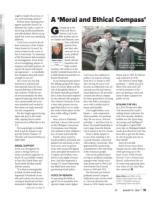
The Levin brothers, Sandy,
9, and Carl, 6, by the family
Pontiac in Detroit
COURTESY WSU PRESS