

12 | DECEMBER 31 • 2020
CORRIE COLF CONTRIBUTING WRITER
IN
THE
JEWS D
ON THE COVER
A
large brick building with caging
on the windows, metal detectors
and security guards greet guests
when they arrive at Osborn High School in
northeast Detroit. Rodents, garbage cans
and unusable bathrooms abound. There
aren’t enough desks, teachers or books.
Welcome to public school in Detroit.
“It really felt like I was going into a jail,
more so than school,
” Osborn grad Jamarria
Hill said.
Twenty-year-old Hill grew up in the city
of Detroit. He was just 15 years old when
attorney Mark Rosenbaum approached him,
his father and his other basketball team-
mates after one of their summer games.
Rosenbaum informed Hill and his father,
who was the athletic director
and basketball coach at Osborn,
about the opportunity to join
a lawsuit that would fight for a
better education and a constitu-
tional right to literacy.
“If the schools are bad and
torn down, then the neigh-
borhood is bad and torn down,
” Hill said.
“Then when there are schools being closed
and incarceration centers being built, and
then they’re looking at our test scores to pre-
dict, not just what job or career we will have,
but if we’re going to be in jail or dead.
“So, basically, it was like, how can we be
productive citizens to society without edu-
cation?”
Growing up, Hill attended charter schools.
Arriving at Osborn for high school was his
first experience with Detroit public schools.
“I took school for granted, as most
people do when they have a great school
foundation,
” Hill said. “My mom always
told me how bad Detroit public schools
were because she grew up in Detroit public
schools, but I never really understood what
she meant by it until I got into high school.
”
In 2016, Hill and six other students from
Detroit Public Schools Community District
(DPS) had had enough of these conditions.
They sued the state of Michigan and then-
Gov. Rick Snyder (later, Gov. Gretchen
Whitmer became the lead named defen-
dant), claiming they were not taught how to
read during their time in the low-perform-
ing schools of Detroit. Rosenbaum was their
lead attorney.
The case, also known as the “Right to
Read” lawsuit, argued that all children have
a constitutional right to literacy and to a
basic minimum education. The lawsuit went
on for four years and ended this June in a
landmark settlement.
And Rosenbaum, a Los Angeles-based
attorney who has spent decades spearhead-
ing big legal battles for civil rights, found
himself returning to Michigan — a state
where he completed his own undergraduate
education and taught law for decades — in
order to sue it. But he saw it as a fight worth
having.
“I don’t think there’s a more import-
ant fight in this country than the fight
to see that all kids have a fair education,
”
Rosenbaum said. “
As long as they don’t have
access to literacy, the nation isn’t a democra-
cy and isn’t true to its ideals.
”
A PATH TO SOCIAL JUSTICE
Rosenbaum didn’t always see himself as a
lawyer.
He was raised in Cincinnati as a Reform
Jew and attended Sunday school at the city’s
Hebrew Union College as a child. He com-
Mark
Rosenbaum
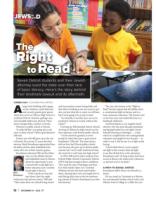
Seven Detroit students and their Jewish
attorney sued the state over their lack
of basic literacy. Here’s the story behind
their landmark lawsuit and its aftermath.
The
Right
to Read
ANTHONY LANZILOTE/BRIDGE MAGAZINE
DETROIT LITERACY GROUP