

DECEMBER 31 • 2020 | 13
pleted his undergraduate degree in pre-med
at the University of Michigan, but then made
a big change.
“My father had been forced to leave med-
ical school due to the Great Depression,
”
Rosenbaum said. “I was supposed to pick
up the mantle and become a doctor, but it
wasn’t my passion. I heard a radical lawyer
talk about what it meant to be a lawyer
during the ’60s, the rule of law and how to
represent activists for civil rights, and that
had a profound impact on me.
”
Instead of medical school, he attended
Harvard Law School. When Rosenbaum
arrived, he was “flabbergasted that every law
student wasn’t studying to become a civil
rights lawyer.
” He didn’t even realize that
there were other types of law. But he knew
that he was meant to fight for civil rights.
After graduating from Harvard,
Rosenbaum’s law career began by taking on
antiwar and Vietnam War cases, which took
him to Los Angeles. He worked for 40 years
with the ACLU in L.A., and for more than 20
years was also teaching at U-M’s law school.
Frequently commuting from L.A. to
Ann Arbor was a drain, but the nature of
Rosenbaum’s work allowed him to make
connections with the ACLU of Detroit.
Eventually, that would lead him to the “right
to read” lawsuit.
Although he says he’s drifted away from
the formal aspects of Judaism, he was always
aware of social justice and cultural traditions.
“I wouldn’t say my religious upbringing
formally had a huge impact on me, but I
was schooled and aware of Jews playing
an important role in advancing social jus-
tice. And that was life-changing for me,
”
Rosenbaum said.
He currently works for the pro-bono legal
firm Public Counsel, where he is directing
attorney for the firm’s Opportunity Under
Law project, which focuses on economic
injustice.
To Rosenbaum, returning to Michigan
was significant because “being in Michigan
was transformative for my life and made me
a better person. I was born in Cincinnati, but
my real home is Michigan.
”
A DIVE INTO THE LAWSUIT
Rosenbaum has been involved with many
educational equality cases, such as Williams
v. California, a lawsuit where he secured over
$1 billion for underserved schools to buy
textbooks, hire qualified teachers and pro-
vide safe and sanitary school facilities. But
nothing could have prepared him for what
he’
d find in Detroit.
Rosenbaum was informed by communi-
ty and teacher groups that he’
d previously
worked with about the obstacles that DPS
students had been facing. These firsthand
accounts of what was happening inside DPS
contributed to his decision to pursue this
case.
Some students did not have a teacher in
their classroom; temperatures in the schools
ranged from below freezing to 90 degrees
due to lack of proper heating/cooling equip-
ment; and some students and teachers had
even passed out because of the heat.
What Rosenbaum saw lined up with what
Hill experienced as a Detroit public schools’
student.
On a typical day in class, “we’re all watch-
ing a movie because there’s not a teacher
available to teach us,
” Hill said. “It’s sad
because it’s more so like a daycare than a
school and we’re learning at a third- and
fourth-grade level comprehension instead of
high school work.
”
It was evident to Rosenbaum that stu-
dents were not being given age-appropriate
instruction and were often graduating from
school without knowledge of even basic
reading.
In 2019, the National Assessment of
Educational Progress rated Detroit lowest in
average reading scores compared to 26 other
urban school districts. That year, only 6% of
students in Detroit public schools performed
at or above the NAEP’s “Proficient” level in
reading.
And if students don’t learn literacy in
school, they often never will. A 2011 report
found that 47% of adults in Detroit were
functionally illiterate.
“I never met a student who had a book
to take home. The books that they had in
a classroom were older than they were,
and most had been obtained by teachers
at garage sales or through donor websites,
”
Rosenbaum said, contrasting the conditions
at DPS with those of the school districts in
nearby, wealthier communities. “For any of
us to be aware of those sorts of injustices
while children in Bloomfield Hills and Ann
Arbor are on campuses that could double for
college campuses is not right.
”
Rosenbaum decided to take on the issue
and truly find the root of the problem.
He met with DPS teachers and had them
speak to some of the students and par-
ents about joining his lawsuit. He also had
reached out to organizations in the commu-
nity that worked with the same kids.
“I think the families wanted to make
sure that their children did better than they
did. I don’t think for those of us who are
privileged, that we really understand what
strength it takes to say, ‘I can’t read,
’ or ‘I can’t
do basic math,
’” Rosenbaum said.
“I had one young man that was a senior
continued on page 14
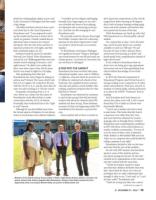
Members of the Detroit Literacy Group outside of Osborn High School: Andrea Jackson, counselor and
parent; Jamarria Hill, Osborn graduate; Mark Rosenbaum, director of the Public Counsel law firm’s
Opportunity Under Law project; Michael Kelley, law partner at Sidley Austin LLP.
DETROIT LITERACY GROUP
DETROIT LITERACY GROUP