

34 | OCTOBER 15 • 2020
D
akota Bread Company, a popular
West Bloomfield bakery known
for its challah, will reopen next
week under surprising new management.
Earlier this week, Friendship Circle, a local
Lubavitch-affiliated nonprofit focusing on
individuals with special needs, announced
the purchase of the bakery, which will be
used as a venue to create job opportunities
for adults with special needs.
The bakery will close temporarily Oct.
16-18 to transition into a kosher-certified
establishment. Reopening is scheduled for
Oct. 19, and a private ribbon-cutting cere-
mony will follow.
Friendship Circle plans to keep all 11
Dakota Bread employees. Within a month,
the training program should be up and
running. Once it is, existing staff will con-
tinue to bake during their regular shift,
with a second shift added for training. This
model will allow the bakery to keep up
with the high demand.
When Friendship Circle co-founders
Rabbi Levi and Bassie Shemtov began
sharing the news about the acquisition, the
response was almost always the same. After
the initial enthusiasm came the gentle, but
stern warning not to change the recipe.
For those concerned, the award-winning
challah recipe will remain exactly the same,
promises Bassie Shemtov.
“The most important thing you can do
for individuals with special needs is to
fill their day with purpose in a way that
includes them in the community, and
this bakery will do exactly that,
” said Levi
Shemtov. “It’
s exciting to be able to take
a brand like Dakota and say that we are
going to keep the challah recipe exactly
the same and give our young adults this
incredible opportunity.
”
The sale came about through what
Bassie Shemtov considers divine provi-
dence. After running Dakota Bread for
almost 21 years, owners Tom and Jennifer
Wilson were thinking about retirement. At
the same time, Ron Hodess, chair of the
Friendship Circle board of directors, gently
pushed the organization to start a bakery.
When the Wilsons bought Dakota
Bread, they hadn’
t even heard of challah.
They just knew it was a hugely popular
item at the bakery they were about to buy.
Although Dakota sells a variety of bread
and baked goods, challah is literally their
“bread and butter.
” Tom Wilson said they
sell between 2,500 and 3,000 loaves each
week, constituting approximately 75% of
their business.
This year between Rosh Hashanah and
Yom Kippur, they sold between 10,000 and
11,000 challahs, Wilson estimated. Before
Rosh Hashanah, it’
s not uncommon to
wait up to two hours to purchase a bread
— almost as long as some High Holiday
services.
Hodess credits his wife, Sue, with the
idea of opening a bakery. Their sons Jay,
27, and Andy, 24, successfully worked in
a bakery, which was one of two vocational
pilot programs started by Friendship Circle
approximately five years ago. The bakery,
along with an art program, was created to
fill a void in services for those aging out of
the organization’
s programming.
Based on the success of these models,
Friendship Circle opened the Soul Café, a
restaurant that trains and staffs individuals
with disabilities, and the Soul Studio, a
supported studio art program. However,
some participants in the bakery program
had a difficult time working in the café
because it required different skill sets.
Jay Hodess was one of the participants
who thrived in the bakery because mak-
ing challah is a straightforward process
involving repetitive steps. In contrast, the
restaurant environment was not a good fit
for him. Hodess anticipates both his sons
will work at Dakota Bread.
EVENTS PLANNED
Future plans for the bakery include hosting
community events such as challah baking
A New Twist
at Dakota Bread
Friendship Circle buys popular bakery,
considers weekly challah subscription service.
JENNIFER LOVY CONTRIBUTING WRITER
eats | drinks | sweets
Nosh
“We are going to keep
the challah recipe
exactly the same.”
— FRIENDSHIP CIRCLE’
S LEVI SHEMTOV
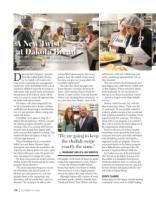
Bassie and
Rabbi Levi
Shemtov
COURTESY OF FRIENDSHIP CIRCLE