

36 | OCTOBER 1 • 2020
CUBA continued from page 35
Immigration Act of 1924 set
quotas on how many people
could come to the country from
Southern and Eastern Europe.
“My family was unwanted
here, so our American lives
began in Cuba,
” she said.
After Communist revolu-
tionary Castro seized power
in 1959, Behar said 94 percent
of the Jews in Cuba left. Until
her immediate family could
obtain American passports,
they spent a year in Israel living
on a Spanish-speaking kibbutz.
The family then immigrated
once more to join her maternal
grandparents in Queens, N.Y.
“I can actually remember
looking out [the] ship’
s window
and seeing the Statue of Liberty
when we arrived,
” Behar said.
There, they joined a sizeable
community of Jewish Cubans,
and Behar worked hard to learn
English. Still, she held onto her
love of Spanish, and eventually
pursued a career that allowed
her to engage with her passion
for language and diversity.
“
As a cultural anthropologist,
I have this intellectual passport
that not only allows but encour-
ages me to connect with the
places I write about,
” she said.
As part of her anthropologi-
cal research and writing, she has
lived and worked in Mexico and
Spain. She has also made many
return trips to her native Cuba.
“I do research there on the
Jewish community, art and liter-
ature, and try to reconnect with
the place I was born,
” she said.
HAVEN FROM THE HOLOCAUST
Now, Behar enjoys a home base
in Ann Arbor, where she teach-
es courses on Cuba and its dias-
pora and the concept of home
at the University of Michigan.
For herself, the concept of home
evokes feelings of gratitude. She
recognizes Cuba as the sanctu-
ary that saved her family from a
possible death in the Holocaust.
In Letters from Cuba, Behar
aims to repaint this picture of
the island as a center of wel-
come for many Jews. She said
when it comes to Jewish migra-
tion to Cuba, scholars focus
on the story of the SS St. Louis,
a German luxury ship that
carried more than 900 Jewish
refugees from Nazi Germany
in 1939. Only a handful were
allowed entry into Cuba upon
arrival. Behar believes this trag-
edy is out of character for the
diverse country.
“I wrote this book in contrast
to those stories,
” Behar said. “I
wanted to show that Cuba did
offer sanctuary to very many
Jews, that the majority, in fact,
did find refuge.
”
Behar also hopes the book
will fill a gap in children’
s learn-
ing, to deliver them the diverse
kind of anthropological material
she teaches to her students at
the University of Michigan.
“They’
ve read a lot of World
War II stories,
” Behar said.
“They’
ve read a lot of immi-
grant stories. But they don’
t
know the stories of Jews who
went to Cuba.
”
In sharing this history, she
believes the novel will teach
young readers to have compas-
sion toward other immigrant
children and hopefully make
her readers better citizens of the
world.
Perhaps most integral to
Behar’
s newest literary adven-
ture, however, is remembrance.
As remaining Holocaust sur-
vivors pass on, and as Behar
worries about what she sees as
a new climate of fascism, the
author wants to make links
between past and future trau-
mas.
“We have to do everything
we can to bring this histori-
cal memory into the present
so young people can see it in
relation to the contemporary
struggles occurring,
” she said.
“We have to be able to connect
all these things and understand
how past and present are always
in relation to one another.
”
LOTS OF PREMIERES
The new season of Saturday
Night Live begins Oct. 3. Five epi-
sodes will air this October. All will
be filmed, live, on stage, in front
of a small audience. The first
episode features a sketch about
the presidential election. Host Jim
Carrey will play former VP Joe
Biden. Of course, Alec Baldwin
will play President Trump. Maya
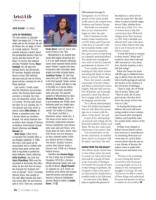
Rudolph, 48, will play Sen.
Kamala Harris, the Democratic
VP nominee. Rudolph portrayed
Harris in three SNL sketches
last year and just won an Emmy
(guest actress, comedy) for one of
those sketches.
Last month, I briefly noted
that the Showtime documentary
series The Comedy Store would
premiere in October. But, that
was not absolutely certain. Now,
it is certain: The five-part series
will start 10 p.m. Sunday, Oct. 4.
The director and main writer is
Detroit native Mike Binder, 62.
Binder, a sometime actor, was
a former stand-up comedian
himself. The series features nev-
er-before-seen footage of famous
comedians. Interviewees include
David Letterman and Howie
Mandel, 65.
Mitzi Shore (1930-2018)
co-founded The Comedy Store, a
Los Angeles nightclub, in 1968.
She had a truly great eye for
young talent and is credited with
giving many great comics their
start or big break (a partial list:
Robin Williams, David Letterman,
Andy Kaufman, Jay Leno and
Garry Shandling). Mitzi was the
real talent in the family. She effec-
tively ran the club from its incep-
tion because her husband and
club co-founder, “so/so” comedian
Sammy Shore, was usually on
the road. Mitzi became the club’
s
sole owner after she and Sammy
split in 1974. Their son, comedian
Pauly Shore, now 52, had a mini-
burst of fame in the ’
90s.
Monsterland is an original Hulu
series that begins streaming Oct.
2. It is an eight-episode anthology
series (each episode stands alone)
about “broken” people who have
encounters with mermaids, fallen
angels and other strange beasts.
Jonathan Tucker, 38, who has
many film and TV credits, co-stars
in the first episode. Tucker, whose
mother is Jewish, will also co-star
in the NBC sci-fi series Debris,
which will premiere sometime
early next year. The seventh
episode of Monsterland co-stars
Michael Hsu Rosen, 30ish. He
is just breaking into TV/film work
following years as a ballet danc-
er and stage actor. His father is
Jewish. His mother is Chinese.
The Good Lord Bird, a
Showtime series, starts Oct. 4.
The focus of the series is the
(fictional) relationship between
famous abolitionist John Brown
(who was real) and Onion, a fic-
tional slave he frees. Onion rides
with Brown and his followers
as they violently battle (1856)
pro-slavery forces in Kansas.
The series’
climatic moment
comes when Brown leads a
famous raid (1859) on a Virginia
federal armory.
Hamilton star Daveed Diggs,
38, has a large role as Frederick
Douglass (1818-95), a famous
African American leader who was
an ally of Brown. Wyatt Russell,
33, appears as J.E.B. Stuart, an
American army officer who helped
repel the armory raid and later
became a famous Confederate
general. Wyatt’
s mother is Goldie
Hawn, 74.
Arts&Life
celebrity jews
NATE BLOOM COLUMNIST
Maya Rudolph