

OCTOBER 1 • 2020 | 35
To Cuba,
With
Gratitude
In a new book, local author
Ruth Behar recalls the island
as a haven for Jews.
MADELINE HALPERT CONTRIBUTING WRITER
L
ast December, Ann Arbor resident Ruth
Behar returned to Havana, her place of
birth, to put the finishing touches on
her newest novel, Letters from Cuba. She stayed
in the same apartment building where she
lived her first five years until 1961 — when
her family left the island two years after Fidel
Castro took over.
During her visit, the author
worked in the nearby park
she went to as a child, using
public Wi-Fi to go over final
editorial changes. The neigh-
borhood is just a half-block
from Temple Beth Shalom,
also known as the Patronato
Synagogue, a major hub of
the Jewish community built
just years before Behar’
s birth.
She said the nostalgic loca-
tion for the visit was inten-
tional.
“I wanted to feel the island right before
my book went to press,
” said Behar, a writer,
anthropologist and the Victor Haim Perera
Collegiate Professor of Anthropology at the
University of Michigan. She is the first Latina
to receive a MacArthur “Genius” Grant.
“I wanted to be there in Cuba again as I
was letting the book go,
” she said.
For Behar and her family, Cuba is not
only a place of birth, but a site of refuge. Her
great-grandfather Abraham Levin journeyed
there from Poland in 1924 during the rise of
antisemitism in Europe. He lived in the rural
Cuban village of Agramonte.
Behar’
s Letters from Cuba, geared toward
middle-grade students, was inspired by the
true story of her maternal grandmother,
Esther, a Polish Jew who journeyed by ship
alone at age 17 in 1927 to join her father in
Cuba. There, she helped make enough money
to bring over the rest of her family from
Poland, on the eve of the Holocaust.
The book features fictional letters from
Esther to her younger sister,
Malka, and imagines the experi-
ence of Esther as a young Jewish
immigrant in a foreign country.
Behar said that fiction became
the perfect outlet for a Jewish
immigration story that history
does not have much record of.
Instead, she used details heard
in family stories, like the bread
and bananas her great- grandfa-
ther sustained himself on upon
arrival.
“That was a clue to how these
new immigrants were taking
care of themselves,
” Behar said. “It showed
how they were gently immersing themselves,
trying the fruit of this new culture, while still
trying their best to follow the kosher tradi-
tions of the old country.
”
In addition to her grandmother’
s story,
Behar said she was motivated to write the
book by the climate of hostility toward immi-
grants exhibited by the Trump administra-
tion. She saw connections between her fami-
ly’
s migration patterns and current events.
“It brought the past and the present togeth-
er for me,
” said Behar. “I thought, ‘
My own
family went through this.
’
”
In the 1920s, when Behar’
s family was
trying to escape persecution, the U.S.
continued on page 36
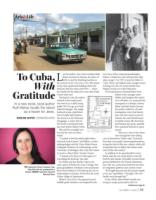
TOP: Agramonte Street in Havana, Cuba.
Baby Ruth with her grandparents in
Havana. CENTER: Goworowo map from
Memorial Book.
Arts&Life
books