

24 | JULY 2 • 2020
A
June 20 Supreme Court decision
invalidates the Trump adminis-
tration’
s attempt to rescind DACA
(Deferred Action for Childhood Arrivals).
For now, these immigrants — the “dream-
ers” — have retained the protections of
DACA.
President Barack Obama’
s 2012 DACA
program protects from deportation some
undocumented immigrants who were
brought to the United States as children and
then raised and educated here. The program
permits DACA recipients, about 700,000
people, to obtain work permits.
Five years later, on Sept. 5, 2017, Elaine
Duke, acting secretary of Homeland
Security in the Trump administration,
issued a memorandum that “terminated
the program.
” The U.S. District Court for
the District of Columbia found that Duke
provided insufficient explanation for ter-
minating the program. Duke’
s successor as
secretary of Homeland Security, Kirstjen M.
Nielsen, then provided additional reasoning
for rescinding DACA.
On June 20, 2020, Chief Justice John
Roberts, writing for the Court, ruled that the
efforts to end DACA were still “arbitrary and
capricious,
” and so DACA remains in force.
At this point, dreamers can breathe a sigh
of relief, and the Trump administration
expresses frustration.
THE LEGAL REASONING
Tim Moran, senior lecturer at the Irvin
D. Reid Honors College of Wayne State
University, cautions that “when the Supreme
Court issues an opinion, it’
s not because they
‘
side with’
any particular issue. They exam-
ine the law and decide whether the law has
been followed correctly.
”
The majority of the court decided the case
as a narrow question of the Administrative
Procedures Act (APA). The executive can-
not simply overturn an administrative rule
without providing a sufficient rationale.
Justice Roberts, joined by the liberal justices,
found that Duke’
s memorandum offered an
“arbitrary and capricious” rationale, and that
Nielsen’
s later additions could not remedy
that original lack.
Three conservative justices dissented
in part on substantive grounds. Justice
Clarence Thomas (supported by Justices
Alito and Gorsuch) wrote that President
Obama’
s orders creating DACA were
themselves illegal, so the court should have
accepted the memorandum ending DACA.
Congress never granted legal status to these
people, and the Department of Homeland
Security could not do so.
Justice Sonia Sotomayor dissented in
part for a different reason: Ending DACA
specifically targets Latino immigrants, and
the court should have considered President
Trump’
s often-expressed animus against
Latinos.
The decision, however, rests on a proce-
dural question. Robert Sedler, professor of
constitutional law at Wayne State University
Law School, notes that Chief Justice Roberts
here follows “the operative principle: Decide
cases on the narrowest possible grounds.
”
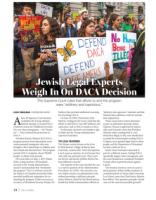
The Supreme Court ruled that efforts to end the program
were “arbitrary and capricious.”
LOUIS FINKELMAN CONTRIBUTING WRITER
Jews in the D
Th
S
C
t
l d th t
ff
t t
d th
Jewish Legal Experts
Weigh In On DACA Decision
BY PAX AHIMSA GETHEN VIA WIKIPEDIA
Protestors in San Francisco
in 2017 defending DACA