

NOVEMBER 21 • 2019 | 31
NOV.
21,
2019
BUILDING FOR
TOMORROW
New MSU facilities empower
research discoveries and
student success
Many of the cranes and construction
barriers on Michigan State University’
s
campus are giving way to shiny new
buildings and renovated spaces that point
toward the MSU of the future. These
facilities not only accommodate a growing
student and faculty population, but they
also provide spaces that put collaboration
and innovation first.
The following are some of MSU’
s new and
upcoming additions.
Powering STEM education
When completed in the fall of 2020, the
117,000-square-foot STEM Teaching and
Learning Facility will house classrooms
and laboratory spaces that will support
introductory courses for biological
sciences, chemistry, computer science,
physics and engineering.
The central structure of the new building is
the former Shaw Lane Power Plant. The
project renovations will keep as much of the
old building as possible to provide student
studio space and a vibrant commons area,
as well as a new home for MSU’
s HUB for
Innovation in Learning and Technology.
Accelerating next-generation
nuclear science
Above and below the surface of MSU’
s
campus, the Facility for Rare Isotope Beams
is taking shape as the world’
s most
powerful rare isotope accelerator,
supporting the mission of the Office of
Nuclear Physics in the U.S. Department of
Energy Office of Science.
This discovery
machine will
power
next-generation
nuclear science
experiments
exploring rare
isotopes — the
forms of elements not
normally found in nature. FRIB will provide
researchers with more than 1,000 rare
isotopes never before produced on Earth.
Continued on page 2
MSU was selected by the DOE-SC to build
and operate the $730 million scientific
user facility that spans more than 550,000
square feet. The university is home to
the nation’
s No. 1 nuclear physics
graduate program, according to U.S.
News & World Report.
When it’
s operational in 2022, FRIB will
power discoveries that will lead to
applications for society as well as educate
the next generation of nuclear scientists
who will advance the benefits of rare
isotope science for generations to come.
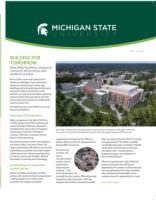
The STEM Teaching and Learning Facility, expected to be completed in fall 2020, will house
21st-century classrooms and laboratory spaces that will support gateway STEM courses.
MICHIGAN STATE
U N I V E R S I T Y