

14 August 29 • 2019
jn
continued from page 12
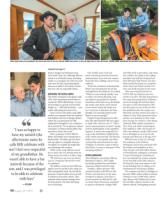
LEFT: Elijah shows his grandfather the suit he will wear for his bar mitzvah. RIGHT: Bill shows 13-year-old Elijah how to start the tractor. FACING PAGE: Grandfather and grandson share a moment.
jews d
in
the
disease, hunger and inhumane treat-
ment under Nazi rule. Although Bill was
raised in an Orthodox home, attending
cheder as a youngster, his 13th year came
and went, the idea of proclaiming his
status as an adult in the Jewish commu-
nity now only an impossible dream.
SURVIVING THE DEATH CAMPS
The family remained in the ghetto until
1944, when liquidation forced them to
Auschwitz. Bill recalled being a 16-year-
old traveling in a grossly overcrowded
freight car — still with his family — and
nearly suffocating from lack of air.
Upon arrival at the death camp, Bill’
s
mother was separated from her husband
and children and sent to Bergen-Belsen,
where she was presumed lost. Bill
explained he thought he, too, would per-
ish at Auschwitz. “It was almost a natural
conclusion, to think you’
d be killed, that
you had no choice but to die.
”
Then, in January of 1945, Bill, his
father and brother were transported to
Buchenwald. “My father got sick there
and was taken to a hospital, where he
was killed,
” he recalled, his bright blue
eyes dimming with emotion.
While in the camp, Bill was saved
by an uncle who was already there by
being chosen to work in a labor camp.
“He told me to say I was an electri-
cian so I would be selected for work,”
he explained.
The ability to work was how Bill man-
aged to survive, but life in the camp was
still unimaginably harsh. He and all the
prisoners worked endless hours yet had
to subsist on starvation rations. They
endured indiscriminate beatings from
the Nazi guards. The dead and dying
were everywhere.
One of Bill’
s most vivid and
heart-wrenching memories from his
imprisonment arose when he remem-
bered the bone-chilling cold everyone
suffered.
“From the crematoria at Buchenwald,
flames were shooting into the air day
and night from the chimney,
” he recalled.
“When we were ordered outside, I was
so cold, I was always shivering. I put
my hands in my pockets for warmth.
Sometimes when there was a downdraft,
the smoke came down, and I noticed
it was warmer where the smoke was.
So, I went over to that place, but then
thought, ‘
I’
m warming myself on the
flames of my own people.
’
”
Despite living through horrors like
that, fate intervened for Bill once again
in April 1945, when he was 17. “There
was an announcement on April 5 saying
all Jews should gather in the appelplatz
(square). A man in the camp told me
to go to the kinderblock (children’
s bar-
rack), which saved my life. The barrack
leader was a Czech gentile, and when
we heard the announcement, he said,
‘
Children, if someone comes to kill us,
they’
ll have to come in with guns. We’
re
not going anyplace.’
”
AFTER LIBERATION
After hiding for several days, Bill was
liberated on April 11, 1945. Sadly,
his brother perished the week before
American soldiers freed the camp.
Notably, a fellow prisoner who
reached freedom with Bill was Elie
Wiesel, who had been on the same
transport in January. Years later, a
proud moment for Bill and his wife
occurred when Wiesel was scheduled
to speak at Rochester College. Bill’
s
wife Ellie tried to get tickets, and when
she couldn’
t, she spoke to the college
president and said her husband had
been liberated with Wiesel. The pres-
ident invited the Kayes to a reception
where they met Wiesel, and the two
men were both honored at the event.
After surviving the horrors of
WWII, Bill was elated to learn his
mother was alive. She had remarried in
the camp, becoming Sylvia Goldstein,
and even though she had lied about
her age to avoid extermination, Bill
saw her name on one of the survivor
lists published after the camps were
liberated, and they found each other. A
relative in New York sponsored Sylvia
and her new husband so they could
leave Europe for America. After being
widowed, Bill’
s mother remained in
New York, and while vacationing in
the Catskills in 1984, she became ill.
After she suffered a stroke, Bill moved
her to Michigan to recover, but she
passed away that year at the age of 87.
Bill had come to the U.S. through
the assistance of the Hebrew
Immigrant Aid Society and lived with
his mother and stepfather in New
York. He got a job with Albee Homes
in Pennsylvania, selling pre-cut homes
(a type of housing kit consisting of
pre-cut materials for a home, popular
in the first half of the 20th century).
He found he had more interest in the
actual building than in selling, so he
transitioned to becoming a builder.
The company sent him to Michigan in
the early 1960s, and he settled in Mount
Clemens. It was in 1969 when, attend-
ing a dance at the Holiday Inn, he met
his wife Ellie, a history teacher in the
Warren schools. Their getting married
“I was so happy to
have my tatteleh (the
aff
ectionate name he
calls Bill) celebrate with
me! I feel very respectful
of my grandfather. He
wasn’
t able to have a bar
mitzvah because of the
war, and I was privileged
to be able to celebrate
with him.”
— ELIJAH
“