

July 4 • 2019 5
jn
views
R
ecent events are leading me
to believe there are no coinci-
dences. I’
m experiencing more
moments where things I’
m thinking
about intersect with things going on
around me. You’
ve
had that feeling,
right?
You think about
a friend you haven’
t
spoken to in a while
and, almost instanta-
neously, you receive
an incoming call
from him. Or perhaps
something more dramatic like what
I witnessed at a funeral of a friend
some years back.
I, along with many others in atten-
dance who talk about it to this day,
remember the precise moment the
rabbi mentioned our beloved friend’
s
love for trains — a train, with the
rabbi having no forewarning of its
approach, appeared out of the dis-
tance and rambled by the cemetery.
Eerie? Actually, I found it comfort-
ing.
This past June 5, just one day prior
to the June 6 75th anniversary of
D-Day, I was having breakfast with
my 92-year-old WWII Jewish War
Veteran (JWV) buddy Art Fishman.
We were joined by Debi Hollis, the
president of the Michigan WWII
Legacy Memorial, who was updat-
ing us on the tribute she is working
tirelessly to bring to the grounds of
Memorial Park on Woodward in
Royal Oak. It will pay homage to
the unique contributions the state of
Michigan made during WWII, both
on the war and home fronts.
As we finished our coffee and dis-
cussion, I looked down and noticed
a penny on the floor just beside our
booth. I’
m a penny-picker-upper
from way back. Are you familiar with
the old tradition of making a wish
on a found penny? I do it often and
have a collection of “wishes” in a cup
at home.
Upon closer inspection, the date
on this penny was … 1944. Yes, with
a WWII veteran as my witness, I had
just found a 75-year-old penny on
the eve of the 75th anniversary of
D-Day. I’
d like to think this was more
than a coincidence — it was a “c-o-i-n”-
cidence.
On Friday evening the day after
the 75th anniversary of D-Day, Art
Fishman left me a voicemail: “Al, give
me a call. I have a story you’
re not
going to believe.”
It turns out while washing his
car Art looked down and saw … a
penny. A 1945 penny. 1945, the year
WWII ended in Europe. Another
“c-o-i-n”-cidence?
On Sunday, June 9, three days
after the 75th anniversary of D-Day,
I attended a Shavuot Yizkor service
at Temple Israel. Honored guests
that morning were members of the
Jewish War Veterans Department of
Michigan, who were invited to par-
ticipate in the morning prayers.
Just days after Memorial and
D-Day commemorations, Rabbi
Marla Hornsten spoke passionately to
the congregation about our beloved
JWV and their contributions to our
nation. It was the perfect setting to
share with her my and Art’
s recent
historical “penny” currency encoun-
ters.
After I gave the rabbi my “2-cents
worth,” she said: “Wait here.” She left
for a moment and retuned with the
Temple Israel prayer book, Shema
Yisrael, in hand; opening it to a page
with a published work of hers about
… a penny.
She was inspired to write the pas-
sage after witnessing a ritual a family
performed about 15 years ago while
presiding over an unveiling.
“When we reached the end of the
service,” Hornsten said, “they told
me that instead of leaving a stone at
the grave, their family tradition was
to leave a penny. The idea was that
we constantly find pennies around
us and every time we find one it’
s
a message or a sign of our loved
ones. And so, they leave a penny as a
marker that they were there.”
I put a penny on your grave instead of
a stone,
Because whenever I see a lost penny
on the street, I think of you.
I remember how you used to put a
penny in that little dish next to the
cash register that’
s says, “Give a penny,
take a penny.
”
How you used to throw your loose
change into the case of the street musi-
cian even when he was out of tune,
And how you dug deep into your
pockets for more than just pennies to
help the person on the street.
“Find a penny, pick it up …
”
I look for lost pennies because every-
where I look, I see you.
— Rabbi Marla Hornsten
So is everything I just shared mere
“c-o-i-n”-cidences? Perhaps. Though
I’
d prefer to think of it as “change”
you can believe in. ■
Alan Muskovitz is a writer, voice-over/acting
talent, speaker, and emcee. Visit his website
at laughwithbigal.com,“Like” Al on Facebook
and reach him at amuskovitz@renmedia.us.
for openers
Pennies from Heaven?
Alan Muskovitz
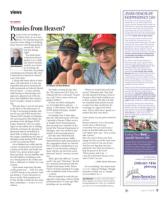
Art Fishman and Alan Muskovitz
For information,
contact Tracey Proghovnick
(248) 661-1836
jslmi.org
JEWISH SENIOR LIFE
INDEPENDENCE DA
Y
Living Your Best ...
Jewish Senior Life
Jewish Senior Life is far more than
a place to live. It’s six beautiful
residences where older adults can
embrace life and community in a
secure and supportive environment.
JSL is proud to provide inclusive residential communities, programs and services. We
welcome all people without regard to race, color, national origin, religion, disability,
gender, sex, sexual orientation, gender identity, age, familial status and marital status.
Our Jewish community has long been
aware that it is one of the oldest in the
country and has understood that when the
Baby Boomers enter their older adulthood,
communal needs will intensify. What the
community may not have understood is
that another trend has been developing as
the Boomers have been approaching their
seventies: People want to age in place.
JSL has already experienced this trend –
older adults are coming to live in our
communities laterthan they did in decades
past and with more needs. What we now
understand, is that the true impact of the
Baby Boom may not really be felt until
the Boomers hit their eighties - which will
happen in just seven to ten years. Therefore,
JSL has a critical window of opportunity
to anticipate and address the needs and
desires of our older adults.
So, while it may be the preference of
Boomers to age in their current homes,
many will not be able to afford to do so.
Given the high cost of home care ($1,000 -
$15,000/month, depending on how
many hours a day are needed) and the
astonishingly low savings rates of Baby
Boomers,
solely on social security just a few years
intoretirement and cannot afford to live at
home. With longevity increasing, this means
we’ll have thousands in our community
whether at home or with us.
While JSL has HUD-subsidized apartments
pay only 30% of their monthly income
towards rent, many older adults will earn
too much to qualify for subsidized housing
but may not have enough to pay for senior
housing with the types of supports they’ll
need, another trend JSL is concerned about.
JSL has been working with international
thought leaders in senior housing, Perkins
Eastman, to help us anticipate, plan for and
dream about how to meet the needs of the
Baby Boomers as well as their desire for
more choices in older adult housing.
Stay tuned and help us shape this dream.
Give us a call!