

July 4 • 2019 11
jn
jews d
in
the
F
iftieth anniversaries are special occa-
sions — usually upbeat moments to
celebrate past achievements, reconnect
with family, friends and colleagues, and
to think about the future, often with good
food, music and heartfelt speeches.
The Society for Humanistic Judaism cel-
ebrated its 50th anniversary with all
these
elements and more at “SHJ@50: Celebrating
Culture, Advancing the Movement,” a con-
ference held April 26-28 at the Birmingham
Temple in Farmington Hills. (The tem-
ple’
s founding members met for a time in
Birmingham, which accounts for the tem-
ple’
s name.)
The conference attracted 130 enthusiastic
participants from 20 states, Canada and
Israel to hear discussions about Humanistic
Judaism’
s history, evolution and outlook for
the future.
THE MOVEMENT’
S BEGINNINGS
Humanistic Judaism began in the Detroit
area when eight suburban couples who were
members of Temple Beth El began meeting
to discuss a new and different sort of Jewish
affiliation. They sought out Rabbi Sherwin
Wine, who was leading a Reform temple in
Windsor and had previously served as assis-
tant rabbi at Temple Beth El in Bloomfield
Township.
Together they developed a framework that
retained a commitment to Jewish history,
culture, holiday celebrations and other tra-
ditions but revised or eliminated elements
focused on God as the source of morality
and power in human life. Wine preferred to
describe himself as an “ignostic”— someone
who doesn’
t know what God means and,
therefore, can’
t validate God’
s existence.
Time Magazine’
s 1965 article “The Atheist
Rabbi” brought this new stream of Judaism
publicity, generating controversy and antag-
onism from some in the Jewish community
here and elsewhere.
But its adherents then and now prefer
to emphasize what Humanistic Judaism
believes — not what it rejects. Their concept
of Humanistic Judaism focuses on human
beings as responsible for their own lives
and for improving society, and on Judaism
as the historic culture of the Jewish peo-
ple.
Within a year, Wine and a small group of
supporters developed a liturgy that removed
references to God. They formed the
Birmingham Temple, the first Humanistic
Jewish congregation, which has no ark. A
Torah, which members consider an import-
ant part of Jewish tradition written by
human beings, is kept in the temple library.
“We are secular humanists who believe
that the world operates
separate from supernatural
authority. We believe that
man is responsible for the
world and each other and we
celebrate the human spirit,”
explains Rabbi Jeffrey Falick
of the Birmingham Temple.
“You don’
t have to be an
atheist, but we focus on human impact.
Why lead with what we don’
t believe?” says
Paul Golin, executive director of the Society
for Humanistic Judaism based on the
Farmington Hills campus.
Humanistic Jewish congregations offer
bar and bat mitzvahs without Torah read-
ings or the traditional Shabbat service.
Instead, the young people develop an indi-
vidualized service, often with a humanistic
aspect, such as “twinning” the bar mitzvah
with a child who died in the Holocaust, a
social service project or research about a
social activist.
THE SOCIETY FOR HUMANISTIC JUDAISM
An umbrella organization, the Society for
Humanistic Judaism, was founded in 1969
(the reason for the recent 50th anniversary
celebration) to connect the first congrega-
tions and others that soon followed. While
some congregations are self-led, others
have rabbis who were originally ordained
by mainstream Jewish seminaries and later
chose Humanistic Judaism.
Humanistic Jews are not the only group
seeking to retain Jewish identity and some
traditions but without the framework of
belief in God and the Torah. Locally, the
Labor Zionist Alliance, Sholem Aleichem
and Jewish Parents Institute meet to com-
memorate Jewish holidays and provide
Jewish education with a secular focus.
In 1990, a Humanistic rabbinic studies
program was established. Candidates were
required to have a master’
s degree in Jewish
studies and then complete a four-year pro-
gram. A shorter course of study was offered
to train officiants for life cycle and other
ceremonies.
Rabbi Tamara Kolton, who attended the
Birmingham Temple as a child, was the first
Humanistic rabbi ordained. Since then, 15
individuals have been ordained and six peo-
ple are enrolled in the Humanistic rabbinic
program, currently including individuals
from Reform, Conservative, Humanistic and
Orthodox backgrounds, according to Rabbi
Adam Chalom, dean of the International
Institute for Humanistic Judaism for North
America, based in Farmington Hills and
Jerusalem.
SHARI COHEN CONTRIBUTING WRITER
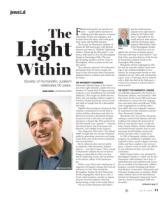
Rabbi Jeffrey
Falick
COURTESY LEONARD N. SIMONS JEWISH COMMUNITY ARCHIVES
The
Light
Within
Society of Humanistic Judaism
celebrates 50 years.
Rabbi Sherwin Wine
continued on page 12