

12 July 4 • 2019
jn
jews d
in
the
continued from page 11
“Where is my light? My light is in me.
Where is my hope? My hope is in me.
Where is my strength? My strength is in me — and in you.”
— RABBI SHERWIN WINE
Humanistic Judaism
Timeline
• 1963: A small group of Temple
Beth El members began to meet
and then hold services with Rabbi
Sherwin Wine. They developed an
alternative approach to Judaism
without a belief in God and began
using a new non-theistic liturgy
developed by Wine in 1964.
• 1969: The Society of Humanistic
Judaism was incorporated in
Michigan to provide an umbrella
for interested groups of humanistic
Jews in multiple locations.
• 1970: Representatives of three
Humanistic congregations located
in Michigan, Illinois and Connecticut
met for the first time.
• 1990: Educational programs were
established for Humanistic rabbis
and officiants.
• 1993: The first Humanistic rabbi
completed studies and was
ordained.
OVERVIEW OF HUMANISTIC
JUDAISM TODAY
• 25 congregations in the U.S. and
Canada, with six in formation
• 15 rabbis ordained
• Approximately 1,900 member
families
CORE BELIEFS OF HUMANISTIC
JUDAISM
• Human beings possess the power
and responsibility to shape
their own lives independent of
supernatural authority.
• A Jew is a person who identifies
with the history, culture and future
of the Jewish people.
• Jewish history is a human saga,
a testament to the significance of
human power and responsibility.
• Jewish identity is best preserved in
a free, pluralistic environment.
• The freedom and dignity of the
Jewish people must go hand in
hand with the freedom and dignity
of every human being.
— Selections from the Society for Humanistic
Judaism website.
Humanistic
Jewish rabbis and
officiants were
among the first to
marry interfaith
couples, which
was a divisive
issue even for
some Reform con-
gregations at the time. Rabbi
Miriam Jerris, Ph.D., the first
executive director of the Society
for Humanistic Judaism, began
officiating at weddings at the
Birmingham Temple in 1985.
The willingness of Humanistic
Jewish clergy to marry inter-
faith couples, especially in the
early years, “was a big draw. You
don’
t have to give up your iden-
tity,” she explained. Many of the
interfaith couples married at the
Birmingham Temple joined the
congregation and raised their
children there.
Rabbi David Nelson, rabbi
emeritus at the Conservative
Congregation Beth Shalom in
Oak Park, remembers sharing
wedding services with Wine.
When a couple wanted a tradi-
tional Jewish wedding, but one
person had a connection with
Humanistic Judaism, Nelson
would conduct the traditional
ceremony and recite the Jewish
blessings. Then Wine would
speak to the couple about their
marriage without references to
God’
s role.
“He was brilliant and a won-
derful teacher although I don’
t
say he was right in some of his
ideas. We had a wonderful dia-
logue during all of the years I
was here,” Nelson says.
Rabbi Daniel Syme, rabbi emer-
itus at Temple Beth El, remembers
first hearing and being startled by
Wine’
s philosophy while attending
a Reform Judaism conclave as a
teenager. “It appeared that he had a
staunch group of followers who had
found a certain spiritual home,” he
says.
Humanistic congregations were
early supporters of inclusivity —
welcoming members with diverse
gender and sexual identities. There
is a strong focus on social justice
or social action. The Birmingham
Temple has established itself as a
sanctuary for immigrants and helps a
family of Syrian refugees living in the
Detroit area.
Along with the appeal of
Humanistic Judaism concepts
to some Jews, founder Wine’
s
brilliance and charisma were
major factors in its growth. “He
trained us,” Jerris says. After
Wine’
s death in a car crash
in 2007, there was great con-
cern about who would replace
him. Chalom, one of the first
ordained Humanistic rabbis,
responded, “None of us and all
of us.”
Wine’
s teachings and publica-
tions continue to be a founda-
tion for Humanistic Judaism and
the book A Life of Courage —
Sherwin Wine and Humanistic
Judaism, was given to conference
attendees.
THE FUTURE OF THE MOVEMENT
Similar to other streams of
Judaism, Humanistic Judaism
has been challenged in recent
years to attract and retain partic-
ipants and members. According
to Golin, about 2,500 families
were part of the Humanistic
Judaism movement in 2000,
but that number is now about
1,900. However, new groups of
Humanistic Jews continue to
meet and organize in several
states.
Most branches of Judaism as
well as other religions in the
U.S. are facing similar affiliation
challenges due in part to chang-
ing ideas about religion and
congregational affiliations, espe-
cially among younger people,
according to the Pew Research
Center. A panel of millennial
Humanistic Jewish leaders at
the conference reaffirmed the
value and appeal of Humanistic
Judaism for recognizing “human
power and potential” and that there
are “multiple ways of being Jewish.”
They expressed a need for religious
literacy — familiarity with Jewish
traditions and symbols — and sup-
ported Humanistic Judaism’
s affir-
mation of all families and couples,
whether intermarried or gay, and its
Rabbi Adam
Chalom
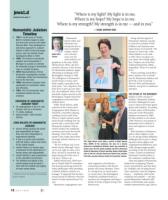
TOP: Rabbi Miriam Jerris holds a portrait of Rabbi Sherwin
Wine. ABOVE: At the conference, the Jews for a Secular
Democracy Constitutional Defender Award was presented to
Rachel Laser, the first Jewish president and CEO of Americans
United for Separation of Church and State. Shown: Sheila Sabor,
chair of Jews for a Secular Democracy; Rachel Laser, awardee;
Paul Golin, executive director, Society for Humanistic Judaism.