

jews in the d
A Mixed Bag
Non-Jewish grandparents celebrate
Chanukah with their Jewish grandchildren.
JENNIFER LOVY CONTRIBUTING WRITER
K
aren Gasinski, a grandmother
from Plymouth, loves Christmas
carols, decorating her Christmas
tree, making cookies and just about
everything else associated with this
festive holiday. So, when her daughter
Kristi Magy converted to Judaism seven
years ago, Gasinski struggled to accept
the notion that Kristi would no longer be
celebrating Christmas.
Jessica Billiau, on the other hand, was
the first Jewish person her in-laws had
ever met. In fact, her mother-in-law, who
grew up on the East Side, “didn’t really
know about the Holocaust,” according to
Billiau, a Royal Oak mother of two.
Having families with different reli-
gions meant that Billiau and Magy both
decided to have the “no Christmas talk”
with their respective family members
and explain why their kids would not be
celebrating Christmas.
“As I spoke about it with my moth-
er, I focused on the symbolism of the
Chanukiah, the lighting of candles and
the foods fried in oil,” said Magy of
Troy. “My mom is the one who taught
me about the importance of stories
and passing on our family history, so
learning about the history and symbols
of Chanukah helped her to understand
why I loved it so much. It was a good
conversation that is still ongoing as she
has a hand in helping me to raise my two
children, ages 4 and 2.”
When Billiau and her husband, Jason,
became parents four years ago, her
mother-in-law talked a lot about cele-
brating Christmas, and they had “the
talk” again.
“She was a bit resistant at first and
asked why we couldn’t celebrate both,”
recalled Billiau of her mother-in-law
who passed away earlier this year.
This will be the first holiday season
without her.
Billiau’s answer to why they couldn’t
celebrate both: “[Her grandson] is Jewish
and will always be a Jew.”
“My mother-in-law was obsessed with
18
November 29 • 2018
jn
Christmas but came to realize the impor-
tance of Judaism to us and that it was not
her place to decide which holidays my
kids would celebrate,” Billiau said. “Once
she was told we would only be celebrat-
ing Chanukah and not Christmas, she
was always very respectful.”
TEACHING CUSTOMS
Being able to engage grandparents in
Chanukah celebrations and teaching
them about the customs and traditions
of the holiday is an important step in
helping them feel included and to under-
stand the differences between the two
holidays.
Because Christmas and Chanukah
almost always fall close to each other
and have evolved to include gift giv-
ing as a major component of the hol-
idays, for better or worse, the two are
often compared.
“My mom helps light the Chanukah
candles; she knows how to sing the
brachot, even though we still have to
remind her of what it means,” Magy
said. “We bake fun Chanukah sugar
cookies in place of Christmas cookies,
and we sing. Singing is something that
has always made my mother and me
close, and we continue that tradition
of the song to build my children’s rela-
tionship with Judaism as well as with
their grandmother.”
Gasinski said she and her grand-
children often search YouTube for
Chanukah songs sung by some mod-
ern musical groups such as Six13, Shir
Soul and the Maccabeats. Her love of
music and enjoyment of these songs
has helped her deepen her relation-
ship with her grandchildren, whom
she spends weekdays with while her
daughter and son-in-law work.
“It’s because of my mother that my
children know so many fun Chanukah
songs,” Magy said.
Gasinksi also enjoys making potato
latkes. “I know how to make them
the good way,” she said, crediting her
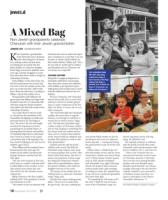
TOP, CLOCKWISE FROM
TOP LEFT: Adam Magy
holding Henry Magy, 4,
Karen Gasinski, Kristi Magy
holding Zelda Magy, 2.
BOTTOM, LEFT TO RIGHT: Ori
Glaser, 5, Craig Glaser, Joe
Stuban and Yoav Glaser, 6.
non-Jewish Polish mother-in-law for
teaching her the secret to a delicious
potato pancake — rinsing and drying
the grated potato to get rid of the extra
starch.
Hillary Glaser, a Walled Lake resi-
dent and mother of two, said her mom
remarried a Catholic man when Glaser
was 13. When Glaser’s mother passed
away in 2014, shivah overlapped
with Chanukah. One night, following
shivah, the family lit their menorah
and proceeded with a gift exchange.
According to Glaser, her stepdad’s face
lit up a bit as he watched his grandchil-
dren open their gifts.
“It’s something he still wants to do,”
she said. “I think by now he knows
most of the [Chanukah] songs. He
doesn’t sing them, but he will clap
along. He definitely tries.”
Her stepdad continues to celebrate
with the family and will often make
Chanukah crafts and decorations with
her two children, Ori, 5, and Yoav, 6½.
“I have a lot of friends who are
intermarried and their in-laws insist
on Christmas presents. I feel lucky
we’re not the norm among blended
families and we’re blended, upon
blended, upon blended,” says Glaser,
lovingly referring to the fact that her
Catholic stepdad is now married to
a Chaldean woman and they con-
tinue to participate in the Glasers’
Chanukah celebrations. ■
See related Population Snapshot on page 8.