

jews in the d
Jewish Contributions to Humanity
#58
#47 in a series
Barbara Ribakove among
Ethiopian Jews
He Was the
“Conscience of
the World.”
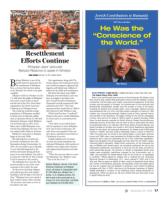
Resettlement
Efforts Continue
Ethiopian Jews’ advocate
Barbara Ribakove to speak in Windsor.
RON STANG SPECIAL TO THE JEWISH NEWS
B
arbara Ribakove is one of the
world’s foremost advocates for
the resettlement of Ethiopian
Jews, a process that has been going
on for decades, but which is not quite
complete.
Ribakove will be in Windsor on Dec.
7 to talk about the plight of Ethiopian
Jews, their current status in Israel
and the role of her New York-based
organization, the North American
Conference on Ethiopian Jewry.
The world has watched as large
populations of Ethiopians resettled
in Israel, most in dramatic airlifts,
such as Operation Moses in 1984 and
Operation Solomon, which Ribakove
was involved with, in 1991. In the
latter, some 14,000 Ethiopians were
moved from Ethiopia’s war-torn civil
war capital Addis Ababa in 36 hours.
Ribakove’s connection to Ethiopia
began in the early 1980s.
She had long been an advocate
for Jewish resettlement, first with
Romanians during Communism. In
1981, she was asked to go to Ethiopia
“to see what had happened to the
Jewish community during all those
years of war and isolation,” she said in
an interview with the JN. She eventual-
ly led 18 missions to the country.
The Ethiopian Jews were the “the
poorest people in one of the worst
countries in the world,” she said.
Yet these Jews had deep religious
and cultural practices and, despite
hardships, held strongly to the idea of
Zion. “Ethiopian Jews were raised at
their mothers’ knees with word that
‘We are Jews; God wants us to be in
Jerusalem,” she said.
Her organization, along with The
Jewish Agency, the Israeli government
and American support, organized aid,
logistics and helped raise millions of
dollars for the airlift and resettlement.
But there have been some 8,000
Ethiopian Jews left behind, and it has
been a struggle to get them reset-
tled. The government of Benjamin
Netanyahu recently announced 1,000
admissions for 2019. “They had
announced they would take in 1,000 in
2018 and never did,” Ribakove said.
While Israel has done “wonderful”
things in the past to resettle Ethiopians
in recent years, its commitment has
waned.
“Very often we are told it’s finan-
cial; it’s expensive to move Ethiopian
Jews” due to lack of education, she
said. Some even question if they are
Jews due to superficial conversions to
Christianity to survive.
Despite isolated cases of racism
in Israel, the Israeli population has
embraced Ethiopians, with marches of
solidarity and a legal system that has
rules against discrimination and hate
speech.
“When the cases are taken to court,
the Ethiopians win,” Ribakove said.
“This is not Jim Crow.” ■
Barbara Ribakove, director of the North
American Conference on Ethiopian
Jewry, will speak at Congregation Beth
El, 2525 Mark Ave., Windsor, Dec. 7
during 7 p.m. Shabbat services. Her
talk is open to the community at no
charge. For more information, call Rabbi
Lynn Goldstein at (519) 969-2422.
Elie Wiesel
ELIE WIESEL ( 1928-2016). b. Sighet, Romania. d. New York, New York.
The Nobel Peace Prize 1986.
Born in pre-war Romania and a survivor of the Holocaust, Elie Wiesel, more
than anyone else, seared that genocide’s horrors onto the Western world’s
conscience. His first major work, Night, recounted his experience of the Nazi
invasion and occupation of Hungary, his imprisonment in the Auschwitz and
Buchenwald concentration camps, and the murder of most of his family,
including his parents and younger sister. Just a teenager, Wiesel survived,
was liberated by the U.S. Army, and then joined a transport to France of 1,000
children who survived Buchenwald. Wiesel moved to Paris, learned French,
and enrolled in the Sorbonne. He began writing for the French newspaper
L’Arche, who sent him to Israel in 1948 to report on Israel’s founding. While
there, he also became a reporter for Yediot Ahronot. Wiesel, like almost every
Holocaust survivor at the time, did not want to talk or write about the terror
he experienced. But in an interview with French author Francois Mauriac, the
Nobel Laureate (a Christian who fought in the French Resistance) persuaded
Wiesel to write about his Holocaust experience. So Wiesel wrote a 900-page
memoir in Yiddish, and then wrote a shortened version, La Nuit, in French in
1955, the same year he moved to the United States. La Nuit didn’t become
known until 1960, when it was translated into English as Night. Wiesel became
America’s go-to voice for describing life as a Jew under Nazi oppression.
Night was translated into 30 languages and has sold over 30 million copies.
Following Night’s popularity, Wiesel wrote voraciously, on the Holocaust but
also on Biblical and Jewish topics. He reluctantly embraced his role as the
Holocaust’s spokesman, and became a voice not only for Jews, but also for
other persecuted groups. His activism on behalf of oppressed Soviet Jews
helped ease emigration restrictions imposed by the communists, and, in
1986, was awarded The Nobel Peace Prize for his work as “a messenger
to mankind.” Wiesel played an integral role in creating the U.S. Holocaust
Memorial Museum in Washington, D.C., which opened in 1993. And in the
‘80s and ‘90s he spoke on behalf of black victims of apartheid South Africa
and victims of the Bosnian genocide. He beautifully wrote and spoke about
his love for Judaism and the Sabbath in particular, even amidst his lifelong
struggles with God. In 2002, returning to his Romanian hometown of Sighet,
Wiesel dedicated a museum in his childhood home, telling Romanians in
attendance, “When you grow up, tell your children that you have seen a Jew
in Sighet telling his story.”
Original Research by Walter L. Field Sponsored by Irwin S. Field Written by Jared Sichel
jn
November 29 • 2018
17