

was always palm fronds. The extras were
donated to their shul.
The jury had seven members, includ-
ing co-chair Anya Sirota, an architect
who teaches at the University of Michigan
Taubman College of Architeture and
founded the archtecture firm Akoaki in
Detroit.
“Since we are all designers and aes-
thetes, we wanted them to be beautiful,”
Resnick, 41, says. “Really critical was
whether these designs were buildable, safe
and rugged within the $10,000 budget.
While there were some
designs that were very
beautiful, it would’ve cost
$50,000 to build them.
Sukkot is a celebration of the in-gathering of the fruit harvest in the
Thinking through to the
early fall. It is one of three “walking” festivals in which Jews in ancient
physical product at the
times streamed into Jerusalem to bring sacrifices to the Temple.
end was something we
The sukkah is a commemoration of the Israelites’ journey through
had to consider.”
the desert after leaving Egypt, when they were protected by clouds of
glory. Its roof, made of natural materials that allow a view of the sky
ORGANIZING THE
and stars, is meant to evoke their spiritual ascent. Another interpreta-
PROJECT
tion is that the sukkahs represent the tents the Israelites dwelled in
The process that began
during the 40-year desert trek. During the week of Sukkot, Jews are
well before the jury began
supposed to eat all their meals and sleep in the sukkah, which should
its work has been over-
be built to withstand the elements. Special prayers are made inside the
seen to a large extent by
dwelling.
volunteer Sigal Hemy.
One of the rituals of the holiday is making a prayer over the four
She helped write the
plant species —palm, myrtle and willow, along with the etrog, a fra-
request for proposals,
grant citrus — that represent the unity of various personalities that
worked with Rabbis
comprise the community of Israel. • — Chabad.org
Ariana Silverman of the
Downtown Synagogue
and Yisrael Pinson of
of the Sukkah x Detroit jury. Resnick is the
Chabad of Greater Downtown Detroit, got
director of the master’s program in architec-
permits (with help from Dan Gilbert’s orga-
ture at University of Detroit-Mercy. He is also
nization), put together a show catalogue and
a principal at LAAVU, an architecture studio
exhibit.
in Corktown.
Hemy praised George Roberts, a board
“To suggest that these rules have been in
member of NEXTGen and director of public
place for a couple thousand years makes it
spaces at Quicken Loans, for assistance in
intriguing,” he says. “They’re arbitrary, on one
helping with the build. Jon Koller, an engi-
hand, but they aren’t made up. They have a
neer, synagogue member and community
history behind them; it gives designers some-
builder, helped ensure the designs were struc-
thing to dig into.”
turally sound.
Resnick has fond memories of the years he
“One of the reasons I was interested in
and his brother built and lived in a sukkah
organizing the project is first, I work in the
behind their Miami home. It was the first
arts, so something that connects Judaism
structure he built and possibly formative in
with the arts in Detroit was in my wheel-
his decision to become an architect.
house,” says Hemy, an arts program officer at
“My brother and I didn’t get along super
the Erb Foundation, where she works with
well, but that’s one of the rare times we did.
Raines. “We support other people’s projects,
We took some of the rules pretty seriously. We
so really, I’ve been enjoying working on some-
made strictly kosher sukkot and had a lot of
thing with my own hands. I’ve learned what it
fun doing that,” he says. The s’chach, or roof,
takes to get that done.” •
What Is Sukkot?
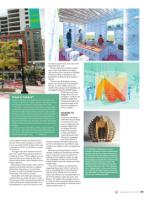
TOP TO BOTTOM: “The Shuk-Kah” by Gamma
Architects, Paul Bassano, Gibraltar: Recycled plastic
vegetable crates form the structure and furniture in
this sukkah that recall fruit displays in markets dur-
ing harvest time; “Pocket Space” by Je-Le, an archi-
tectural design and research office in Detroit headed
by Michael Jefferson and Suzanne Lettieri. This
sukkah embraces the fruit harvest and uses inter-
nal netting to define the “walls” of the sukkah and
more; “Seedling Sukkah” by Noah Ives of Portland,
Ore.: Inspired by the simple elegance of natural pat-
terns, this sukkah is an intimate gathering space as
well as an eye-catching place marker.
jn
September 20 • 2018
41