

arts&life
design
Sukkah x Detroit
Downtown Synagogue’s
design competition
to bring Sukkot alive at
Capitol Park.
JULIE EDGAR
CONTRIBUTING WRITER
A
sukkah can be a humble thing, a
hut made of plywood two-by-fours
and nails with a roof of evergreen
branches. It can be chateau-like in min-
iature, with chandeliers, carpets and
windows. Or it can be egg-shaped and
covered in petal-shaped shingles.
However plain, grand or whimsical,
the sukkah must serve the purpose of
providing shelter for the seven days of the
holiday of Sukkot, this year from sundown
Sept. 23 through Sept. 30.
The timing of the harvest holiday coin-
cides with the Detroit Month of Design,
making the first-ever Sukkah x Detroit
sukkah design competition a neat addi-
tion to Detroit’s thriving creative economy.
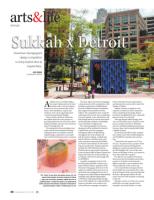
TOP: “Hallel” by Abre Ettah, New Malden, Britain, UK: This
sukkah brings together the historic elements of Sukkot
— light, water and festive celebration. ABOVE: Nice One of
Cambridge, Mass., created this sukkah as an impermanent
shelter exposed to the elements. Composed of thousands of
suspended bundles, it hides an intimate place of rest.
40
September 20 • 2018
jn
The Isaac Agree Downtown Synagogue
is lead presenter of the competition, with
funding coming from a $100,000 grant
from the William Davidson Foundation
plus support from Jennifer and Dan
Gilbert. The competition drew nearly 80
submissions from as far away as Gibraltar,
Iran and Uganda. A jury selected five suk-
kah designs based on criteria that includ-
ed functionality, aesthetics, buildability
and conformity to religious law.
The winning sukkahs (two by local
designers) will be exhibited in Detroit’s
Capitol Park, near the synagogue,
throughout Sukkot. Programming
throughout the week includes suk-
kah decoration making, a sukkah hop,
lunch and learn, a klezmer party and
other activities connecting the holiday
to Detroit’s rich tradition of urban farm-
ing and social justice. Program partners
include The Well, NEXTGen Detroit,
ChabaD, Hazon, the Jewish Community
Center, Reboot, Hillel of Metro Detroit and
Repair the World. For a full schedule, go
to Sukkah x Detroit’s Facebook page (bit.
ly/2N4WRjU).
A similar competition in New York
in 2010 inspired Sukkah x Detroit, says
Jodee Fishman Raines, president of the
Downtown Synagogue. Detroit is in the
midst of a rebirth, and because it is one
of the first cities designated as a City of
Design by the United Nations Educational,
Scientific and Cultural Organization
(UNESCO), celebrating design through
forms of the sukkah was a natural. Raines
hopes to introduce new people to the
Griswold Street synagogue, strengthen
bonds with other Jewish organizations,
and educate Jews and non-Jews about the
holiday of Sukkot.
Sukkah x Detroit competitors were
required to submit an artist’s statement
with a rendering of the design. Raines
loved how thoughtful they were, especially
because most are not Jewish.
That egg-shaped sukkah design, how-
ever, was created by a Jew, Noah Ives, who
runs an architecture firm in Portland,
Ore. Ives celebrated Sukkot growing up in
Newton, Mass., but his family didn’t build
a sukkah at home.
He loved the specificity of the competi-
tion, which came with a $5,000 design fee
and $10,000 for materials and construc-
tion.
“I kind of love the nuances of it,” Ives,
36, says. “It’s great to have a project where
requirements, instead of being purely
budgetary or about productivity, have to
do with daylight and a view of the stars.
These are all things we love, so it’s great to
have them built into a project.”
Ives did run into a glitch: He learned
that a plywood roof wouldn’t pass kosher
muster, so he had to use basswood, a
lighter wood that is not considered opti-
mal in builds but works in this case.
A few weeks before coming to Detroit
for the build, Ives connected with a work-
shop in Detroit to laser-cut the petals that
form the 1,000-pound sukkah. He still
wasn’t sure how he’d transport everything
to the city.
Having a context, or in this case, arcane
Jewish law, can make a project more
enjoyable, says Noah Resnick, co-chair