
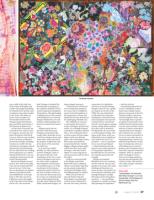

The Beauty of Summer
was a rabbi in the East New
York section of Brooklyn and
a tailor who designed clothing
for Admiral Perry and his team
of explorers when they headed
to the Arctic. Her father, an
artist, ran for Congress on
the Socialist ticket in 1926.
Schapiro began sketching at
age 6 and later took classes at
the Museum of Modern Art.
At Iowa State University, she
received her B.A. and two mas-
ter’s degrees, and met her hus-
band, the painter Paul Brach.
Later on, when he was teaching
at the University of Missouri,
she had several jobs, including
secretary to a rabbi. She has
said that her marriage to Brach
deepened her Jewish identity;
she was affected by his retelling
of his experiences as a soldier
during World War II, as he was
among the Americans who lib-
erated Theresienstadt.
Brach and Schapiro moved
back to New York in the 1950s,
when she devoted herself full-
time to her art. At the time
she was painting in an angular
abstract expressionist style
and exhibited her work regu-
larly. In 1967 they moved to
California, where she taught
at the University of San Diego,
and in 1971, she and artist
Judy Chicago co-founded the
first feminist art program at
the California Institute of Arts,
and the important installation
Womanhouse. Through leading
workshops all over the country
and through her own artwork,
Schapiro furthered a new and
inclusive understanding of art
based on women’s lived experi-
ence.
Schapiro spent the last
decades of her life in East
Hampton, Long Island. She
would collect materials for her
work from antiques shows and
estate sales, and at the end of
the summer would hold a sale
at her home of the materials
she didn’t use.
In an interview, Judith
Brodsky, an artist, professor
emerita at Rutgers, chair of
the board of the New York
Foundation of the Arts, a close
friend of Schapiro’s and execu-
tor of her estate, explained
that Schapiro’s renewed inter-
est in Judaism grew out of her
involvement in the feminist
movement and her interest in
the lives of earlier women art-
ists. (She also did several narra-
tive works, not included in this
show, referencing Jewish fig-
ures like Anne Frank and Frida
Kahlo, with Jewish imagery, on
house-shaped canvases.)
“I think that the whole busi-
ness of using domesticity for
art comes out of a childhood
where the Jewish tradition of
the importance of home and
family life were key elements in
her upbringing,” Brodsky says.
The exhibition is meant as
a conversation between the
works of Schapiro and the nine
artists. It’s as though Schapiro
created the vocabulary. Jasmine
Sian, a New York-based artist,
recycles scraps of brown paper
bags to make very delicate
paper cuts, with imagery drawn
from nature and intricate,
ornamental borders. Sanford
Biggers collages antique quilts,
which have their own coded
messages, with other found
objects to create large pieces
whose geometric patterns form
the edges.
Using an overturned table
as his display stand, Josh
Blackwell creates sculptural
objects out of plastic bags that
are decorated, embroidered
and laced with bright colors,
resembling baskets or textiles.
While several of the art-
ists told Auther that they
felt Schapiro was influential
in their careers, Blackwell is
the only one with a personal
connection. In a telephone
interview, he recalls meeting
Schapiro when he was a gradu-
ate student at Cal Arts in the
1990s. She was invited back
to talk about her experience
founding the university’s femi-
nist art program. He expected
a formal lecture, and instead
she led a consciousness-raising
session, asking all the students
how they came to feminism.
For Blackwell, who now teach-
es at Bennington College, “hav-
ing an artist whose work was
influential to me in significant
ways invited me into a con-
versation — not as a spectator
but as an active participant
— about feminism and mak-
ing art; it was really important
in my graduate experience.”
He adds that he was struck by
her warmth, generosity and
strength.
Shapiro has inspired
Blackwell in his own teaching
and his artwork. The son and
grandson of women who made
clothing and theatrical cos-
tumes, he grew up amidst a lot
of sewing and crocheting, and
through Schapiro’s example
felt empowered to bring these
practices — “not something
marginal, or a hobby, not lesser
than painting but equivalent”
jn
— into his artwork.
Commenting about the rel-
evance of Schapiro’s work in
these times, Jennifer Samet,
director of research at the Eric
Firestone Gallery, which rep-
resents Schapiro’s estate, says,
“Increasingly, there is greater
acceptance and interest in the
radical turns that artists make
over the course of their careers,
and how it leads to innovative,
experimental work. Schapiro
also embraced her own iden-
tity as a woman and mother in
her work, even when she was
making paintings rooted in an
Abstract Expressionist vocabu-
lary. Contemporary artists are
still finding ways to reinvent
gestures and vocabulary associ-
ated with a rigorous modernist
tradition. There is a generous
spirit in Schapiro’s work in
terms of revealing untold sto-
ries and personal identity that
I think is in line with and has a
lot to offer younger contempo-
rary artists.” •
details
“Surface/Depth: The Decorative
After Miriam Schapiro” is on view
through Sept. 9 at the Museum of
Arts and Design, New York.
Madmuseum.org.
August 2 • 2018
37