

arts&life
exhibits
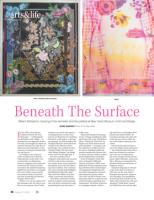
Gates of Paradise by Miriam Schapiro
Voyage
Beneath The Surface
Miriam Schapiro’s marrying of the domestic and the political at New York’s Museum of Art and Design.
SANDEE BRAWARSKY SPECIAL TO THE JEWISH NEWS
I
n the 1970s, artist Miriam
Schapiro invented the term
“femmage” — combining the
words feminine and collage — to
describe her new approach. In spir-
ited style, she brought the objects of
women’s domestic lives, like bits of
fabric, lace and embroidery, to her
canvases, weaving her feminist poli-
tics into her art.
For Schapiro, who achieved
earlier acclaim for her Abstract
Expressionism works, there were
no hierarchies or distinctions
between categories of art and craft,
or between the abstract and the
decorative. She pushed boundaries,
uplifted the decorative, encouraged
the work of other women artists
and created a body of work that
has been acclaimed and honored.
Schapiro died in 2015.
“If there ever was an audience for
her femmage work, the time is now.
We are at a moment where I think
36
August 2 • 2018
jn
audiences are much more open to
accepting beauty in works of art
and are not dismissive of something
decorative as all surface, or having
no meaning,” says Elissa Auther, the
Windgate Research and Collections
Curator at the Museum of Arts
and Design, who curated the show
“Surface/Depth: The Decorative
After Miriam Schapiro,” on display
in New York City through Sept. 9.
The show combines 29 of
Schapiro’s richly patterned canvases
with the work of nine contempo-
rary artists whose work crosses the
boundaries of art and craft, follow-
ing in her tradition. The contempo-
rary artists include Sanford Biggers,
Josh Blackwell, Edie Fake, Jodie
Mack and Sara Rahbar; and their
works are personal and political.
“All of these artists have intense
interest in pattern and ornamenta-
tion, and all are committed to reap-
propriating the term ‘decorative,’”
Auther says.
Along with Schapiro’s femmages
are her writing, including the influ-
ential essay she wrote with Melissa
Meyer, “Waste Not, Want Not: An
Inquiry into What Women Saved
and Assembled — Femmage,” and
the collections of objects used in
her pieces, including traditional
women’s needlework, buttons, fab-
ric hearts, stencils, ribbons, embroi-
dered handkerchiefs and doilies.
Some of Schapiro’s works, like
Gates of Paradise (1980) and
Tapestry of Paradise (1980), seem
inspired by Persian miniature paint-
ing, with their fabric floral designs
overlapping the detailed geomet-
ric borders framing the work and
other geometric frames within.
The works are full of vibrant color,
arabesque patterns on patterns and
coded messages compelling close
examination. The Beauty of Summer
is rectangular shaped, overflow-
ing with flowers and designs, both
painted and made of fabric. By
recycling materials, she makes the
works become stories within sto-
ries, with chapters opening to the
viewer.
Some densely patterned pieces
are in the shapes of fans and hearts
— she embraced forms that others
may have devalued as sentimen-
tal, as she saw no distinctions.
Her series of eight neutral-colored
prints called collotypes, Anonymous
Was a Woman, are inspired by the
detailed handiwork and history of
forgotten women.
Schapiro’s biography is relevant
to her work. Born in Toronto in
1923, she was the only child of
Russian-Jewish parents, and grew
up in Brooklyn. One grandfather
invented the first movable eye for
dolls in the United States and man-
ufactured “Teddy Bears,” named
for Teddy Roosevelt, and the other