

jews d
in
the
KENN DUNCAN
continued from page 13
“I became successful because of a high-
quality, low-cost gymnastics program.”
— WENDY HILLIARD
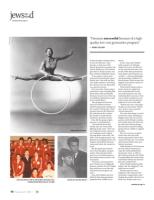
Wendy Hilliard in motion
Coach Zina Mironov with her Detroit Metro Gymnastics team,
including Wendy Hilliard (top row, far right)
Coaches Zina and Alex Mironov
of Detroit Parks and Recreation,
to hire the Mironovs. They
became co-directors of the
Detroit gymnastics program and
Detroit employees. The position
gave them a steady income and
their students affordable classes.
“It was open to those most
interested in learning the sport,”
Wendy says. Zina took the kids
who really wanted to work hard;
her choices were not dependent
on a parent’s income.
Five years later, Zina’s unique
and diverse team, including Oak
Park’s Jodee Abel and Marsha
Freeman, became one of the top
two rhythmic gymnastics teams
in the United States.
“Our program became the
most successful recreation
rhythmic gymnastics program in
the country,” Wendy says. “We’d
practice between the Oak Park
JCC and Detroit Rec Centers
like Tindal, Crowell and the
Northwest Activities Center.”
How did this group of girls
become so extraordinary?
“We drank the Kool-Aid,”
Wendy says, her warm smile
lighting up the room. “This was
not a laid-back team. Zina was
very ambitious and competi-
tive and didn’t waste time,” she
adds. “And, though parents com-
plained of a language barrier, the
students all understood Zina’s
vision and where she wanted us
to go.”
But the girls learned much
more than discipline and gym-
nastics. Zina introduced her
team to art, to famous dancers
like Isadora Duncan and to clas-
sical music.
“We had an amazing educa-
tion,” Wendy says, recalling the
Russian routines they did. “Black
kids with bows in our hair did
wild, fresh and energetic rou-
tines.”
Zina and Vladimir also ben-
efited by directing gymnastics
programs they couldn’t do in
Russia.
In fact, Zina and Vladimir
both wanted to be Olympic
athletes but were not allowed
on the team because they were
Jewish. Both then pursued doc-
toral degrees from Russian uni-
versities — Zina’s in physiology
and gerontology, Vladimir’s in
biomechanics. Both became the
highest-level master coaches in
the Soviet Union.
Their Detroit team’s achieve-
ments, however, might have
been overlooked but for the
city embracing the team and
marketing their successes. They
were invited to perform at city-
wide venues, from the Detroit
Institute of Art to Cobo Hall.
“Detroit was not a very popu-
lar place in those days,” Wendy
says, “and we were a positive
‘tourist attraction.’”
The team also began to travel
around the world, including to
Bulgaria and China. It was the
parents, led by Wendy’s mother,
who raised money for their trav-
els; and some Detroit groups,
like the black women’s reading
group, Sorosis, rallied to support
the girls.
But not everyone accepted
Zina’s team, the only truly
diverse gymnastics team in the
country, Wendy says. Two-thirds
of the Detroit Metro team was
African American.
While Wendy, in 1978, became
the first African American to
make the National Rhythmic
Gymnastics team, in 1983, at
the training camp for the World
Championships, the head coach
overlooked Wendy and selected
girls who ranked lower.
When Wendy questioned the
judge’s call, she explained, “You
stand out too much!”
Wendy’s parents sent a
telegram to the national USA
Gymnastics organization, chal-
lenging the coach’s call and won
their case. Wendy went on to
continued on page 16
14
February 8 • 2018
jn