

arts&life
art
HOLOCAUST
REMEMBRANCE DAY
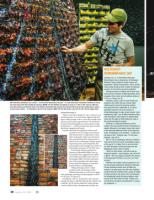
TOP: Artist Bruce Gendelman uses a trowel — and more than 500 pounds of oil paint — to create Aerial View of Auschwitz II-Birkenau to convey
how slave laborers felt when building the chimneys. BELOW: The Dom Katolicki, oil painting on canvas, 8 x 5 feet. In 1941, close to 1,000 Jews
were taken by Nazis and Ukranian locals to the Catholic Community Center, tortured, then marched into the forest. Each painted brick is unique —
in color, texture, pattern — to memorialize a life lost in the massacre. INSET: The Dom still stands; a post-war fire left a charred support beam.
continued from page 37
“When I saw these things,” he says, “I had an over-
whelming desire to convey those nightmarish feel-
ings to other people, and in a way that would reach
across to post-witness generations.” He decided to
interpret his photographs on canvas and in sculp-
tural projects — and the results have been termed
shocking, engaging and brutal.
Friends who knew Gendelman’s earlier work
wanted to see the images and artwork
that had become so important to him.
After visiting his studio near his home,
they passed along their impressions to
others in the community. Groups started
requesting visits, and Gendelman did
presentations that brought his artistry to
wide public attention for the first time.
Two friends, Myrna and Spencer
Partrich of Bloomfield Hills, were so
moved that they suggested an exhibit
at the Holocaust Memorial Center in
Farmington Hills. The pieces became
part of an expanding tour that began
at the National Museum of American
Jewish History in Philadelphia.
“Sifting Through Ashes,” which
includes a life-size diorama of the
Birkenau barracks as well as nine large-
scale paintings and about 20 photographs, will be
on view Jan. 21-March 27.
Gendelman, who is covering the costs of trans-
porting the pieces, will help launch the exhibit with
a talk Jan. 22. He will be joined by Arthur Berger,
a retired official whose background includes ser-
38
January 18 • 2018
jn
Saturday, Jan. 27, is International Holocaust
Remembrance Day. In observance, the Holocaust
Memorial Center Zedelman Family Campus will
supplement “Sifting Through Ashes” with a simulta-
neous exhibit showing works created by Holocaust
survivors in the center’s permanent collection.
Among the pieces on display will be three sculp-
tures by Henry Friedman of West Bloomfield, who is
a speaker at the center and will address visitors at
12:15 p.m. Friday, Jan. 26.
Friedman’s works, made of mixed metals and
donated to the center last year, include Fallen
Soldiers (which honors the American soldiers
who gave their lives in World War II), KL (which
describes Friedman’s life as an inmate in a
Konzentrationslager, he says, where inmates “were
branded like cattle”) and El Moley Rachamim (May
God Have Mercy; which depicts an extermination
camp with the Angel of Death taking the souls of
the murdered people to heaven).
Friedman is a dedicated Holocaust survivor
speaker who has touched the lives of thousands of
people. Although he has spoken nearly every week
at the Holocaust Memorial Center for the past four
years, his testimony is not recorded. “I couldn’t tell
my story on film,” Friedman says. “It’s too heart-
breaking. I live with it.”
Born in 1924 in Rastenberg, Germany, Friedman
was sent to the first of seven concentration camps
at the age of 16. In May 1945, he and two broth-
ers were liberated by American troops from the
Mauthausen-Gusen camp in Austria.
“When my time comes, I will need to ask an
important question,” says Friedman, who will be 94
in March. “Did I do enough to preserve the memory
of the Holocaust? Perhaps no one can, but I tried
my best.”
Friedman has created moving sculptures to con-
vey his personal experiences during the Holocaust.
He also transforms stories from the Bible into
sculpture. He takes great care with each sculpture
using armaments combined with a variety of metals
to depict emotions and scenes from the Holocaust.
He painstakingly welds the pieces together, work-
ing out of his home where he said “it takes a lot
of machining, handwork and brainwork” to create
his sculptures. •