
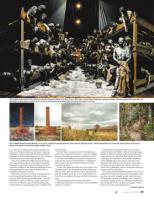

TOP: Birkenau Bunks Diorama, wood, metal, foam and fabric installation. Haunted by the faces of men in their bunks in several famous photographs, Gendelman wanted to show the empty barracks he had seen, but
with people. To allow viewers to “feel the horror,” he says, or put themselves in the inmates’ place, he used his own image on each man.
LEFT TO RIGHT: Birkenau Barracks Memorial 1, oil on canvas. A chimney at Auschwitz-Birkenau. Portal, Auschwitz II-Birkenau, Poland. Josef Ber Bruckenstein, Son of Israel Iser shows the grave site and stone, in
Yiddish, of Gendelman’s great-great-grandfather, Bolekhiv, Ukraine.
vice with the U.S. Department of State and the U.S.
Holocaust Memorial Museum. The topic, “American
Diplomacy and the Holocaust: The Roots of Hatred
Explained in History and Interpreted in Art,” will com-
municate personal and broader perspectives.
“This is a complicated exhibit because it’s meant
to be a powerful statement about genocide and the
Holocaust in particular,” says Gendelman, who has
seen other exhibits at the Holocaust Memorial Center
during periodic business trips on behalf of Bruce
Gendelman Insurance Services.
“My works are meant to convey a message about
there being limited numbers of people remain-
ing who suffered through the Holocaust — and the
remembrance has to continue. I hope that others
who view it will have a gut emotional feeling that
will jolt them into thinking about the viability of the
Jewish people.”
Because these European travels left Gendelman
with a heavy heart, he wanted to convey the weighty
feeling by developing enormous canvases, as wide
as 12 feet, with hundreds of pounds of oil paints. He
used trowels instead of paintbrushes to emphasize
that trowels were used by slave laborers to build
structures of death.
“I read a lot about the Holocaust, but I wasn’t over-
whelmed until I saw firsthand the scale of Birkenau
and the other sites,” Gendelman says. “The barracks
and the facilities go on for acres. I took pictures of
the chimneys, and they became symbols in the paint-
ings.”
The photographs show Krakow, Auschwitz
II-Birkenau and Tuchow in Poland as well as Bolekhiv
and Lviv in Ukraine.
The paintings, completed with a mix of darkly
somber colors and brightly colored Van Gogh-esque
details, include four Birkenau Barracks Memorials,
which portray the chimneys that remain part of the
landscape; Dom Katolicki, which details remnants
of the building where the artist’s ancestors were
tortured; three Birkenau Deathscapes, which depict
Gendelman’s own nightmares after the trip; and
Aerial View of Birkenau, which conveys the industrial
design of the horrific places.
“I’m hoping that the methods used to create the art
and having a visual interpretation would add a medi-
um that can reach younger people who don’t have
the historical context,” Gendelman says. “Using the
art doesn’t require words or reading for younger, less
knowledgeable viewers to become engaged. I think
that is one of my motivating factors.”
continued on page 40
jn
January 18 • 2018
39