

health
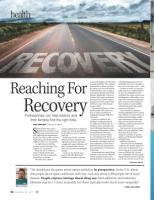
Reaching For
Recovery
Professionals can help addicts and
their families find the right help.
LOUIS FINKELMAN CONTRIBUTING WRITER
S
ome people start with a
legitimate prescription and
then keep using. Some start
with a gift from an acquaintance,
just for fun. After a while, a person
might give up the drugs entirely,
might use them as a casual habit
— or might discover that life
revolves around the drugs. Then
what do can a person do?
What can you do when you
notice a family member has
started to develop an unhealthy
dependence on drugs?
No matter how a person
becomes dependent on drugs, the
people who treat drug problems
do not offer any easy or quick way
back out.
Rabbi Jose Gomez, a certified
substance abuse counselor, says
“clients have to know that their
struggle with opiate addiction will
take a sustained effort of more
than a year to achieve meaningful
change.”
Gomez is the clinical super-
visor for Bio-Med Behavioral
Healthcare, an opiate treatment
center with facilities in Waterford,
Roseville and Flint. The condition
he treats there, opiate-use disor-
der, often co-occurs with mental
health disorders, such as depres-
sion, bipolar disorder and schizo-
phrenia. Statistically, 70 percent
of those with opiate-use disorder
also have these mental or physi-
ological issues that make it hard
for them to cope with ordinary
stresses of life.
Environmental factors, includ-
ing the people with whom one
lives or works, contribute to
making this disorder difficult to
overcome.
Gomez is certified by the
Michigan Certification Board
for Addiction Professionals as a
substance abuse counselor and
by the Michigan Department of
Licensing and Regulatory Affairs
as a professional counselor.
He earned his master’s degree
in counseling from St. Mary’s
University in San Antonio. He also
has earned a law degree and rab-
binic ordination. Gomez lives in
Oak Park with his wife and chil-
dren and belongs to Young Israel
of Oak Park.
Many people take opioid drugs
and only some become addicted.
Gomez explains that the same
opioid receptors in the brain deal
with physiological pain and emo-
tional pain. It is not a coincidence
that we use the same word — pain
— for how we react to a physical
injury and to an emotional injury,
he says. Our endorphin system
modulates the release of serotonin
and dopamine, which allows us to
cope with emotional and physical
pain. If someone feels trapped or
stuck for lack of social mobility,
a functioning endorphin system
counteracts this pain.
A person with an underper-
forming endorphin system cannot
cope with the everyday stresses of
long-term relationships, employ-
ment and finances, Gomez says.
These stresses lead to pain and
suffering, and the person does not
have much resiliency.
Such a person, he says, is more
likely to become addicted. While
the person does not have
adequate endorphin responses,
opiates can fill the physiological
endorphin gap.
Addiction ruins lives.
“Someone who has developed
a tolerance for opiates might well
need a dose of opiates five or six
times a day, at a cost that might
come to $100 per day,” Gomez
says. “Getting the next fix and get-
ting the financial means to get the
next fix become the center of this
continued on page 56
“We should put the panic about opiate addiction in perspective. In the U.S., about
200 people die of opiate addiction each day; each day about 2,200 people die of heart
disease. People express outrage about drug use; food addiction and sedentary
lifestyles may be 11 times as deadly, but these typically evoke much more sympathy.”
Rabbi Jose Gomez
54
November 30 • 2017
— RABBI JOSE GOMEZ
jn