

» gif t g uid e 2017
“We can tackle darkness and evil with the light of just one
little candle. We add one more each night as if we are adding
to our efforts to bring more good deeds into this world.”
— RABBI LEVI DUBOV
Light Over Darkness
STACY GITTLEMAN CONTRIBUTING WRITER
The mitzvah
of displaying
a Chanukah
menorah
publicly.
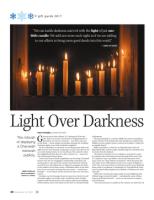
ABOVE: Fulfilling the
mitzvah of displaying a
menorah in a window.
44
November 16 • 2017
G
rowing up in Staten Island, N.Y., during the 1970s and
’80s, mine was not the most Jewish of neighborhoods. In
December, our electric menorah — one of the only ones
on the block — shone simply and steadily amongst the twinkling
Christmas lights of my Irish and Italian neighbors.
We lit a chanukiah, or menorah, on our dining room table each
night, but my mom insisted on placing a second, safer electric one
in a street-facing window of our townhouse. She wanted to show
the neighborhood that that we as Jews existed, too — minus the
risk of burning the house down.
At the time, Staten Island’s population was booming. Chanukah
became time for our synagogue’s membership committee and
youth group to team up for the annual “menorah hunt.” Driving
around the new developments, we slipped a synagogue brochure
in the mailbox of any home where a chanukiah shone in the dark-
ness. It was our way to welcome the newcomers — mostly from
Brooklyn — to the island, and let them know they were not alone
as Jews.
Brooklyn was the borough where lots more Jews lived. On cold
December nights, my brother and I would keep track of all the
windows that had menorahs in the massive apartment buildings
of Bensonhurst and Coney Island on the drive to extended family
jn
celebrations.
Placing chanukiah in a window fulfills the mitzvah of publiciz-
ing the miracle of the holiday. But why should Jews celebrate this
holiday in such a public manner and just how public is within the
acceptable limits?
Rabbi Levi Dubov, co-director at Chabad Jewish Center of
Bloomfield Hills, said the origin of publicizing the Chanukah mira-
cle stems from the Talmud.
The debate of whether or not to display a menorah in a pub-
lic setting in the United States has been heard all the way to the
U.S. Supreme Court, said Dubov, who this fall has been teach-
ing a course on “Great Debates in Judaism,” which discusses this
very topic. In the 1989 Supreme Court Case County of Allegheny v.
ACLU, the court struck down a Christmas nativity scene displayed
alone inside a courthouse in Pittsburgh, Pa., but upheld the same
city’s broader holiday display that included a Christmas tree and a
menorah.
Dubov also cautions that large, public menorah lightings that
Chabad stages around the globe — including the many celebra-
tions around Metro Detroit — are in no way meant to compete
with Christmas.
“The intent instead is to publicize the miracle, not about the oil