
jews d
in
the
continued from page 106
To remain credible, the Jewish News committed
to having its news pages reflect realities within
the Jewish community.
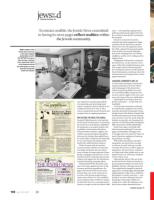
RIGHT: Publisher Arthur
Horwitz shares mock-ups
of the newly redsigned
Jewish News to staff in
1997. BOTTOM: Coverage of
Israel has been a mainstay
of the Jewish News. Stories
on the Eichmann trial and
the Jewish Agency for Israel
generated considerable
acclaim and criticism.
years — and requiring ongoing moral,
political and financial support from the
Jews of Detroit and all Jews remaining in
the diaspora.
Slomovitz ventured to Israel for
extended reporting assignments, filing
exclusives for the Jewish News and the
Detroit Free Press. His dispatches from
the 1950s captured the pioneering spirit
of the Israelis, the myriad challenges
they faced, including from ever-hostile
neighbors, and the never-ending need to
support them.
A highpoint of Slomovitz’s writing for
the Jewish News was his extensive cover-
age in 1960 of the Adolph Eichmann trial,
with readers back home knowing that
he was filing his reports via telex directly
from the Jerusalem courthouse where the
notorious Nazi was being tried for crimes
against humanity.
CHANGING COMMUNITY AND JN
was important in positioning itself for
the readership and advertising battle
with its competitor that lay ahead. It was
a battle the Jewish News won in 1951,
when it acquired the Jewish Chronicle and
merged it into its ongoing operations.
REFLECTING THE NEED FOR ISRAEL
Founder Philip Slomovitz, who had edit-
ed the Jewish Chronicle prior to launching
the Jewish News, had already established
his reputation as an ardent Zionist, will-
ing battler of anti-Semites like Henry
Ford and Father Charles Coughlin, and
reliable community builder through his
advocacy for charities that uplifted Jews
in need locally, in Palestine and especially
in war-torn Europe. His editing of the
Jewish News reflected these interests.
While the paper had the requisite
announcements of births, bar mitzvahs,
marriages and deaths, the man-about-
town writings of young columnist Danny
Raskin, synagogue and club news, it was
heavily focused on national and overseas
subjects and support for the Federation’s
annual fundraising campaign efforts.
Following World War II and the expo-
sure of atrocities against the Jews by the
Germans and their sympathizers, the
pages of the Jewish News became more
focused than ever on the need and cor-
rectness of the Jewish people having a
nation-state of their own. The establish-
ment of Israel in May of 1948 was treated
by the Jewish News as a crowning achieve-
ment by a people in exile for almost 2,000
As the Jewish community continued to
expand and prosper, the more robust
advertising pages of the Jewish News
reflected a growing ability by its read-
ers to purchase higher-end goods and
services, spend a night on the town, and
move into many of the new subdivisions
— built largely by developers from the
Jewish community — in Oak Park and
Southfield.
As the Jewish community continued
its northwesterly migration, key institu-
tions like the Jewish Community Center,
Temple Israel, Adat Shalom, Temple Beth
El and Jewish-sponsored senior housing
were erected to meet the needs of Jewish
families moving into new housing devel-
opments in West Bloomfield, Farmington
Hills and portions of Bloomfield Hills.
Jewish News pages were flush with
advertisements pushing JCC and syna-
gogue memberships, mortgages and
ever-larger and more expensive homes in
need of furniture, appliances, landscap-
ing and floor coverings.
With stable subscription and adver-
tising bases, the Jewish News was able
to increase its staff, with more weekly
coverage of local news to fill its pages. In
appearance, the Jewish News continued
as a black-and-white tabloid and, as was
typical for the era, with heavy emphasis
on the written word.
Following the March 1984 sale of the
Jewish News by the Slomovitz family to a
group headed by Baltimore Jewish Times
publisher Charles A. Buerger, the Jewish
News significantly changed its physical
appearance, running bigger photographs,
adding splashes of spot color, selling the
back page to a jewelry advertiser — and
daring to move the obituaries from the
back pages of the paper. Within two
weekly news cycles, the obituaries were
back where readers demanded them,
continued on page 110
108
July 18 • 2017
jn
Scanned image of the page. Keyboard directions: use + to zoom in, - to zoom out, arrow keys to pan inside the viewer.
July 18, 2017 - Image 109
- Resource type:
- Text
- Publication:
- The Detroit Jewish News, 2017-07-18
Disclaimer: Computer generated plain text may have errors. Read more about this.