

health
Building
Resilience
Kadima to bring
parenting expert
Dr. Deborah
Gilboa for youth
mental health
conference.
JENNIFER LOVY CONTRIBUTING WRITER
P
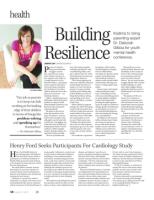
Dr. Deborah Gilboa
“Our job as parents
is to keep our kids
working at the leading
edge of their abilities
in terms of things like
problem-solving
and speaking up for
themselves.”
— Dr. Deborah Gilboa
arents of children
facing mental health
struggles wonder
how much leeway to give
their children and how to
best support each child. It’s
a tough question, but Dr.
Deborah Gilboa, a parenting
expert, speaker and author
of several books including
Get the Behavior You Want,
Without Being the Parent You
Hate!, has an answer — by
building resilience.
Gilboa, a family physician in
Pittsburgh, will be the keynote
speaker at a May 21 Youth
Mental Health Conference and
Resource Expo for parents
and professionals.
She plans to devote her
entire presentation to the
topic of resilience. And, her
bottom line message is that
although it can be hard with
a child who is struggling, one
of the best ways to help is by
building that child’s or teen’s
resilience. While empathy
matters, feelings of guilt, she
said, don’t help your child.
“How do you build resil-
ience? By having empathy
and high expectations,” said
a multitasking Gilboa, who
gave a phone interview while
returning home from grocery
shopping for Passover.
“That means figuring out
what your child has mastered
and deciding what they are
ready to try next. Our job as
parents is to keep our kids
working at the leading edge
of their abilities in terms of
things like problem-solving
and speaking up for them-
selves,” said Gilboa, a mother
of four boys.
Gilboa offered a poignant
analogy: If a child’s first-grade
teacher tells her parents how
well she is doing with advance
math problems, the parents
will want to know what skills
the teacher plans to work
on next. If the teacher says
“‘Nothing. She’s good where
she is for now,’ that response
isn’t going to go over very well
with the parents. The same
is true with our kids’ mental
health.”
The conference, sponsored
by Kadima, will be held at
the Birmingham Covington
School in Bloomfield
Township. It is geared toward
parents and professionals
with breakout sessions to
address youth mental health-
related topics affecting new-
borns to college-aged young
adults.
Session topics will include
understanding the impor-
tance of attachment in the
early years, identifying anxiety
in young children, building
positive self-image, bully-
proofing through empower-
ment, the impact of ADHD on
siblings, gender identification,
an introduction to some of
the mental health diagnoses
that arise during the teenage
years and addiction.
In addition to the keynote,
Gilboa will also lead a break-
out session for parents on
how to talk about mental
health concerns with their
children and an afternoon
session for professionals on
how to effectively partner
with parents.
“Mental illness is so far
behind all other illnesses and
disabilities in this country in
terms of the continued nega-
tive associations and fear,”
said event chair Suzanne
Zwiren. “Far too many people
struggle silently with a mental
health challenge, or watch
their child struggle without
getting the help they need or,
unfortunately, wait until a cri-
sis occurs.
“The purpose of the con-
ference is to continue to
expand the communication
and education for and, more
importantly, between parents
and professionals regarding
the mental health of our chil-
dren.”
Tickets for the conference
and expo are $25 for the
morning parent and commu-
nity session. The afternoon
session, with continuing
education for social work-
ers and educators, is $45. To
register, visit kadimacenter.
org/hbhm2017 or call (248)
663-4330. •
Henry Ford Seeks Participants For Cardiology Study
H
enry Ford Health System is
recruiting people with diabetes
who have had a heart attack to
participate in a National Institutes of
Health (NIH)-sponsored study looking
at the benefits of removing toxic metals
from the bloodstream.
The study follows another analysis
that found a 41 percent reduction in
recurrent heart events by chelation in
patients with diabetes who already had
sustained a heart attack.
Chelation is a process by which a
medication can “grab” and remove toxic
metal pollutants like lead or cadmium,
which are present in the bloodstream of
68
April 27 • 2017
jn
most people. Cadmium is a metal com-
monly found in industrial workplaces,
including in some industrial paints
and battery manufacturing processes.
Lead, a soft, heavy metal, is most often
ingested through chips and dust from
old paint. Both are toxic to humans.
Although the chelation process was
developed in the 1950s at Wayne State
University for lead poisoning treatment,
it is not a treatment for people exposed
to high lead levels in their drinking
water.
“We’re glad to help definitively answer
the questions about the effects of che-
lation on those with established heart
disease and diabetes,” says the new
study’s principal investigator, Jonathan
Ehrman, Ph.D., Henry Ford Health
System Associate Director of Preventive
Cardiology. “The first study had such
promising results; we’re grateful to be
able to continue that research on behalf
of patients.”
Henry Ford Health System is currently
recruiting patients for participation in
the study, particularly African American
patients, who are often under-repre-
sented in national studies, Ehrman says.
Candidates must be 50 years of age or
older, have diabetes and experienced a
prior heart attack. Enrollees will receive
$15 per visit to cover travel expenses.
The study is being conducted at Henry
Ford’s Center for Athletic Medicine in
Midtown, Detroit; Henry Ford Medical
Center-Livonia and Henry Ford West
Bloomfield Hospital.
“If TACT2 is positive, it will forever
change the way we treat heart attack
patients and view toxic metals in the
environment,” said Gervasio Lamas,
M.D., study chairman.
Patients interested in participating
can contact the study team through
www.tact2.org, by calling (313) 972-4120
or by emailing Heather Golden at
hgolden1@hfhs.org. •