

bridal
Afterward, I showered and pulled on the green
lehenga (skirt) and the decorated choli (bare mid-
riff top) of my new Indian outfit. Then I arranged
the dupatta, a flowing, green-and-gold scarf, and
secured the tikka jewel so it hung on my forehead.
My anklets jingled with each step while bangles
clattered on my wrists.
Norman looked like my own prince, wearing
purple pants, curled-up shoes and a long, sparkling
white-and-purple jacket. I focused on his face, his
eyes and let out the breath I wasn’t quite aware I
had been holding. With him by my side, I felt like a
princess in my exotic dress.
Norman’s auntie then caked thick, brown henna
paste onto my finger. A few days before, the artist
had painted the intricate swirls and designs on my
hands, arms, feet and lower legs, but this final fin-
gerful of henna finished the process that some say
marks the transition from girl to woman.
Other rituals wishing abundant food, prosperity
and good fortune followed — guests placed money
in a plate in front of me, fed me sweet
morsels, tossed rice over my shoulders,
offered blessings and more.
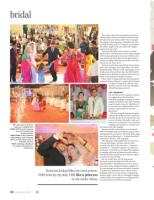
TOP: Family joins the bride and
groom for a traditional hora.
ABOVE, LEFT: The bride and groom
enter their reception amid
shooting sparklers.
ABOVE, RIGHT: In their traditional
Indian wedding outfits in Mumbai;
Tami has intricate henna tattoos on
both hands and arms.
RIGHT: Celebrating a blending of
two cultures with Judaism as a
common bond.
Norman looked like my own prince.
With him by my side, I felt like a princess
in my exotic dress.
62
January 26 • 2017
jn
THE CEREMONY
The next day at the wedding ceremony,
as I walked down the aisle of the
Orthodox synagogue wearing my white,
traditional Western-style dress, Norman
sang the psalm Yonati Ziv (My Beloved
is a Dove) in the traditional Bene Israel
melody as generations of men had
before him.
When he stopped singing, I stopped
walking. We finally met and I squeezed
his hand, harder than I should have, but
he never flinched. We didn’t circle each
other as we would later in our American
wedding, but together we stepped up to
the bimah under the chuppah.
Norman and the cantor (there is no ordained
rabbi in Mumbai) said more Hebrew prayers, but I
only grasped bits and pieces. We drank funky grape
juice that tasted fermented — Norman drank half
and I had to finish it, with a big gulp.
After placing a twisted gold band on my henna-
covered index finger, Norman took the cloth-
covered wine glass in his hand and — instead of
stomping it — smashed it against a wooden box,
breaking it on his first try. We signed the tradition-
al ketubah, and then he fastened a gold necklace
with black beads around my neck, another sign of
a married woman in India.
But we weren’t done yet. My dad placed
Norman’s ring on his finger and took the now-
signed ketubah. I attempted not to let my annoy-
ance show at the outdated Orthodox tradition of
the man buying his wife from her father. I wanted
to embrace my husband’s native culture and its
traditions, but I’m sure my sisters recognized my
strained smile. I knew that our Michigan wedding
would include more progressive wording that bet-
ter represented our shared commitment.