

arts & life
continued from page 48
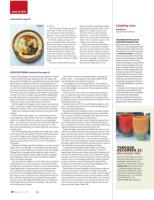
Hummus
he writes.
“One of the great things about bread,”
Scheft says, “is that even if it doesn’t
turn out the best, family will enjoy it.”
He adds, “Like so many other things in
life, you can always do better tomorrow.”
I write this, sipping very good cof-
fee, at a communal table at the uptown
Breads, which opened earlier this year
near Lincoln Center, alongside some
Russian immigrants sharing breakfast
sandwiches and pastries. Nearby are
tourists from Sweden, a designer from
Dubai attracted by the look of the place
and an Asian family cutting into a whole
babka.
“The idea of this beautiful and nour-
ishing loaf made by hand and bringing
people together around a table or even
gathered at a kitchen counter to rip
off a piece and eat it with such great
enjoyment — to me, this is true love,”
Scheft writes in the book’s introduction.
Those words, “true love,” appear on the
T-shirts worn by Breads workers.
“When I branded my Israeli bakery, I
had the idea not only about breadmak-
ing. This is the atmosphere of my shops,
between coworkers, toward customers.
True love,” he says. With bread and with
people, he tries to pay close attention to
the way they do things. “You have to live
what you’re talking about, by example
more than by talking about it.”
*
CHOCOLATE BABKA continued from page 48
and mix until the dough is smooth and has good elasticity, 4 minutes.
Stretch and fold the dough: Lightly dust your work surface with
flour and turn the dough out on top; lightly dust the top of the dough
and the interior of a large bowl with flour. Grab the top portion of
the dough and stretch it away from you, tearing the dough. Then fold
it on top of the middle of the dough. Give the dough a quarter turn
and repeat the stretch, tear and fold. Continue to do this until you
can stretch a small piece of dough very thin without it tearing, about
5 minutes. Then use your hands to push and pull the dough against
the work surface and in a circular motion to create a nice round of
dough. Set the ball in the floured bowl, cover the bowl with plastic
wrap, and set it aside at room temperature for 30 minutes.
Chill the dough: Set the dough on a piece of plastic wrap and press
it into a 1-inch-thick rectangle. Wrap the dough in plastic wrap and
refrigerate it for at least 1 hour or up to 24 hours before proceeding.
Lightly coat 2 standard loaf pans with room-temperature unsalt-
ed butter.
Roll the chilled dough: Lightly coat 2 standard loaf pans with
room-temperature unsalted butter. Unwrap the cold babka dough
and set it on a lightly floured work surface (or on a long dining
table — you need at least 4 feet of work space). Roll the dough into
a 9-by-24-inch rectangle (it should be just a little shy of ¼ inch
thick) with a long side facing you. Pull and shape the corners into a
rectangle shape.
Note: Only roll going along the length of the dough (left to right)
and not up and down the dough. The height will naturally increase
as you roll the dough, and by rolling the dough in just one direc-
tion, you’re not going to stress the gluten. If the dough starts to
spring back, that means it’s tired. Let it rest for 5 minutes before
trying again.
Fill and roll the dough: Spread the Nutella in an even layer over the
dough, all the way to the edges. Then sprinkle the chocolate chips in
an even layer over the Nutella, across the entire surface of the dough.
Working from the top edge, roll the dough into a tight cylinder. As
you roll it, push and pull the cylinder a little to make it even tighter.
Then, holding the cylinder at the ends, lift and stretch it slightly to
make it even tighter and longer.
Twist the strips into a babka: Use a bread knife to slice the cylinder
in half lengthwise so you have 2 long pieces, and set them with the
chocolate layers exposed. Divide the pieces crosswise in half, creating
4 equal-length strips. Overlap one strip on top of another to make
an X, making sure the exposed chocolate part of the dough faces
up; then twist the ends together like the threads on a screw so you
have at least 2 twists on each side of the X. Repeat with the other two
pieces. Place each shaped babka into a prepared loaf pan, exposed
chocolate–side up. The dough should fill the pan by two-thirds and
fit the length perfectly. Cover the pan with plastic wrap and repeat
with the other pieces of dough.
50 December 1 • 2016
Note: Embrace the mess! Twisting the dough is a sticky process,
but don’t worry — after baking, even the messiest babka will still
look beautiful and, more important, taste great.
Let the dough rise: Set the loaf pans aside in a warm, draft-free
spot until the dough rises 1 to 2 inches above the rim of the pan and
is very soft and jiggly to the touch, 2 to 3 hours, depending on how
warm your room is.
Note: If your room is very cold, you can speed up the rising pro-
cess: Set a large bowl of hot water on the bottom of the oven, place
the loaf pans on the middle oven rack, close the oven door, and let
the dough rise in the oven. Just remember that your babka is in there
before preheating the oven!
Preheat the oven to 350°F. (If you are letting the dough rise in the
oven, as described in the note, be sure to remove the loaf pans and
bowl of water before preheating.)
Bake the babkas: Place the babkas in the oven and bake until they
are dark brown and baked through, about 40 minutes; check them
after 25 minutes, and if they are getting too dark, tent them loosely
with a piece of parchment paper or aluminum foil.
Meanwhile, make the simple syrup: Combine the sugar and water
in a small saucepan and bring to a boil over high heat. Reduce the
heat to medium-low and simmer, stirring occasionally to dissolve the
sugar. Turn off the heat and set aside the syrup to cool.
Brush with simple syrup: Remove the babkas from the oven, and
while they are still hot, brush the surface generously with the cooled
sugar syrup (the syrup makes the top of the babkas shiny and beauti-
ful and also locks in the moisture so the cake doesn’t dry out; you
may not need to use all the syrup — save any extra for sweetening
iced coffee or tea). Use a paring knife to separate the babkas from the
pan edges, and turn them out from the pan. Slice and serve warm, or
cool completely in the pans before unmolding and slicing.
Freezing and defrosting babka: Babka dough can be frozen so
a fresh-from-the-oven babka can be had anytime. To freeze the
shaped dough, double-wrap it in plastic wrap, then in aluminum foil
(and then in a resealable freezer bag if it fits). To defrost the dough,
unwrap it and let it sit out at room temperature, loosely covered with
a kitchen towel or in a homemade proofing box, until it has proofed
to about 1 inch above the lip of the loaf pan (the dough will take
several hours to defrost, then extra time to proof depending on the
warmth of your room). Then bake as instructed.
Baked babkas also freeze beautifully, so don’t hesitate to wrap one
or two from your batch in a double layer of plastic wrap and then
aluminum foil and freeze them for up to 1 month. Leave the wrapped
frozen babka at room temperature for a few hours to thaw, and then
remove the plastic wrap and rewrap in foil and place it in a preheated
325°F oven for 8 to 10 minutes to warm through. For the last 5 min-
utes in the oven, open the foil to expose the surface of the cake so it
dries out just a bit. Makes 2 babkas.
*
Celebrity Jews
Nate Bloom
Special to the Jewish News
DECEMBER MOVIES: OSCAR
CONTENDER RELEASE TIME
Manchester by the Sea, which opens
Friday, Dec. 2, has already gotten good-
to-great reviews from major critics and
Oscar-talk is in the air for the lead actors
and Kenneth Lonergan, 55, the film’s
director and screenwriter. The film tells
the story of the working-class Chandler
family. Joe and his 17-year-old son,
Patrick (Lucas Hedges), live just north of
Boston. Joe dies suddenly, and his will
names his younger brother, Lee (Casey
Affleck), as Patrick’s legal guardian. The
money that comes with the guardian-
ship persuades Lee to give up his noth-
ing job and come back to Manchester-
by-the Sea, even though it forces him
to deal with a tragic past involving his
ex-wife (Michelle Williams), who lives in
Manchester.
Lonergan, whose mother was Jewish,
has plowed this ground before. Most
of his works begin with an unexpected
event that forces a confrontation
between close friends or family mem-
bers. The confrontation always features
dialogue that is smart, sharp and sur-
THROUGH
DECEMBER 22:
BBAC HOLIDAY SHOP
More than 3,500 square feet of the
Birmingham Bloomfield Art Center’s
Birmingham gallery will be trans-
formed into a boutique for its annual
Holiday Shop. One-of-a-kind items
— including ceramics (like these
vases by Sarah Gelsanliter), jewelry,
home decor, stationery, paintings,
Judaica and more — by 130 artists
will be offered Dec. 1-22.
(248) 644-0866; bbartcenter.org.