
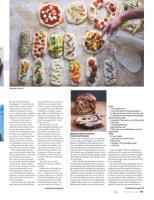

Vegetable Focaccia
ily moved from Ra’anana to
Copenhagen — his parents want-
ed the family to take in Danish
culture and get to know their
family. He returned to Israel to
serve in the army, then traveled in
India and China before studying
biology at Tel Aviv University.
His parents, both teachers,
chose their profession not out
of passion but in order to have
skills that would translate. From
a young age, he knew that he
wanted to do something he loved.
In a later trip to India, he had
one of those “a-ha” moments and
realized he wanted to take up
baking seriously. He went back
to Copenhagen to study in a top
cooking school, and after a day
knew this was the path he wanted.
While studying and apprentic-
ing, he also traveled to learn from
other traditions. After a few years,
he went back to Israel, got to
know the local scene and suppli-
ers, and in 2001 opened Lehamim
(which means “breads”) Bakery
in Tel Aviv. He would go see Arab,
Druze and other bakers, not to
document specific recipes but
to see what they were doing, for
inspiration. From his wife’s family,
he learned about Yemenite and
Moroccan baking.
At Breads, they sell challah and
other breads and rolls including
raisin walnut, olive, caraway rye,
North Sea rye and whole wheat
varieties, pastries and sandwiches.
In a regular week, they sell about
1,000 loaves of challah, and per-
haps 3,000 over the holidays. He
notes that in Israel, they make
challah only for Shabbat, but here
there’s a demand for the “Jewish
bread” all week.
While the place uses only
kosher ingredients and they serve
no meat products, they do not
have kosher certification (his
bakeries in Israel do have rab-
binic certification). Scheft, who
grew up in a strictly kosher home,
explains that in New York they are
open seven days a week, which
is essential in the middle of the
city. In the early stages, he was
offered ways to get kosher certi-
fication even if they were open
on Shabbat, as other businesses
do, but he didn’t feel comfortable
with that.
“It’s tricky,” he says, and
describes the bakery as kosher-
friendly.
Scheft used to tell people that
to make bread they need two
tools — hands and an oven. Now
he adds a digital scale to that list.
The book’s straightforward, step-
by-step directions are accompa-
nied by helpful illustrations. “If
you read carefully, you’ll get it,”
continued on page 50
BREADS BAKERY FAMOUS
CHOCOLATE BABKA
“When I create a new pastry, it is very important
for me to make a psychological connection to the
pleasures of childhood, and in Israel, just about
every schoolchild eats a lunchtime sandwich made
with a chocolate spread,” writes Breaking Breads
author Uri Scheft. “To tap into that taste memory,
I use Nutella to give this babka its intensely choco-
late taste. The croissant-like babka dough is loaded
with Nutella and chocolate chips and then twisted
into a loaf shape.
“I first called this chocolate krantz cake, but in
all honesty, that name didn’t effectively commu-
nicate the deep, ephemeral pleasure of biting into
the wonderfully rich and deeply chocolaty pastry.
We decided to call it chocolate babka instead, and
within three months, our babka was selected by
New York magazine as the best in New York City.
We went from selling a few dozen a day to a few
hundred a day. It remains the most popular item
at Breads Bakery, and we are very proud that our
babka sparked a babka trend across the country.”
Dough:
½ tsp. vanilla extract
½ cup whole milk (at room temperature)
2½ Tbsp. fresh yeast or 2 tsp. active dry yeast
2¼ cups plus extra for dusting and kneading
all-purpose flour, sifted
2 cups plus 2 Tbsp. pastry or cake flour, sifted
2 large eggs
½ cup granulated sugar
Large pinch fine salt
5 Tbsp. plus 1 tsp. unsalted butter (at room
temperature)
Filling:
1½ cups Nutella
1 cup semisweet chocolate chips
Simple Syrup:
¾ cup plus 1 Tbsp. granulated sugar
½ cup water
Make the dough: Whisk the vanilla into the
milk in the bowl of a stand mixer fitted with the
dough hook. Use a fork or your fingers to lightly
mix the yeast into the milk. Then, in this order,
add the flours, eggs, sugar, salt and finally the but-
ter in small pinches.
Mix on the lowest speed, stopping the mixer to
scrape down the sides and bottom of the bowl as
needed, and to pull the dough off the hook as it
accumulates there and break it apart so it mixes
evenly, until the dough is well combined, about
2 minutes (it will not be smooth). If the dough is
very dry, add more milk, 1 tablespoon at a time; if
the dough looks wet, add more all-purpose flour,
1 tablespoon at a time, until the dough comes
together. Increase the mixer speed to medium,
continued on page 50
December 1 • 2016
49